How to Invest in US Stocks from the Philippines
Three ways to buy US stocks from the Philippines: a fractional-share app funded with GCash or Maya, an international broker, or tokenized stocks held in a wallet, and what each one owns, costs, and pays in tax.

There are three ways to invest in US stocks from the Philippines: a fractional-share app such as GoTrade funded with GCash or Maya, an international brokerage account such as Interactive Brokers, or tokenized US stocks held in a personal wallet. A Filipino resident can legally use any of them. The routes differ in what the investor owns, how the account is funded, what it costs, and how the position is taxed.
Filipino demand for US assets has climbed sharply. Philippine residents held US$29.3 billion in foreign securities as of mid-2025, up more than 25% in a year, and the United States was the largest destination at half the total. The peso is part of the reason, sliding from about ₱58.8 to the dollar at the end of 2025 to around ₱61.6 by mid-July 2026 and raising the appeal of dollar assets. Investors in India and Indonesia reach US stocks through a similar set of routes, with different funding rails and tax rules.
Key takeaways
- A fractional-share app such as GoTrade accepts GCash and Maya, needs no US bank account, and buys real shares from $1, roughly ₱62 at the mid-July 2026 rate.
- Foreign brokers and apps that serve Filipinos are regulated abroad but are generally not registered with the Philippine SEC, which issued an advisory against eToro in March 2024 before the platform left the country.
- US dividend withholding is 30% by default and 25% under the US-Philippines treaty, and the lower rate needs a Form W-8BEN on file with the broker.
- US estate tax starts at $60,000 of US assets and reaches 40%, and the Philippines has no estate tax treaty with the United States.
- Tokenized US stocks are restricted to non-US persons, so a Filipino resident is eligible to hold them.
Is it legal to invest in US stocks from the Philippines?
Yes. A Philippine resident may hold foreign securities and open an account with a foreign broker that accepts Filipino clients. Income from the shares is reported on the annual Philippine tax return.
The regulatory constraints apply to the platforms. A foreign broker or app that solicits Filipino clients is expected to register with the Philippine Securities and Exchange Commission, and many do not. Holding the shares is legal for the resident; whether a given platform is authorized to offer them is the continuity risk covered further below.
The three routes compared
US stocks can be bought with pesos on every route. To settle the purchase, the pesos are converted to dollars, and that conversion carries a currency spread charged differently on each route. A ₱10,000 order, for example, converts to about $162 at the mid-July 2026 rate before the spread. The visible fees in the table below are small next to it.
| Fractional-share app | International broker | Tokenized stocks | |
|---|---|---|---|
| What the investor owns | Real shares, held by the app's partner broker | The share itself, in the investor's name | A token from an offshore issuer, backed 1:1 by real shares |
| Funded with | Pesos by GCash, Maya, or bank transfer | A US dollar wire | Pesos converted to a stablecoin |
| Minimum | From $1, fractional | Set by the wire | Fractional, no minimum |
| Visible cost | Trading spread, roughly 0.5% to 2% | Commission, wire fee, currency spread | Exchange spread and network fee |
| Protection | SIPC where the executing broker is a US member | SIPC at a US member firm | Collateral and a security agent, no SIPC |
| US estate tax | Applies above $60,000 | Applies above $60,000 | Not publicly settled |
1. A fractional-share app funded with GCash or Maya
What it is. A mobile app that sells fractional shares of US-listed stocks and ETFs in pesos. GoTrade is the common route in the Philippines, and GCash offers US stocks through its GStocks Global feature, launched under an SEC sandbox in 2025.
How to do it. Download the app, register with an email and an ID, and pass identity verification, which GoTrade completes for most users within an hour. Fund the account in pesos through GCash, Maya, or a bank transfer over InstaPay. Buy a stock or an ETF from $1. GoTrade acts as an introducing broker: it is the app the customer uses, while a partner broker executes the trade and holds the shares.
Advantages. This is the lowest-friction route. There is no US bank account, no wire, and no minimum beyond the amount invested. Fractional sizing means a share of any company, or of an S&P 500 ETF such as SPY or VOO, costs as little as $1. Setup runs under ten minutes.
Disadvantages. The app converts pesos to dollars internally and builds the cost into the exchange rate it quotes. GoTrade's trading spread runs roughly 0.5% to 2%. The protection that applies depends on which broker executes and holds the shares, so that entity should be checked before funding.
Best for beginners who want to start in pesos with the fewest steps.
2. An international brokerage account
What it is. A securities account with a broker outside the Philippines that buys real shares and holds them in the investor's name. Interactive Brokers is the long-standing choice for Filipino clients who want breadth and low fees. BrokerChooser's 2026 ranking placed TradeStation Global first for Philippine-based investors, with MEXEM and CapTrader also listed.
How to do it. Open an account with a broker that accepts Philippine residents. Complete identity checks and sign a Form W-8BEN, the IRS document that certifies non-US status and claims the reduced treaty rate on dividends. Fund the account by international transfer. The currency conversion happens here, and the bank takes a remittance fee and a spread on the rate. Then place the order.
Advantages. The investor owns the share itself, receives cash dividends, and can vote where the broker passes votes through. An account at a US member firm carries SIPC protection up to $500,000.
Disadvantages. Funding is the main obstacle, and some Philippine banks still arrange an outbound wire in a branch. The protection an account carries depends on which legal entity the broker assigns, so that entity should be checked before any money is sent.
Best for investors who can send dollars abroad and want the share held in their own name.
3. Tokenized US stocks
What it is. A tokenized stock is a token on a public blockchain that tracks the price and reinvested dividends of a US share, one form of real-world asset issued onchain. It is restricted to non-US persons, so a Filipino resident is eligible to hold one while a US resident is not. The largest issuer serving non-US investors is Ondo Global Markets, which reported more than $1 billion across over 430 tokenized stocks and ETFs in July 2026.
An Ondo token is issued by an offshore company and backed one-for-one by real shares held at a US-registered broker-dealer. Tokenization removes the investor's own brokerage account while the shares stay in custody at that broker-dealer. The holder receives the price movement and the reinvested dividends without becoming a shareholder of record. Voting runs through a non-binding relay that Ondo added with Broadridge in April 2026.
How to do it. Convert pesos into a dollar stablecoin on a licensed Philippine exchange, move the stablecoin to a personal wallet, and buy the token. An app like Glider is one way to hold them, combined into a portfolio that rebalances on a cadence the holder chooses. The Philippine SEC treats tokenized securities as securities under existing law, so a platform offering them to Filipino clients falls under the same registration expectation as any securities platform.
Advantages. No brokerage account and no wire are required, and the funding rail runs through a stablecoin. Dividends reinvest into the token rather than paying out as cash. Tokens transfer at any hour.
Disadvantages. The token is a claim on the issuer, so recovery in a failure runs through the security agent rather than a share register. There is no SIPC cover. Prices can drift from the underlying share when the US market is closed, and liquidity is thinner for the smaller names.
Best for investors who already hold a stablecoin and accept holding a token rather than a share.
Are these platforms registered with the Philippine SEC?
Foreign brokers, apps, and crypto platforms that serve Filipino clients are regulated in their home countries, and many are not registered with the Philippine SEC to solicit locally. The Commission has acted on this before. In March 2024 it issued an advisory against eToro, stating that the platform was not authorized to sell or offer securities in the Philippines and was not registered as a Philippine corporation. eToro then wound down its Philippine service, suspending trading in December 2024 and closing account access in February 2025. Existing clients were given time to withdraw.
The SEC has extended the same approach to crypto platforms. Its Crypto-Asset Service Provider rules, in force since July 2025, require any platform serving Filipino clients to register locally, hold a Philippine office, and keep ₱100 million in paid-up capital. In August 2025 the Commission named ten crypto platforms accessible in the country without a license, including OKX, Bybit, and Kraken. Account continuity therefore depends in part on how the regulator treats a given platform, which is a reason to keep records and withdrawal methods current.
How US stocks are taxed for Filipino investors
Two tax systems apply: the United States taxes the income at source, and the Philippines taxes its residents on worldwide income.
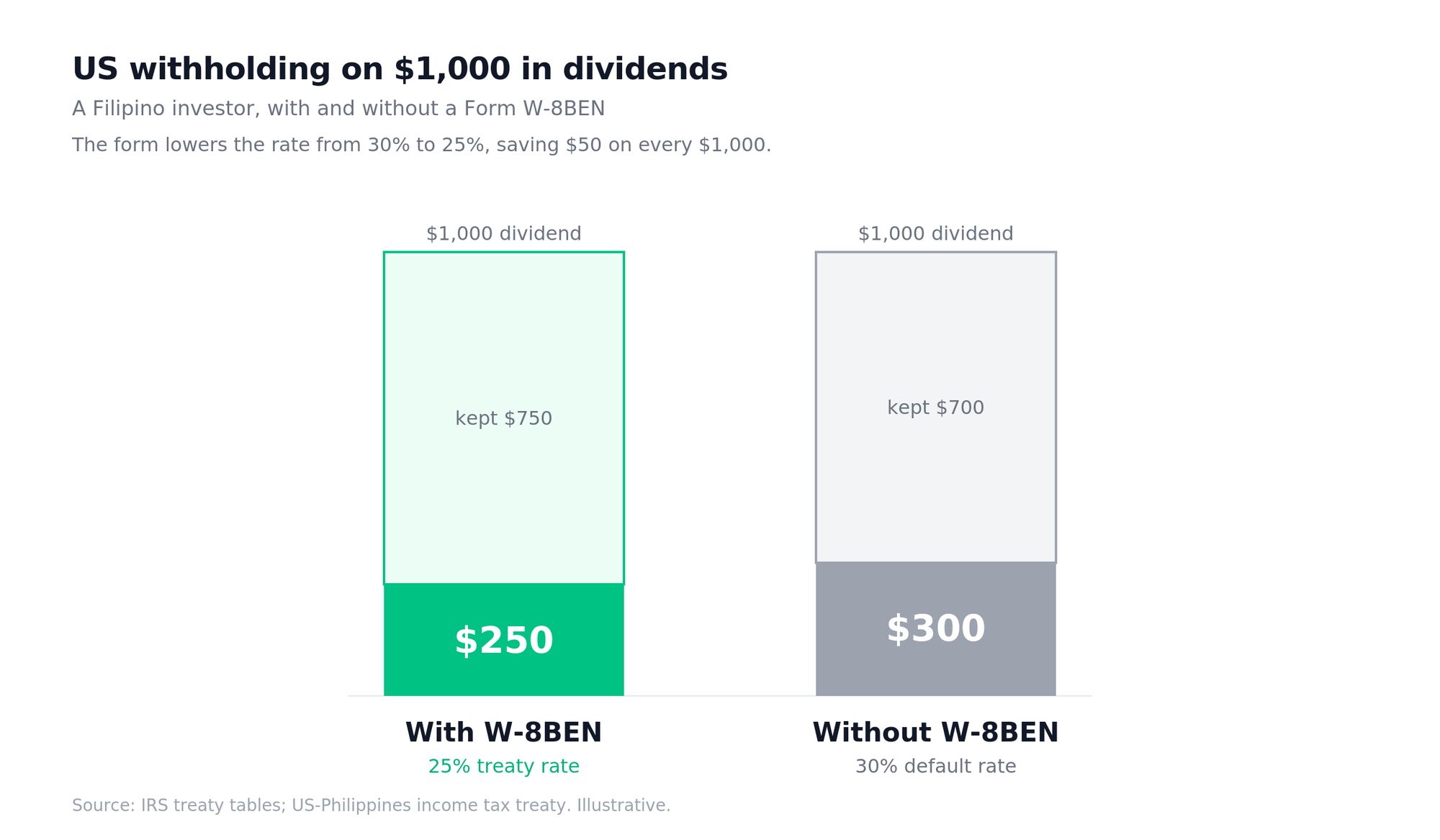
US dividend withholding. The United States withholds 30% of dividends paid to a non-resident by default. The US-Philippines tax treaty lowers the rate on portfolio dividends to 25%, and that rate applies only when a Form W-8BEN is on file with the broker. On $1,000 of dividends, the treaty rate withholds $250 and the default rate withholds $300. The 25% treaty rate is high next to newer US treaties, several of which cap portfolio dividends at 15%.
US capital gains. A non-resident who spends fewer than 183 days a year in the United States generally pays no US tax on gains from selling US shares.
Philippine tax. A Philippine resident citizen is taxed on worldwide income, so US dividends and gains are reported on the annual return, with a foreign tax credit for the US tax already withheld. The 15% capital gains tax and the stock-transaction tax that apply to Philippine-listed shares do not apply to US shares. Many local guides describe US-stock gains as untaxed. That reflects the absence of the domestic-share tax; for a resident citizen the gain falls into income taxed at graduated rates. The interaction of the source rules, the foreign tax credit, and the holding period is where a Philippine tax professional is worth consulting.
The $60,000 estate tax rule
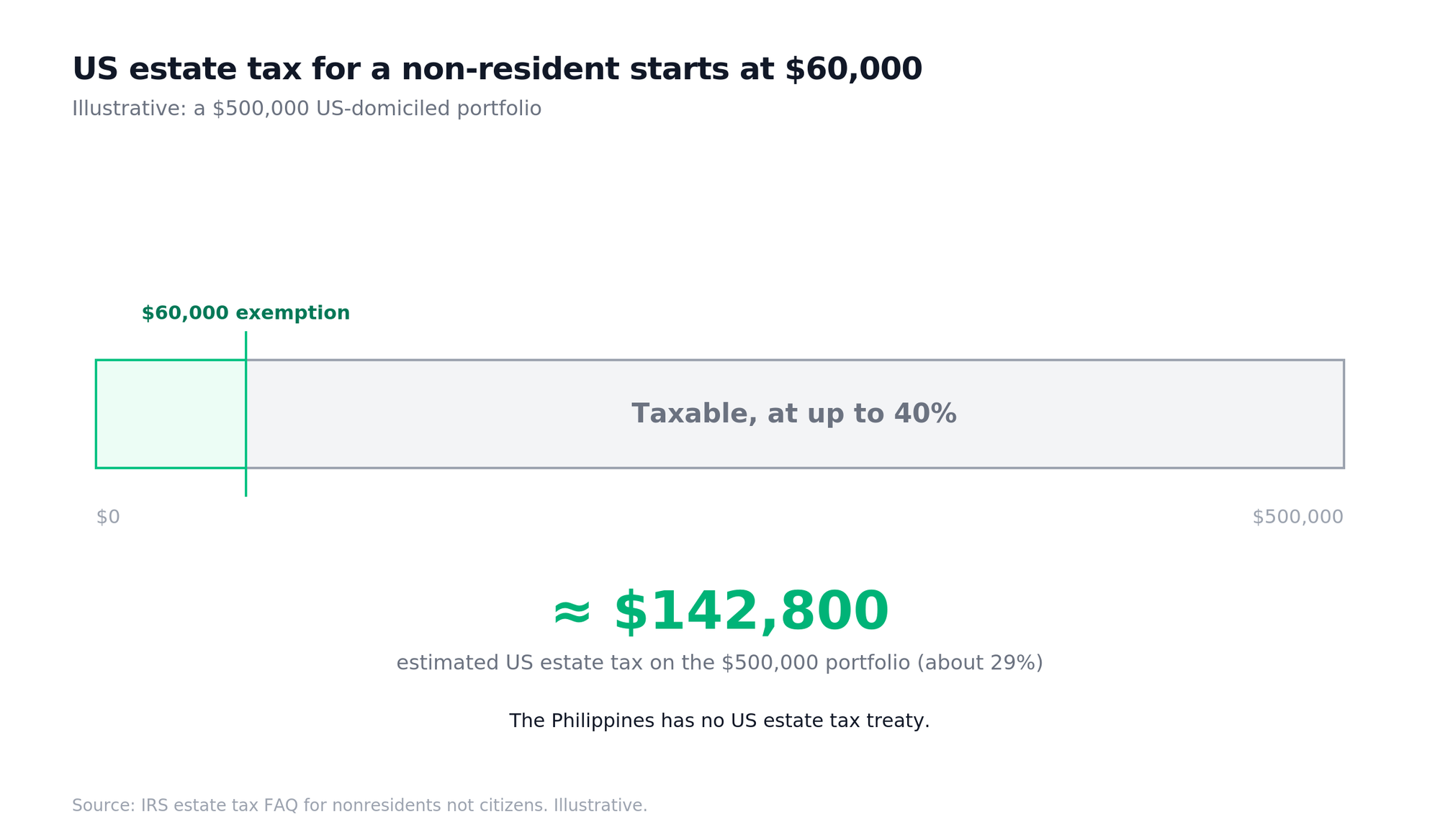
A non-resident who dies holding US-situated assets receives a US estate tax exemption of only $60,000. Above that, the tax reaches 40%, and the executor files Form 706-NA within nine months of death. The threshold is not adjusted for inflation.
US-situated assets include shares in US companies, US-domiciled ETFs, and cash in a US brokerage account, and holding them through a foreign broker does not change that status. The United States has estate tax treaties with fifteen countries, and the Philippines is not among them. On $500,000 of US-domiciled holdings, the resulting US estate tax is roughly $142,800. A fund domiciled outside the United States, such as an Ireland-based ETF that tracks the S&P 500, is not a US-situated asset, which removes the estate tax for an investor whose position is large enough for it to matter.
The three routes track the same US prices and grant different rights, costs, and tax treatment. A fractional-share app is the quickest start in pesos, an international broker puts the share in the investor's own name, and a tokenized stock reaches the market through a wallet without a brokerage account. The question worth settling before any deposit is what the investor would own on the morning a platform stopped working, and how a position near $60,000 would be taxed on death.
Frequently asked questions
Can Filipinos legally invest in US stocks?
Yes. A Philippine resident may hold foreign securities and open an account with a foreign broker that accepts Filipino clients. Income from the shares is reported on the annual Philippine tax return. The registration question applies to the platform offering the product, not to the investor holding it.
How is a US stock account funded with GCash or Maya?
Apps built for the Philippine market, such as GoTrade, accept GCash and Maya top-ups directly and convert pesos to dollars inside the app. International brokers do not take e-wallets and require a bank transfer or wire instead. The e-wallet route is the reason app-based investing is the most common beginner path.
How much US tax is withheld on dividends for a Filipino investor?
The default rate is 30%. The US-Philippines treaty lowers withholding on portfolio dividends to 25%, and that rate applies only when a Form W-8BEN is on file with the broker. On tokenized stocks the withholding is handled at the issuer's custody level, and the individual holder files no form.
Are tokenized US stocks the same as owning the share?
No. A tokenized stock is a token issued by an offshore company and backed one-for-one by real shares held at a US broker-dealer. The holder receives the price movement and reinvested dividends without becoming a shareholder of record, and there is no SIPC protection. Tokenized stocks are restricted to non-US persons.
Does US estate tax apply to Filipino investors?
Yes, above $60,000 of US-situated assets, which include US shares, US-domiciled ETFs, and cash in a US brokerage account, wherever the broker is located. Rates reach 40%, and the Philippines has no estate tax treaty with the United States. Funds domiciled outside the US fall outside the definition.
This article is for educational purposes only. It is not financial, legal, investment, or tax advice, and not a recommendation to buy or sell any asset. Tax treatment depends on individual circumstances and on rules that change, so anyone investing across borders should consult a qualified tax professional in the Philippines. Tokenized equities are not available to US persons. Figures are accurate as of the date shown.