What Are Tokenized Stocks and How Do They Work?
A tokenized stock is a token issued on a public blockchain that carries the economic value of a real company share. A regulated firm buys the underlying share, holds it at a US-registered broker-dealer, and issues a matching token onchain. A holder can buy, sell, or redeem that token from a wallet, with no brokerage account involved.
The format exists because a US brokerage account is difficult to open from most countries. Tokenized stocks are one category of real-world assets, traditional assets issued as blockchain tokens. Ondo Stocks, the largest issuer serving investors outside the US, reported more than $1 billion held across over 430 tokenized stocks and ETFs on 25 June 2026.
Key takeaways
- A tokenized stock is backed one-for-one by a real share held at a US-registered broker-dealer, and is issued only to investors outside the United States under Regulation S.
- Ondo tokenized stocks are total-return trackers: dividends are reinvested into the token after 30% US withholding tax, so one token comes to represent more than one share over time.
- A holder receives the share's economic value and no shareholder vote. Ondo opened an advisory voting relay through Broadridge on 28 April 2026.
- Most Ondo tokenized stocks trade 24 hours a day, five days a week. Six of them, including SPYon and NVDAon, can be created and redeemed at any time.
How do tokenized stocks work?
A regulated firm buys the underlying share on a US exchange and holds it at a US-registered broker-dealer. It then issues a token backed by that holding. When a buyer pays stablecoins, the token is created in the same transaction. When a holder sells, the token is destroyed and stablecoins are returned at the underlying's value at that moment.
Each Ondo token carries the on suffix. The tokenized version of Tesla is TSLAon, and the tokenized S&P 500 ETF is SPYon. Ondo charges no fee to create or redeem a token, so the quoted price is the price paid. Issuing an asset this way is called tokenization, and the same structure carries gold and US Treasuries onchain.
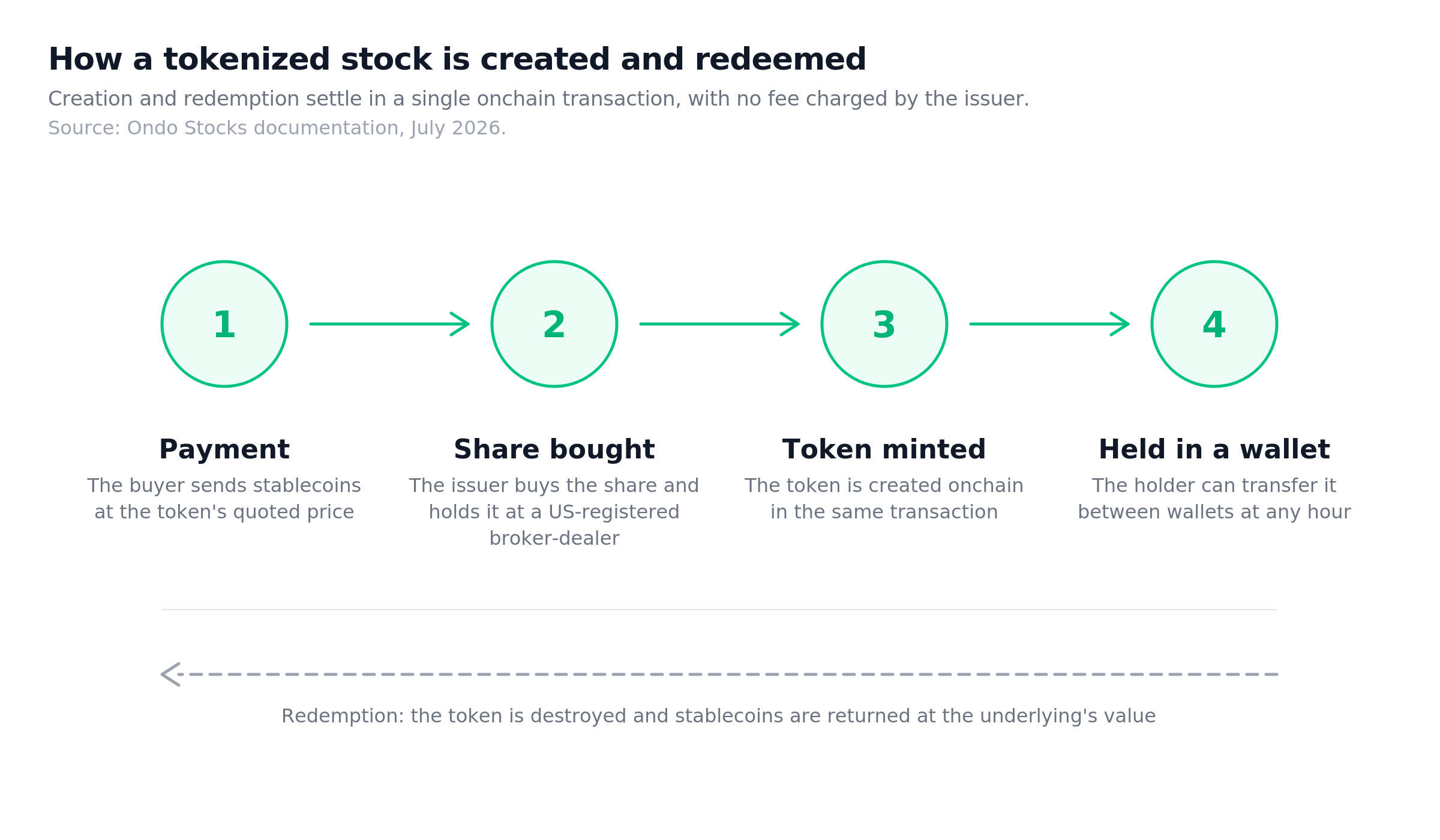
Creation and redemption are also what hold the price in line. Any eligible buyer can create new tokens at the share's current value. If the token traded above that value, creating tokens and selling them would be profitable, and the selling pushes the price back down. The same works in reverse through redemption.
The token itself moves between wallets in a single onchain transaction. The underlying share still settles through the US market's one-business-day cycle, which the SEC shortened from two business days on 28 May 2024.
Why does a tokenized stock's price drift from the share price?
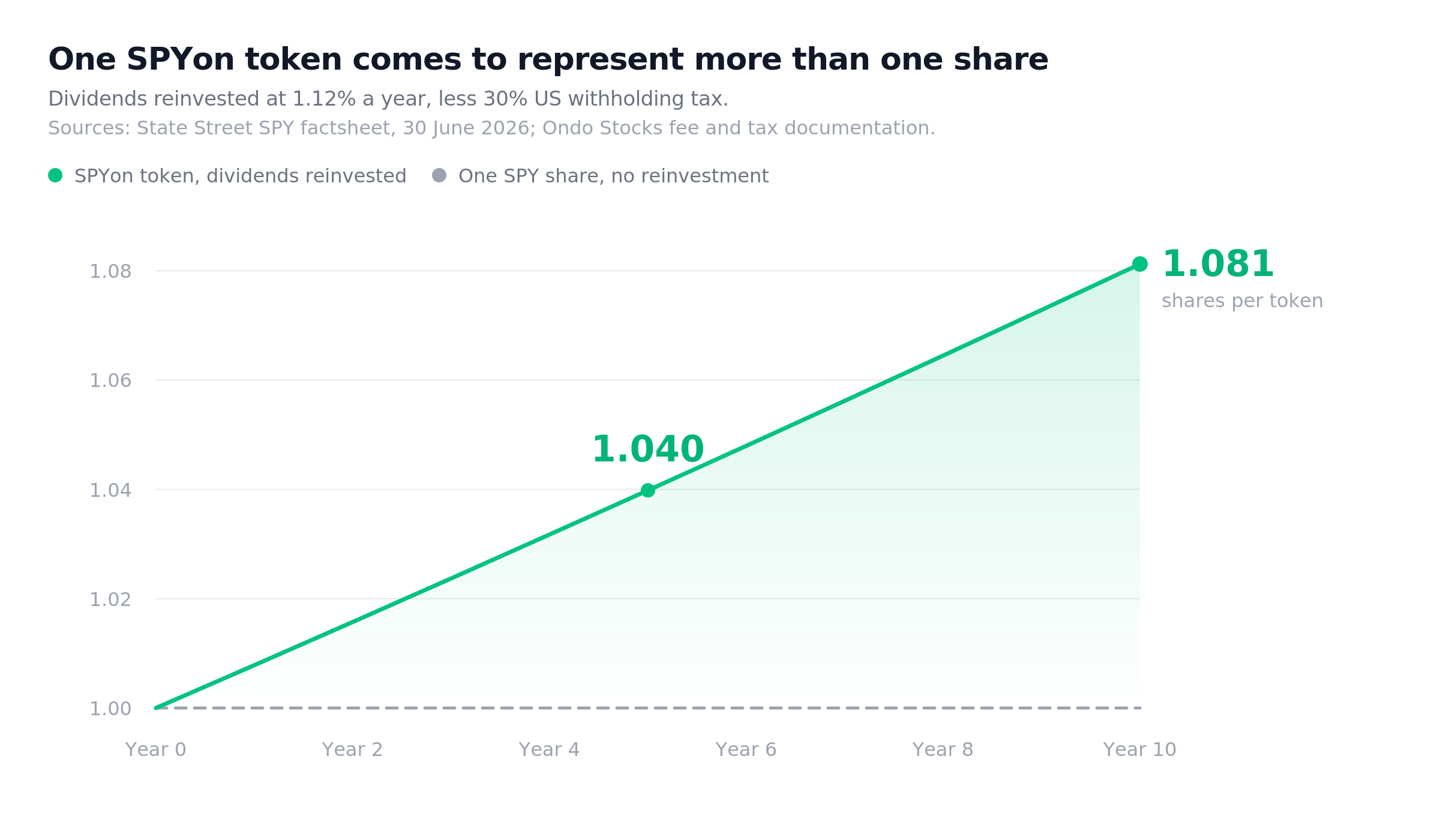
Ondo tokenized stocks are total-return trackers. A dividend paid by the underlying share never reaches the holder as cash. Ondo collects it, US withholding tax is deducted, and the remainder buys more of the same share. One token comes to represent more than one share, and its quoted price rises above the share price.
The arithmetic is checkable. SPY, the S&P 500 ETF, tracked an index with a dividend yield of 1.12% a year as of 30 June 2026. The entity that issues Ondo's tokens is registered in the British Virgin Islands, so US dividends paid to it are taxed at the standard 30% rate, with no treaty reduction available. That leaves 0.784% a year to reinvest.
Starting at one share per token and holding the yield steady, after five years one SPYon token represents about 1.04 shares. Its quoted price sits roughly 4% above the SPY share price, and on a $10,000 position the reinvested dividends account for about $398. After ten years the gap is about 8.1%. An investor holding SPY directly through a broker in a treaty country would face 15% withholding instead of 30%, worth about $485 over the same five years.
On Solana and BNB Chain, wallets that support Ondo's scaled display show a price and a balance closer to the underlying share. The economic value is the same in both presentations. Other issuers pay the dividend out in cash instead, compared under do tokenized stocks pay dividends.
What does a tokenized stock holder own?
A tokenized stock holder owns a token carrying the share's economic value, not the share. Ondo's documentation states that holders receive no shareholder voting rights, no statutory information rights, and no other shareholder rights from the company that issued the security. The shares themselves sit at one or more US-registered broker-dealers.
On 28 April 2026, Ondo and Broadridge Financial Solutions opened proxy materials to holders of more than 250 Ondo tokenized stocks and ETFs. A holder can review filings and submit a voting preference weighted by the tokens they hold. Ondo votes the underlying shares, and the preference guides that vote rather than binding it.
| Feature | Tokenized US stock (Ondo) | US share through a broker |
|---|---|---|
| What the investor holds | A token backed by a share held at a US-registered broker-dealer | The share itself, held through the broker |
| Account required | A crypto wallet | A brokerage account, subject to the broker's country rules |
| Dividend treatment | Reinvested into the token after 30% US withholding, no cash paid | Paid as cash, 30% withholding or about 15% under a tax treaty |
| Shareholder vote | None. An advisory preference can be submitted through Broadridge | A binding vote at company meetings |
| Compensation scheme | None. No SIPC or FDIC coverage | SIPC coverage at a US broker if the broker fails |
| Trading window | 24 hours a day, five days a week, with six assets available at any time | US exchange hours plus the broker's extended sessions |
| Who may buy | Investors outside the United States only | Depends on the broker and the investor's country |
When can tokenized stocks be traded?
Most Ondo tokenized stocks can be bought and sold 24 hours a day, five days a week, from Sunday evening to Friday evening New York time. Transfers between wallets run at any hour. Since 25 June 2026, six of the most traded tokens can also be created and redeemed on weekends and US market holidays: SPYon, QQQon, CRCLon, NVDAon, TSLAon, and GOOGLon.
Trading pauses briefly between sessions, during corporate actions such as dividends and stock splits, and when the platform's risk limits are reached. Pricing tends to be wider when the US market is closed, because fewer participants are quoting the underlying share.
Who is allowed to buy tokenized stocks?
Ondo tokenized stocks are offered to investors outside the United States. The issuer, Ondo Global Markets (BVI) Limited, prohibits US persons as defined in Rule 902 of Regulation S from acquiring or redeeming the tokens, and prohibits orders placed from inside the United States. Further country restrictions apply. A tokenized stock is one form of security token, a blockchain token that is, or legally represents, a regulated security.
The regulatory position on the format itself is settled. Staff from three SEC divisions issued a joint statement on 28 January 2026 confirming that the federal securities laws apply to tokenized securities to the same extent as to their traditional counterparts, whatever the format. SEC Chairman Paul Atkins stated the principle in a speech on 12 November 2025: "Securities, however represented, remain securities."
A separate US effort runs on different rails. The SEC approved a Nasdaq rule change on 18 March 2026 permitting Russell 1000 stocks and major index ETFs to trade in tokenized form, cleared and settled by the Depository Trust Company. Those trades still clear on the one-business-day cycle, with tokenization applied afterwards, and they are a domestic product rather than the Regulation S tokens described here.
What are the risks of tokenized stocks?
The issuer is the first risk. A tokenized stock is a claim on the firm that holds the share, so its legal structure decides what a holder recovers if the firm fails. Ondo issues through a special purpose company with at least one independent director, publishes daily attestations of the assets held at regulated US entities, and grants a first-priority security interest to a third-party agent.
Three further risks are structural. Tokenized holdings carry no SIPC or FDIC coverage, so no compensation scheme stands behind them. The 30% withholding rate applied to the BVI issuer is higher than the treaty rate many investors would face holding the share directly, and that difference compounds. The token also depends on code and on a price feed, and a flaw in either can cause loss.
Market risk is unchanged by the format. The token falls exactly as far as the share does. A contract for difference tracks the same share price with leverage and no share behind it, and the cost and risk differences between tokenized stocks and CFDs are set out separately.
How does someone buy a tokenized stock?
A person buys a tokenized stock by funding a wallet with dollars or a stablecoin and purchasing the token through an app or exchange that lists it. Ondo's own platform requires its own onboarding checks, so most individual investors reach these tokens through a partner app.
Glider is one way to hold them. A user funds an account, adds tokens such as SPYon or NVDAon to a portfolio, and the app handles the network fees and routing. The portfolio rebalances back to the target mix on a cadence the user chooses, and the assets stay in the user's own account. Tokenized stocks are not available to US persons.
A tokenized stock is a token backed one-for-one by a real share held at a regulated US firm. Its value follows the share and the dividends reinvested into it, net of 30% US withholding tax, which is why one token comes to represent more than one share over time. The holder receives the economic result of owning the share and no shareholder vote. What the format removes is the brokerage-account requirement, and it is open only to investors outside the United States.
Frequently asked questions
How do tokenized stocks work?
A regulated firm buys a company's share and holds it at a US-registered broker-dealer. A token backed by that holding is issued on a blockchain and can be created or redeemed at the share's current value. The token's value follows the share, and dividends are reinvested into it rather than paid as cash.
Are tokenized stocks legal?
Yes, where they are issued in line with securities law. SEC staff confirmed in January 2026 that federal securities laws apply to tokenized securities regardless of format. Ondo's tokenized stocks are issued to investors outside the United States under Regulation S, and rules on holding them differ by country.
Do tokenized stocks pay dividends?
Ondo's tokenized stocks pay no cash dividend. The issuer collects each dividend, 30% US withholding tax is deducted, and the remainder buys more of the underlying share. The token then represents slightly more than it did before, so the dividend reaches the holder as an increase in the token's value.
Can US investors buy tokenized stocks?
No. Ondo Global Markets (BVI) Limited prohibits US persons under Rule 902 of Regulation S from acquiring or redeeming its tokens, and prohibits orders placed from within the United States. A separate US framework, approved for Nasdaq in March 2026, is a different product on different infrastructure.
This guide is for educational purposes only and is not financial, tax, or legal advice or a recommendation to buy or sell any asset. Tokenized stocks carry market, issuer, and technology risk, and their value can fall. Tokenized stocks and ETFs issued under Regulation S are not available to US persons. Anyone considering them should check the rules that apply in their own country.