Do Tokenized Stocks Pay Dividends?
A tokenized stock is a blockchain token that represents a real company share, such as Apple or an S&P 500 ETF, and moves with its price. A dividend is a cash payment a company makes to its shareholders, usually every quarter, out of its profits. Tokenized stocks pass through the value of these dividends, but most do not pay them out as cash. Instead, the dividend is reinvested into the token, so the token's value grows. A small number of issuers pay the dividend out as cash in a stablecoin.
Key takeaways
- Most tokenized stocks reinvest dividends into the token, so the value appears as a higher token price or a larger token balance rather than a cash payment.
- Ondo Global Markets, the largest tokenized-stock issuer, reinvests dividends automatically, net of US withholding tax.
- Some issuers pay cash instead. Dinari pays a stablecoin, and Robinhood's EU stock tokens pay a euro cash equivalent.
- US tax is withheld before the dividend is reinvested, usually 30%, or about 15% where a tax treaty applies.
- Tokenized stockholders receive the value of the dividend, but not shareholder voting rights or SIPC protection.
How does a dividend reach the holder of a tokenized stock?
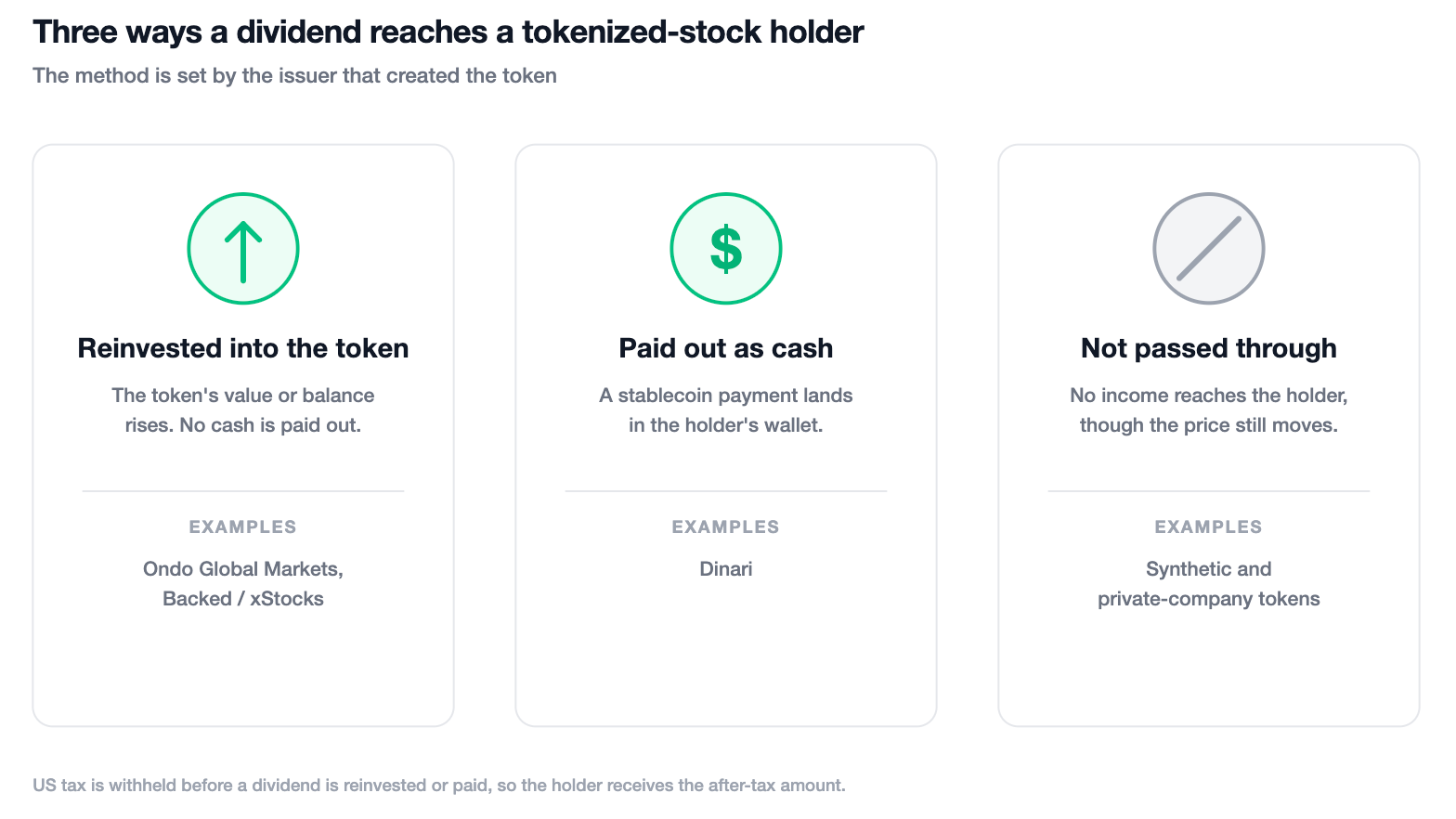
A dividend reaches a tokenized-stock holder in one of three ways.
Reinvestment is the most common method. When the underlying stock pays a dividend, the issuer collects it, deducts tax, and uses the rest to buy more of the same stock. The token then represents slightly more than it did before. This design is called a total-return tracker, because the token reflects both the share price and the reinvested dividends.
The reinvested value can appear in one of two ways, depending on how the issuer implements the token on each chain. Ondo Global Markets uses both.
- On Ethereum, the token's price rises above the share price, so one token comes to represent more than one share.
- On Solana and BNB Chain, the holder's token balance increases instead, while each token keeps matching the share price. The financial result is the same.
Ondo documents how the math works. A token tracking a $98 stock receives a $2 dividend. After 30% US tax, $1.40 is left, which buys 0.014 more shares. The token then represents 1.014 shares, and its price rises to $99.40. No cash is paid out.
Some issuers pay cash instead of reinvesting. Dinari sends the dividend to the holder's wallet as a stablecoin. Robinhood's EU stock tokens pass a cash equivalent in euros.
Synthetic tokens, and tokens that track private companies, often carry no dividend, because there is no real share or no dividend behind them.
| Issuer or product | How the dividend is handled | What the holder sees |
|---|---|---|
| Ondo Global Markets ($AAPLon, $SPYon and similar) | Reinvested into the token, net of US tax | A higher token price on Ethereum, or a larger token balance on Solana and BNB Chain. No cash. |
| Backed / xStocks (on Kraken, Bybit) | Reinvested by raising the token balance | More tokens in the account; each still tracks one share's price. No cash. |
| Dinari (dShares) | Paid as cash in a stablecoin (USD+) | A stablecoin payment in the wallet. |
| Robinhood EU stock tokens | Paid as a cash equivalent in euros | A euro cash credit. |
| Synthetic or private-company tokens | Usually no dividend | Nothing passed through. The price may move, but no income arrives. |
Why is the dividend smaller than the company paid?
The dividend is smaller because US tax is withheld before the holder receives it. The US taxes dividends paid to non-US investors, usually at 30%. Where the holder's country has a tax treaty with the US, the rate is often 15%. The issuer deducts this tax before reinvesting or paying out the rest.
This is not unique to tokens. Any non-US investor who owns US shares through a regular broker pays the same withholding tax. With a tokenized stock, the issuer applies it automatically and reinvests or pays whatever remains, so the amount that reaches the holder is the after-tax dividend, smaller than the figure the company announced.
What else does a tokenized stockholder get?
A tokenized stockholder gets the financial result of owning the share, including its price movements and dividends, but not the legal rights of a shareholder. With most issuers, the holder owns a token backed by the share rather than the share itself.
This means no direct ownership and no vote of the holder's own. The issuer owns the actual shares and holds the voting rights. In April 2026, Ondo added proxy voting through Broadridge that lets holders of more than 250 of its tokenized stocks and ETFs submit voting preferences, weighted by how many tokens they hold. Under Ondo's own terms, these are rights to express preferences to the issuer, which owns the shares and casts the vote.
There is also no SIPC protection, the US program that covers securities if a brokerage fails. Any protection instead depends on how the issuer holds the underlying shares.
Why hold a tokenized stock?
Tokenized stocks give investors outside the US, in countries like India and China, a way to hold US stocks that they often cannot buy through a local broker. They settle in minutes, trade 24 hours a day on weekdays, and can be held in a self-custodial wallet, which is a wallet the investor controls directly, without a brokerage account.
Because they live on a blockchain, tokenized stocks can also be used in ways a brokerage share cannot. A holder can move them between wallets, use them in decentralized finance (DeFi) apps, or post them as collateral, all without a broker in the middle. Traditional shares sit inside a closed brokerage system and cannot do any of this.
Holding a tokenized stock also removes intermediaries on the investor's side. There is no personal brokerage account and no broker sitting between the investor and the token, which can mean fewer fees. The underlying shares are still held by a custodian on the issuer's side, as covered above; what changes is the investor's side.
How does someone hold a tokenized stock?
Holding a tokenized stock works through an app or wallet that lists them, not a traditional brokerage. The holder funds an account, buys the token, and the issuer handles any dividend automatically in the background. With a reinvesting token, there is nothing to claim and nothing to manage.
Glider lets a holder buy tokenized stocks such as $SPYon or $AAPLon, hold them directly in their own account, and combine them into a portfolio that rebalances on a cadence the holder chooses. Each dividend reinvests into the position on its own, and the tokens can be moved or used onchain like any other asset. Tokenized stocks are available to investors outside the US.
Tokenized stocks do pay dividends, but the money usually stays inside the token. Most issuers reinvest it automatically, net of tax, so the token's value grows instead of paying out cash. The method an issuer uses decides whether a holder ever receives cash, which is the first thing to check before buying a tokenized stock for income.
FAQ
Do all tokenized stocks pay dividends?
No. Whether a tokenized stock passes a dividend through depends on its structure. Most tokens backed by real shares reinvest the dividend or pay it as cash. Synthetic tokens, and tokens that stand in for private companies, often pass nothing through, because there is no held share or no dividend behind them.
Do tokenized stock dividends get paid in cash?
Usually not. Most issuers, including Ondo Global Markets, reinvest the dividend into the token, so the value grows instead of cash arriving. Only issuers that use a cash model, such as Dinari, send a payment to the holder, normally in a stablecoin.
Are tokenized stock dividends taxed?
US tax is withheld on the dividend before it reaches the holder, usually 30%, or about 15% under a tax treaty. How the holder's own country treats the reinvested value is a separate question and varies by jurisdiction. This is general information, not tax advice.
Do tokenized stocks come with voting rights?
Most do not. With a third-party issuer, the holder owns a token backed by the share, so the vote stays with the issuer that owns the share. Some platforms let holders submit a voting preference, but it is advisory, and the issuer decides how the shares are voted.
Disclaimer: This article is for educational purposes only. It is not financial, tax, or investment advice. The tokenized stocks described here are offered to non-US persons only and are not available to US investors.