
How to Invest in US Stocks and ETFs from India

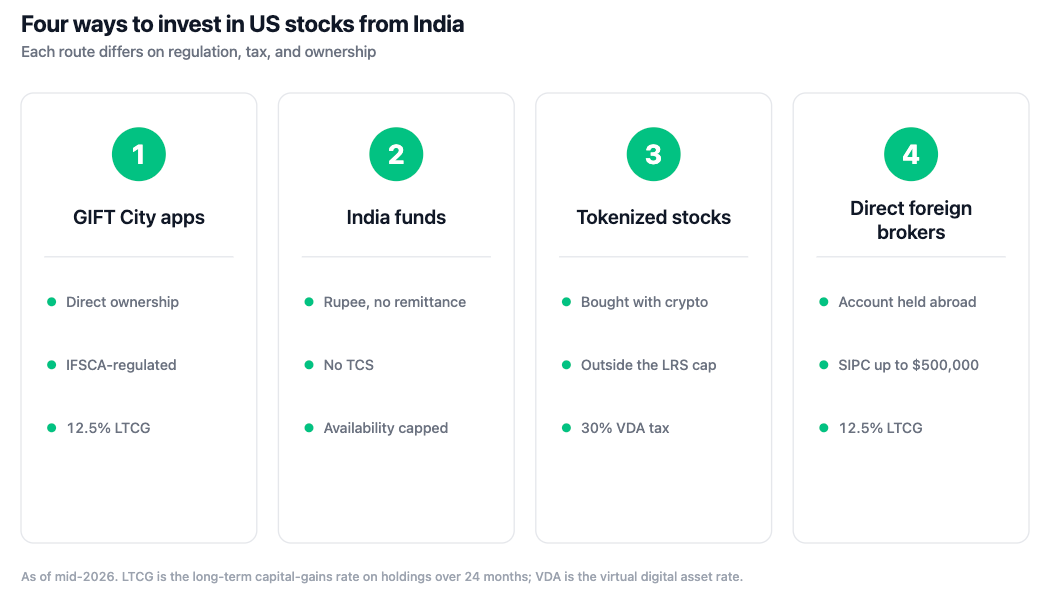
Resident Indians can legally invest in US stocks and ETFs from India under the Reserve Bank of India's Liberalised Remittance Scheme (LRS), the rule that lets a resident send money abroad, up to $250,000 per person each financial year.* The four ways are GIFT City brokers accessed through investing apps, India-domiciled funds, tokenized stocks, and direct foreign brokers, and they differ in cost, tax, and whether the investor owns the share.
* The $250,000 LRS limit applies to the bank-based ways. Tokenized stocks are bought with crypto and fall outside it (see Way 3).
Key takeaways
- Resident Indians can legally invest in US stocks under the RBI's Liberalised Remittance Scheme, up to $250,000 per person per financial year.
- The most common app-based retail route is a GIFT City broker app with an IFSCA Global Access Provider licence, which gives direct ownership of US shares under Indian regulation.
- Directly held US stocks are taxed at 12.5% on long-term gains held over 24 months; tokenized US stocks are taxed as virtual digital assets at a flat 30%.
- Tokenized stocks are bought with crypto and fall outside the $250,000 LRS cap, but the FEMA position on acquiring them is unresolved.
Why are Indian investors buying US stocks?
US markets have delivered strong returns over the past decade, and the rupee's long decline against the dollar has added to those returns in rupee terms. Over the ten years to December 2025, US indices outperformed Indian indices in rupee terms, led by the tech-heavy Nasdaq 100.
| Index | 10-year annualized return (INR) |
|---|---|
| Nasdaq 100 | about 23% |
| S&P 500 | about 18% |
| Nifty 500 | about 15% |
| Nifty 50 | about 13% |
Rupee total return, ten years to December 2025. US indices are total return in US dollars, converted at the rupee's depreciation against the dollar over the period; Indian indices are NSE Total Return Index. Sources: index providers, NSE Indices, and RBI reference rates. Figures are approximate.†
That performance gap is why more investors in India now look to American stocks and ETFs. There are four main ways to reach these markets.
Way 1: GIFT City brokers (the popular app route)
A resident opens an account with an investing app that holds a Global Access Provider licence, funds it under the LRS, and buys US shares directly. INDmoney and Vested are common choices.
How it works: GIFT City is India's International Financial Services Centre, regulated by the IFSCA and treated as offshore under FEMA. The Global Access Provider (GAP) framework, opened in August 2025, lets a licensed broker route orders to a US broker partner. Six GAPs are licensed as of mid-2026. Money moves from an Indian bank account to a GIFT City wallet, converts to dollars inside India, and buys US shares held in US custody, with beneficial ownership.
An older sub-variant, NSE IFSC Receipts (UDRs): Before the GAP framework, GIFT City access ran through unsponsored depository receipts that mirror about 50 S&P 500 stocks, custodied by HDFC Bank's IFSC unit in a segregated demat account without SIPC cover. That route still operates, but most new flow has moved to GAP platforms, which reach roughly 9,000 US stocks and ETFs rather than 50.
The LRS limit and TCS: The scheme caps remittances at $250,000 per person per financial year. Tax Collected at Source (TCS) of 20% applies above ₹10 lakh of remittances in a year (Section 206C(1G)). It is refundable, adjusted against the year's tax or refunded on filing.
Tax on gains and dividends:
- Long-term gains, on holdings sold after more than 24 months, are taxed at a flat 12.5% with no indexation (Section 112, effective 23 July 2024), and the ₹1.25 lakh exemption for Indian listed shares does not apply.
- Short-term gains, on holdings sold within 24 months, are added to income and taxed at the slab rate.
- Dividends are withheld at 25% in the US under the India-US treaty with Form W-8BEN, then taxed again in India at the slab rate, with a Foreign Tax Credit for the US tax claimed through Form 67.
Advantages:
- A regulated onshore gateway, with IFSCA oversight, local settlement, and dispute resolution under Indian law.
- On the GAP route, the US broker that holds the shares is a SIPC member, so SIPC protection up to $500,000 per customer applies.
- Onboarding is fully digital, fractional shares are available, and the route reaches thousands of US stocks and ETFs.
Tradeoffs:
- It needs a separate GIFT City demat and trading account rather than a domestic one.
- Each remittance involves LRS paperwork and a currency markup, and TCS creates an upfront cash-flow drag above ₹10 lakh.
- US holdings must be reported in Schedule FA, and large holdings can be subject to US estate tax.
How to start:
- Open an account with an IFSCA-licensed GAP app such as INDmoney or Vested.
- Complete KYC online with PAN and Aadhaar, and file Form W-8BEN to claim the 25% treaty dividend rate.
- Fund the GIFT City wallet by LRS remittance.
- Buy shares or ETFs, including fractional amounts.
- At tax time, report holdings in Schedule FA and gains in Schedule CG, and file Form 67.
Way 2: India-domiciled US funds
India-domiciled funds are rupee mutual funds and fund-of-funds that hold US stocks for the investor, though supply limits make many of them hard to buy right now.
How it works: A user buys a rupee-denominated fund that holds US equities, such as a Nasdaq 100 fund-of-funds, like any Indian mutual fund. The fund handles the overseas holding.
Availability: Indian mutual funds share an industry-wide cap of USD 7 billion on overseas securities, with a separate USD 1 billion cap on overseas ETFs. The ETF cap filled first, so overseas-ETF funds have been closed to fresh money since April 2024. Fund-of-funds reopen in waves as redemptions free up room: around 28 were open in early 2026, but several houses re-suspended through the first half of the year. Confirm a scheme is open for fresh subscription before investing.
Tax: A holding is taxed in India as a mutual fund, at a rate that depends on the fund's structure and holding period. There is no US withholding and no Schedule FA reporting. Fund taxation has changed more than once, so confirm the current rate first.
Advantages:
- There is no LRS remittance, no TCS, and no foreign-asset reporting.
- The process runs entirely in rupees, with a low entry ticket.
Tradeoffs:
- Availability is unreliable, and many funds are closed to fresh money.
- The investor does not own the underlying shares, and tracking error applies.
- Fund-of-funds add a layer of fees on top of the underlying fund.
How to start:
- Find an India-domiciled US fund currently open to fresh investment.
- Complete KYC with any Indian mutual-fund platform.
- Invest in rupees, as a lump sum or a SIP.
- Report gains in the ITR when units are sold.
Way 3: Tokenized US stocks
Tokenized stocks are blockchain tokens that track the price of a US stock or ETF, including dividends. Each is backed one-to-one by the underlying security, held by a US-registered broker-dealer, and bought with crypto rather than a bank remittance. They are not sold to US residents, and an Indian investor reaches them through a crypto app rather than a regulated Indian broker.
How it works: The largest issuer, Ondo Global Markets, holds more than 70% of the tokenized-equity market, which itself passed roughly $1.5 billion in mid-2026, and offers more than 430 tokenized US stocks and ETFs across Solana, Ethereum, and BNB Chain. Apps built on these issuers let a user buy the tokens and assemble automated portfolios that hold the underlying stocks directly rather than through a fund. Voting rights are limited and only beginning to appear, through on-chain proxy voting introduced in 2026.
Tokenized stocks do not pass through the LRS channel, since they are bought on-chain with crypto rather than through an authorised dealer bank, so neither the $250,000 LRS cap nor the 20% TCS applies. The regulation is unresolved: Indian authorised dealers generally decline crypto-related remittances, and FEMA does not clearly cover acquiring foreign-asset tokens with crypto. It remains a grey area rather than a clean way past the cap.
Tax:
- A holding is taxed in India as a virtual digital asset (VDA), at a flat 30% under Section 115BBH, plus cess.
- There is no lower rate for a longer holding period, and no set-off of losses.
- A 1% TDS applies under Section 194S, with gains reported in Schedule VDA.
- The Finance Act 2025 expanded the VDA definition to cover crypto-assets from 1 April 2026, which includes these tokens.
Advantages:
- The purchase faces no LRS cap and no TCS.
- Trading runs round the clock, with no US brokerage account and fractional sizing.
- The tokens sit alongside a user's other crypto in the same account.
Tradeoffs:
- The holder owns a token rather than the share, with no SIPC protection.
- Value depends on the issuer's custody and one-to-one backing, alongside smart-contract risk.
How to start:
- Open an account with a tokenized-stocks app such as Glider.
- Fund it with crypto, usually a dollar-pegged stablecoin.
- Buy the tokenized stock, ETF, or portfolio.
- Keep records of purchases and sales, and report gains in Schedule VDA.
Way 4: Direct foreign brokers under the LRS
Direct foreign brokers let a resident open an account abroad, remit dollars under the LRS, and buy US shares directly, owning them outright. Interactive Brokers is a common choice for India-resident clients. This is the most hands-on way, suited to investors comfortable holding an account with a foreign-regulated broker.
How it works: The investor opens an account directly with a US-regulated broker and funds it through an outward LRS remittance. The assets sit with the US broker, a member of the Securities Investor Protection Corporation (SIPC).
Tax: The $250,000 LRS limit, the 20% TCS above ₹10 lakh, and the capital-gains rules are the same as the GIFT City route: 12.5% on long-term gains after 24 months, and the slab rate on short-term gains. Dividends carry the 25% US withholding with Form W-8BEN, taxed again in India with a Foreign Tax Credit through Form 67.
Advantages:
- Direct ownership of the shares, the full $250,000 LRS headroom, and the widest selection of US stocks and ETFs.
- Fractional shares are available, with assets held by a SIPC member and protected up to $500,000.
Tradeoffs:
- The account sits with a foreign-regulated broker, with dispute resolution outside India.
- Each remittance involves LRS paperwork and a currency markup of roughly 0.5% to 1.5%.
- Holdings must be reported in Schedule FA, and large holdings can be subject to US estate tax.
How to start:
- Open an account directly with a US-regulated broker such as Interactive Brokers.
- Complete KYC and file Form W-8BEN to claim the 25% treaty dividend rate.
- Fund the account by LRS remittance (purpose code S0001).
- Buy shares or ETFs, including fractional amounts.
- At tax time, report holdings in Schedule FA and gains in Schedule CG, and file Form 67.
What to watch for
Schedule FA is mandatory: any resident and ordinarily resident holding a foreign asset must disclose it, regardless of income and with no minimum threshold. ITR-1 cannot be used, so the return moves to ITR-2 or ITR-3. Non-disclosure can attract a Black Money Act penalty, though that penalty generally does not apply where aggregate foreign assets other than immovable property stay under ₹20 lakh, a relief in effect from 1 October 2024.
A few other points shape the choice:
- US estate tax is a tail risk: US-situated assets, including US stocks and US-domiciled ETFs, can face US estate tax above a $60,000 exemption for non-resident non-citizens, with no India-US estate treaty to reduce it.
- Tokenized stocks are taxed as VDAs, at a flat 30% with no loss set-off, heavier than the 12.5% long-term rate on directly held US stocks. On a ₹1,00,000 long-term gain, that is ₹30,000 in tax versus ₹12,500 on a directly held US stock.
Indian demand for US stocks has climbed sharply, and the ways to reach them now range from GIFT City apps to tokenized stocks bought on-chain, each with its own cost, tax, and ownership profile. As GIFT City matures and tokenization scales, more of the US market is opening up to investors in India.
FAQ
Is it legal to invest in US stocks from India?
Yes. The RBI's Liberalised Remittance Scheme permits up to $250,000 per person per financial year for overseas equities, routed through an authorised dealer bank or a GIFT City Global Access Provider. The holdings must be disclosed at tax time.
Can a person invest more than $250,000 in US stocks from India?
Not through the bank-based ways, which the LRS caps at $250,000 per person per financial year. Tokenized stocks bought with crypto fall outside the LRS channel, so the cap does not apply to that purchase, though the FEMA position on buying foreign-asset tokens with crypto is unresolved.
Is income from US stocks taxed in India?
Yes. Long-term gains on directly held US stocks held more than 24 months are taxed at 12.5% without indexation, short-term gains at the slab rate. Dividends face 25% US withholding, are reported gross in India, and the US tax is credited through Form 67. Tokenized stocks are taxed differently, as virtual digital assets at a flat 30%.
Can a person invest in US stocks without using the LRS?
For most retail investors, a GIFT City broker app with a Global Access Provider licence is the simplest route. It runs onboarding, the LRS remittance, and tax reporting in-app, gives direct ownership of US shares under Indian regulation, and reaches thousands of US stocks and ETFs.
† Returns are cyclical. Over some windows Indian indices have led, and the result turns on the period and the rupee-dollar rate. Past performance does not predict future returns.
This article is for educational purposes and is not investment, tax, or legal advice. Tax and remittance rules change; figures are current as of June 2026 and should be verified against the latest RBI, SEBI, IFSCA, and Income Tax Department guidance.