What Is a Security Token? A Plain Guide for Investors
A security token is a blockchain-based token that is, or legally represents, a regulated financial security such as a stock, bond, or fund. You hold the asset's economic value onchain, under the same securities rules and investor protections that apply to traditional securities.
For most of history, owning a US stock or a government bond meant clearing a brokerage and the paperwork behind it. A security token is that same asset reaching you through a wallet instead. Same protections, fewer gatekeepers.
Key takeaways
- The Howey test, set by the Supreme Court in 1946, decides what counts as a security. A token passes it when you put money into a shared venture and expect to profit from other people's work.
- Putting a security on a blockchain changes only how it is recorded. The same securities rules apply onchain as on paper, so a stock stays a stock.
- The clearest examples today are tokenized stocks, treasuries, and gold, many holdable now by non-US investors.
- A third-party tokenized stock pays the asset's economic return, its price plus reinvested dividends, while the vote and direct ownership stay with the issuer.
- Each token is fully backed by the real asset held with regulated custodians, with legal safeguards designed to put holders first if the issuer fails.
What makes a token a security?
A security is a tradable financial asset with monetary value. It can represent ownership in a company, a lending relationship with a government or corporation, or a claim to ownership rights. A security token is treated as a security when it meets the Howey test: put money into a shared venture, expect to profit from other people's work, and the law counts it as a security.
The Howey test comes from a 1946 US Supreme Court case, SEC v. W.J. Howey Co., which set out four conditions for an investment contract: money is invested, in a common enterprise, with an expectation of profit, drawn mainly from the work of others. In any form, an asset that meets these four criteria is a defined as a security. Moving a security onto a blockchain does not exempt it. In January 2026, staff across three SEC divisions issued joint guidance confirming the point: a tokenized security stays bound by the same rules as the original, because tokenizing changes how the asset is recorded and held, while its legal status stays the same.
How big is the Security Token market?
Security tokens are no longer an experiment. Tokenized real-world assets, the wider market they sit in, reached about $32 billion on public blockchains by June 2026, held across nearly 930,000 holders and up more than fivefold since early 2025, according to rwa.xyz. Of that total, tokenized US Treasuries are the largest single category at more than $6 billion, with tokenized money market funds close behind, both of them securities.
The issuers are established names. BlackRock, the world's largest asset manager, runs a tokenized Treasury fund that has passed $2.5 billion. Others have followed: Franklin Templeton, which launched the first US-registered tokenized fund back in 2021, and WisdomTree both run tokenized funds of their own, with large institutions and sovereign wealth funds now among the buyers.
What does a holder actually get?
With most tokenized stocks available today, the holder gets the asset's economics while legal ownership stays with the issuer.
What the holder gets:
- The price: The token tracks the asset's price, up and down.
- The dividends: Captured by the token (as the Apple example below shows).
- The exit: The token can be redeemed for its value at any time.
What the holder doesn't get:
- A vote: No say in company decisions.
- A name on the register: The shares are held for the issuer.
- Shareholder standing: None of the rights that come from owning the share directly.
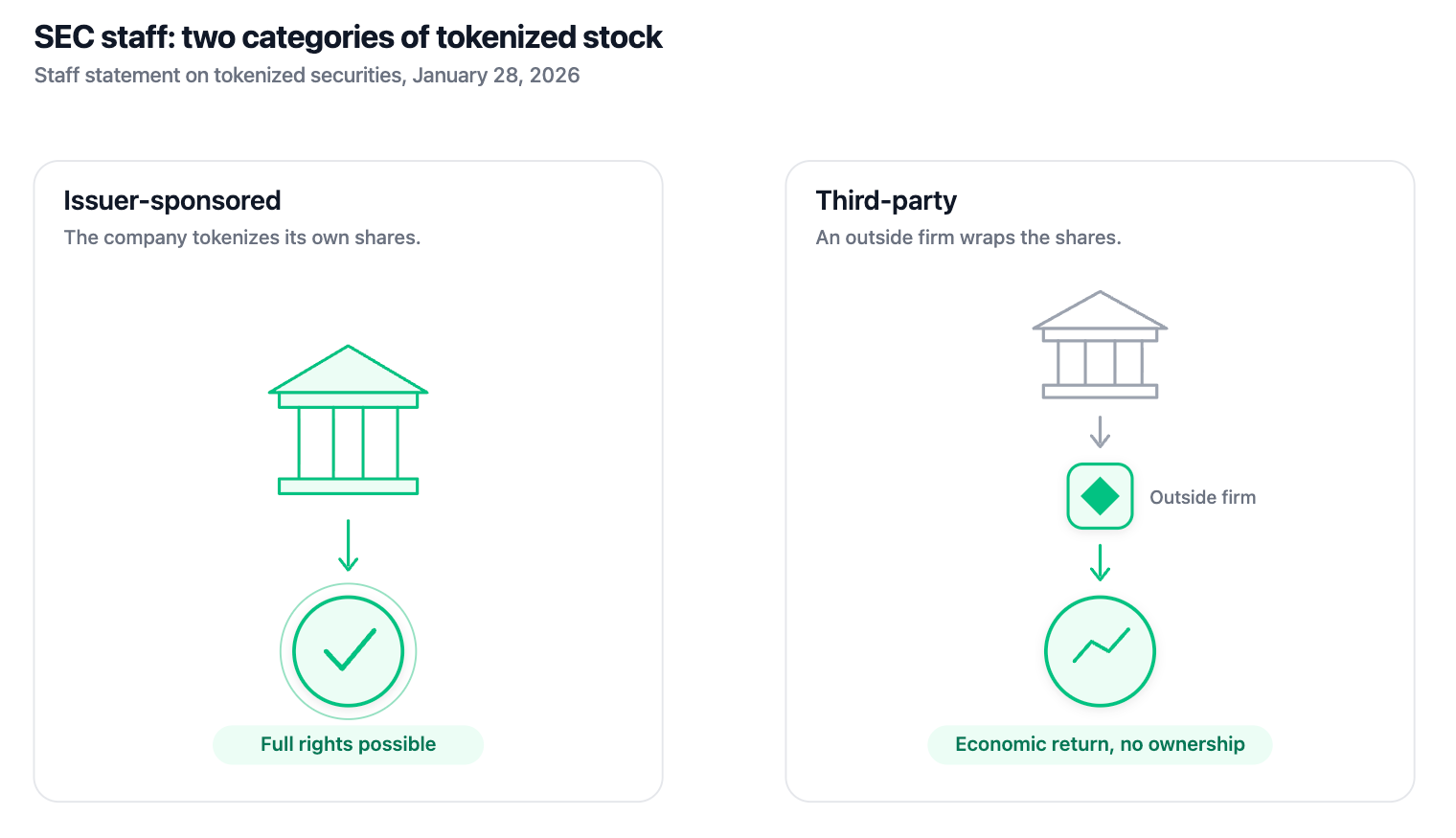
Which of these the holder gets depends on how the token is built. The main split SEC staff draw is between two models. When a company tokenizes its own shares, holders can carry the full set of rights. When an outside firm wraps someone else's shares, holders usually get the economics without the ownership. Ondo Finance, which issues tokenized US stocks, is one example of the second model; its tokens track the share while the firm holds the real one. The issuer creates the token, and investors hold it through an app or wallet.
A real example: holding tokenized Apple ($AAPLon)
$AAPLon is a tokenized version of Apple, built on the third-party model described above. It is a total-return tracker, fully backed by real Apple shares held with regulated custodians. When Apple's price moves, the token moves with it. However, a dividend works differently, since it is reinvested into the token rather than paid out as cash. With this, each token comes to represent a little more than one share over time.
Example (using illustrative numbers): AAPL and $AAPLon both start at $100. AAPL rises to $110, and the token rises with it, still tracking one share. When Apple pays a dividend, a normal shareholder receives it as cash. With a tokenized security, that dividend buys more AAPL instead, so after withholding tax the token comes to track about 1.05 shares. From there it sits slightly above a single share, carrying those reinvested dividends. Over the years, that gap is Apple's dividends compounding inside the token.
Is a security token safe?
A security token can be well protected and still carry risks an ordinary share does not.
What protects the holder:
- Bankruptcy-remote issuer: The issuing company is kept separate from the rest of the business, so its failure cannot pull the asset down with it.
- Full backing: Each token is backed by the real shares, often with an extra buffer on top.
- Independent security agent: An outside agent holds a claim on those shares and can sell them for holders if the issuer fails.
- Daily proof: Holdings are attested every day, and the smart contracts are independently audited.
What to watch:
- Issuer risk: A token like this is a debt instrument from the issuer, so its value rests on that company's setup as much as the share it tracks.
- Smart-contract risk: Code can carry bugs.
- Redemption risk: Cashing out depends on the issuer working as intended.
- Legal venue: The issuer may be an offshore entity governed by foreign law.
Before holding one, it is worth reading how it is structured and keeping the position sized to that risk.
Who can hold one, and why are they non-US?
Most tokenized stocks are built for non-US investors because of legal reasons. Selling a security to US persons means registering it with the SEC or fitting a narrow exemption, which is slow and costly. So issuers use Regulation S instead, a US rule that lets a security be sold without that registration as long as the buyers are not US persons. On top of that, issuers run KYC checks and block sanctioned or restricted jurisdictions, which in practice rules out places like Iran and North Korea as well.
For an investor in one of the countries that qualifies, the payoff is direct access to US assets from a wallet, settling onchain in seconds instead of waiting on the clearing cycle of traditional markets.
How to actually hold a security token
You can hold security tokens through an app or wallet that lists them, not from the issuer directly. Glider is one such app, supporting tokenized stocks like $AAPLon, tokenized treasuries like $SGOVon (short-term US Treasuries), and tokenized gold, with the assets held in your own account.
A security token is a regulated asset with the gate removed. What is gone is what kept so many people out: the right brokerage, the right country, the right paperwork. For a lot of people, that was the only thing in the way.
Key terms
- Security token: a token that is, or legally represents, a regulated security such as a stock or bond.
- Tokenized security: a traditional security issued or recorded as a token on a blockchain; in law, still a security.
- Total-return tracker: an instrument designed to mirror an asset's full return, its price plus reinvested dividends, rather than price alone.
- Regulation S: a US rule that allows securities to be offered to non-US persons without full US registration.
- Structured note: a debt instrument whose payout is tied to another asset's value, used here to deliver a stock's economic return.
Is a tokenized stock a security token?
Yes. A tokenized stock is a security token: a token that represents a regulated equity. With most versions available today, the holder gets a token that tracks the share's value rather than the share itself.
Do tokenized stocks pay dividends or carry voting rights?
With third-party tokenized stocks, dividends are usually reinvested into the token's value rather than paid as cash, so they are still captured over time. They do not come with shareholder voting rights or a place on the company's share register.
Are security tokens legal?
Yes, when they are issued in line with securities law. A security token is regulated as a security, not exempt from the rules. Tokenized stocks, for instance, are commonly offered under Regulation S to investors outside the US.
What is a security token offering (STO)?
An STO is a regulated fundraise that issues new security tokens, the compliant successor to the ICO. It is different from buying an already-tokenized stock or bond, which is a purchase on the secondary market.
Can US investors buy tokenized stocks?
Generally no. These products are offered under Regulation S to non-US persons, and US persons are screened out by design. Anyone considering them should check the rules in their own country first.
Disclaimer: This guide is for educational purposes only and is not financial or legal advice or a recommendation to buy or sell any asset. Tokenized securities described here are not available to US persons. Always do your own research.