How to Invest in US Stocks from Indonesia
There are four ways to invest in US stocks from Indonesia: an international brokerage account, tokenized US stocks held in a personal wallet, an investing app such as Pluang or Reku, or a fund that holds US assets. An Indonesian resident can legally use any of them. The routes differ in what the investor owns, how the account is funded, what it costs, and how the position is taxed.
Demand has grown as the domestic market has weakened. The IDX Composite was trading near 6,060 in mid-July 2026, down roughly 15% over twelve months. Indonesian investors buy US shares for access to companies with no domestic equivalent, particularly in semiconductors and artificial intelligence, for the ability to hold assets priced in US dollars, and for the depth of the New York Stock Exchange and Nasdaq.
Key takeaways
- Pluang and Reku do not sell shares. Both route US stock orders through a futures and derivatives licence, and both state that customers receive no voting rights.
- Tokenized stock holders gained a voting channel in April 2026, when Ondo began relaying proxy votes through Broadridge. Holders are still not shareholders of record.
- Indonesian tax on foreign shares runs 5% to 35%. The 0.1% final tax most guides quote applies only to shares listed on the Indonesia Stock Exchange.
- US dividend withholding is 30% by default and 15% under the treaty, and the reduced rate needs a Form W-8BEN from the account holder.
- US estate tax starts at $60,000 of US assets, and Indonesia has no estate tax treaty with the United States.
Is it legal to invest in US stocks from Indonesia?
Yes. Indonesian residents may hold foreign securities and may open accounts with foreign brokers that accept them.
The restriction that shapes the market applies to Indonesian firms, not to the investor. Domestic securities companies have not historically been permitted to route retail orders into foreign equity markets, which is why every local provider sells US stocks through a futures and derivatives license rather than a securities license. Crypto, which the tokenized route depends on, moved from Bappebti supervision to the Financial Services Authority (OJK) on 10 January 2025, and the status of a tokenized security under Indonesian law is still developing.
The four routes compared
Every route converts rupiah into US dollars at some point, which is usually the largest cost an investor never sees on a statement. The visible fees below are small. The currency spread is not, and it is charged in a different place on each route.
| International broker | Tokenized stocks | Pluang and Reku | Fund | |
|---|---|---|---|---|
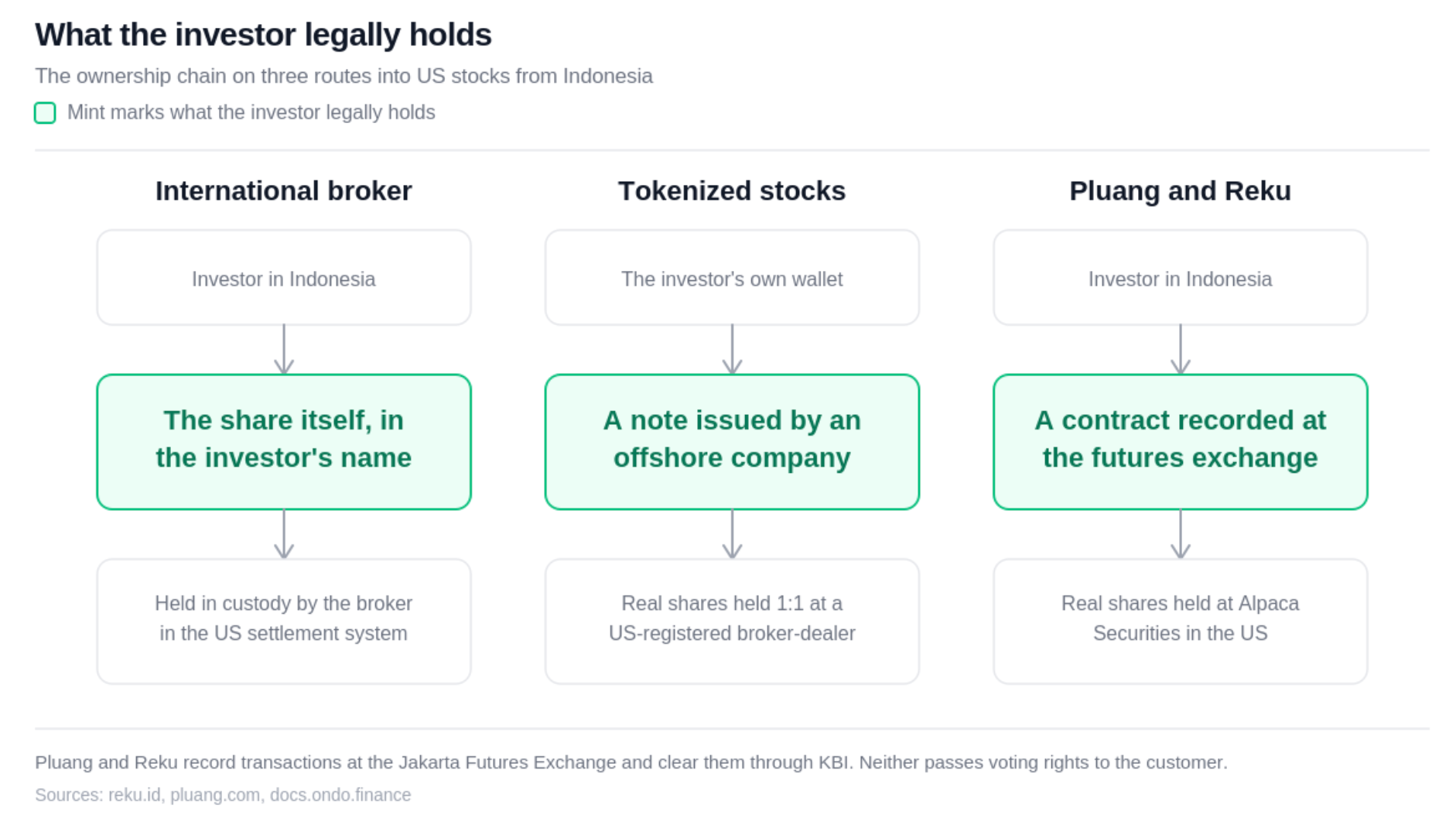
| What the investor owns | The share itself, in the investor's name | A note from an offshore issuer, backed 1:1 by real shares | A contract position recorded at the Jakarta Futures Exchange | Units in a fund holding US assets |
| Voting rights | Yes, where the broker passes them through | A preference relayed to the issuer | None, stated by both platforms | Held by the fund |
| Funded with | A US dollar wire | Rupiah converted to a stablecoin | Rupiah by virtual account or e-wallet | Rupiah locally, a wire abroad |
| Minimum | Set by the wire | Fractional, no minimum | From $1 or Rp10,000 | Varies by fund |
| Cost | Commission, wire fee, currency spread | Exchange spread, network fee, 0.21% crypto tax | 0.23% to 0.34% all-in, plus an embedded currency spread | Annual management fee |
| Protection | SIPC at a US member firm | Collateral and a security agent, no SIPC | Clearing at KBI, scope not documented | The fund's home regulator |
| US estate tax | Applies above $60,000 | Not publicly settled | Not publicly settled | Not applicable to a non-US fund |
1. An international brokerage account
What it is. A securities account with a broker outside Indonesia, such as Interactive Brokers, which buys real shares and holds them in the investor's name through the US settlement system.
How to do it. Open an account with a broker that accepts Indonesian residents. Complete identity checks with a KTP or passport, proof of address, and an NPWP. Sign a Form W-8BEN, the IRS document that certifies non-US status and claims the reduced treaty rate on dividends. Fund the account by international bank transfer, which is where the currency conversion happens: the bank charges a remittance fee and takes a spread on the exchange rate, and brokers reject transfers sent from an account in a different name, which rules out several remittance services. Then place the order.
Advantages. The investor owns the share itself, receives cash dividends into the account, and can vote where the broker passes votes through. An account at a US member firm carries SIPC protection.
Disadvantages. Funding is the main obstacle, and some Indonesian banks still require an outbound wire to be arranged in a branch. The protections an account carries depend on which legal entity the broker routes the applicant to, so that entity should be checked before any money is sent. US estate tax applies most sharply here.
Best for investors who can send dollars abroad without difficulty and want the share held in their own name.
2. Tokenized US stocks
What it is. A tokenized stock is a token on a public blockchain that tracks the price and reinvested dividends of a US share. The largest issuer serving non-US investors is Ondo Global Markets, which reported more than $1 billion across over 430 tokenized stocks and ETFs in July 2026.
An Ondo token is a structured note issued by an offshore company, backed one-for-one plus a buffer by real shares held at a US-registered broker-dealer. Ankura Trust Company holds a first-claim legal interest in those shares and verifies them daily. In April 2026, Ondo partnered with Broadridge to give holders of more than 250 tokenized stocks and ETFs access to filings and proxy voting.
How to do it. Convert rupiah into a dollar stablecoin such as USDC on an OJK-supervised Indonesian exchange. This is the conversion step, and it carries the exchange's spread plus a final income tax of 0.21% on the sale leg. It is also the one point in this route where money sits with a company, so the choice of exchange matters, and not every exchange is equally safe. Move the stablecoin to a personal wallet and buy the token. An app like Glider is one way to hold them.
Advantages. No brokerage account, no wire, and no minimum transfer are required. The funding rail runs through a stablecoin, which an Indonesian investor is more likely to already hold than dollars in a foreign brokerage account. Roughly 20 million Indonesians held crypto accounts as of January 2026. Tokens transfer at any hour, weekends included.
Disadvantages. The token is a claim on the issuer, so if the issuer fails, recovery runs through the security agent rather than a share register. There is no SIPC or FDIC cover. Dividends are reinvested into the token rather than paid as cash. Prices can drift from the underlying share when the US market is closed. Liquidity is also uneven: the largest names trade in deep markets, while the long tail has thin order books, where a large order moves the price against the person placing it and the spread widens.
Best for investors who already hold a stablecoin, want to keep custody of the asset, and accept holding a note rather than a share.
3. Apps like Pluang and Reku
What it is. Indonesian apps that sell US stocks in rupiah with fractional sizes and instant local top-ups. These are the most widely used route in Indonesia.
Neither app holds a securities licence. Reku routes orders through a futures broker with a Bappebti PALN licence and calls the product "proportional contracts". Pluang uses a derivatives broker supervised by OJK.
Transactions on both platforms are recorded at the Jakarta Futures Exchange (JFX) and cleared through Kliring Berjangka Indonesia (KBI), and the real shares are held in the United States by custodians that Pluang names as Alpaca Securities and Atomic Vaults. What the Indonesian customer holds is a position recorded at a futures exchange. Both platforms state directly that the customer receives no voting rights.
How to do it. Register with a KTP and NPWP, top up in rupiah through a bank virtual account or an e-wallet, and buy fractionally from $1. There is no wire and no separate conversion step, because the app converts rupiah to dollars itself and builds the cost into the rate it quotes rather than showing it as a fee.
Advantages. This is the lowest-friction route, with no wire transfer and no foreign account. Investors can buy from $1 or Rp10,000 and trade extended hours from Monday 07:00 WIB to Saturday 07:00 WIB.
Disadvantages. The customer holds a contract position rather than a securities-account position, and what a clearing guarantee covers in a default is not publicly documented. There are no voting rights. Fees also sit above the headline rate. Pluang charges 0.30%, or 0.20% for Plus members, before 11% VAT and an exchange fee, so a $1,000 buy costs a Plus member $2.34 all-in. Reku charges 0.25% before VAT, or 0.278% all-in, with a minimum of $0.25 plus VAT per trade.
Best for beginners who want to start in rupiah with the fewest steps and do not need voting rights or a securities account.
4. A fund that holds US assets
What it is. Units in a fund rather than the assets themselves. A global equity mutual fund (reksa dana) is sold locally through platforms such as Bibit and settles in rupiah. A fund listed outside the United States, such as an Ireland-domiciled ETF tracking the S&P 500, is bought through an international broker.
How to do it. For a local feeder fund, register on a licensed mutual fund platform and buy in rupiah, with the conversion handled inside the fund. For a non-US-domiciled ETF, open an international brokerage account, send a wire, and check that the broker's entity permits the purchase.
Advantages. One purchase provides diversification across many companies. A fund domiciled outside the United States is not a US asset for estate tax, which removes the $60,000 problem entirely.
Disadvantages. The investor has no control over individual holdings, management fees compound over long periods, and local feeder funds add a second layer of costs on top of the underlying fund.
Best for investors who want one holding rather than many, and for anyone whose portfolio is large enough for US estate tax to matter.
How US stocks are taxed for Indonesian investors
There are 3 main taxes that apply:
- US withholding on dividends. The United States withholds 30% of dividends paid to a non-resident by default, and the US-Indonesia tax treaty caps withholding on portfolio dividends at 15%. That rate requires a Form W-8BEN filed with the broker. On a brokerage account the investor files it. On a tokenized stock the shares sit with the issuer's broker-dealer, dividends are reinvested net of whatever withholding applies at that level, and the individual holder has no form to file. Capital gains are generally not taxed by the United States for a non-resident.
- Indonesian tax on the gain. Indonesian tax residents are taxed on worldwide income, and gains on foreign shares are assessable at normal individual rates of 5% to 35%. The 0.1% final tax applies only to shares listed on the Indonesia Stock Exchange, and an investor who assumes it covers a US portfolio will underpay.
- Tax on the crypto leg. MOF Regulation 50/2025, effective 1 August 2025, removed VAT on crypto transfers and applies a final income tax of 0.21% on sales through a domestic platform and 1% through a foreign one.
The $60,000 rule
A non-resident who dies holding US-situated assets receives a US estate tax exemption of only $60,000. Above that, estate tax reaches 40%, the executor must file Form 706-NA within nine months of death, and the threshold is not adjusted for inflation.
US-situated assets include shares in US companies, US-domiciled ETFs, and cash in a US brokerage account, and holding them through a non-US broker does not change their status. The United States has estate tax treaties with fifteen countries, including Australia, Germany, Japan and the United Kingdom. Indonesia is not among them. For a portfolio near or above that threshold, this is the largest single cost in the category.
The four routes track the same prices and grant different rights. The question worth answering before any deposit is what the investor would actually own on the morning the platform stopped working.
Frequently asked questions
Can Indonesians legally invest in US stocks?
Yes. Indonesian residents may hold foreign securities and open accounts with foreign brokers that accept them. The regulatory restriction applies to Indonesian firms offering the product, which is why domestic apps route US stock orders through futures and derivatives licences.
Do investors on Pluang and Reku actually own the US shares?
Real shares are held at a US broker-dealer, but the Indonesian customer holds a contract position recorded at the Jakarta Futures Exchange and cleared through KBI. Both platforms state that customers receive no voting rights. Reku calls the product proportional contracts; Pluang calls it a derivative product with securities as the underlying asset.
How much US tax is withheld on dividends for an Indonesian investor?
The default rate is 30%. The US-Indonesia treaty reduces withholding on portfolio dividends to 15%, and that rate applies only when a Form W-8BEN is on file with the broker. On tokenized stocks, withholding is set at the issuer's custody level and the individual holder does not file the form.
Are tokenized US stocks the same as owning the share?
No. An Ondo tokenized stock is a debt instrument issued by an offshore company and backed one-for-one by real shares held at a US broker-dealer. The holder receives the price movement and reinvested dividends without becoming a shareholder of record, and there is no SIPC protection. Tokenized equities are not available to US persons.
Does US estate tax apply to Indonesian investors?
Yes, above $60,000 of US-situated assets, which include US shares, US-domiciled ETFs, and cash in a US brokerage account, wherever the broker is located. Rates run up to 40%, and Indonesia has no estate tax treaty with the United States. Funds domiciled outside the US fall outside the definition.
This article is for educational purposes only. It is not financial, legal, investment or tax advice, and not a recommendation to buy or sell any asset. Tax treatment depends on individual circumstances and on rules that change, so anyone investing across borders should consult a qualified tax professional in Indonesia. Tokenized equities are not available to US persons. Figures are accurate as of the date shown.