
What Is Crypto Liquidity?
Crypto liquidity is how easily a token can be bought or sold at the price shown on screen. It comes from the money sitting on both sides of a market, either as resting orders in an exchange order book or as reserves inside a liquidity pool. Deeper markets absorb larger orders with smaller price moves.
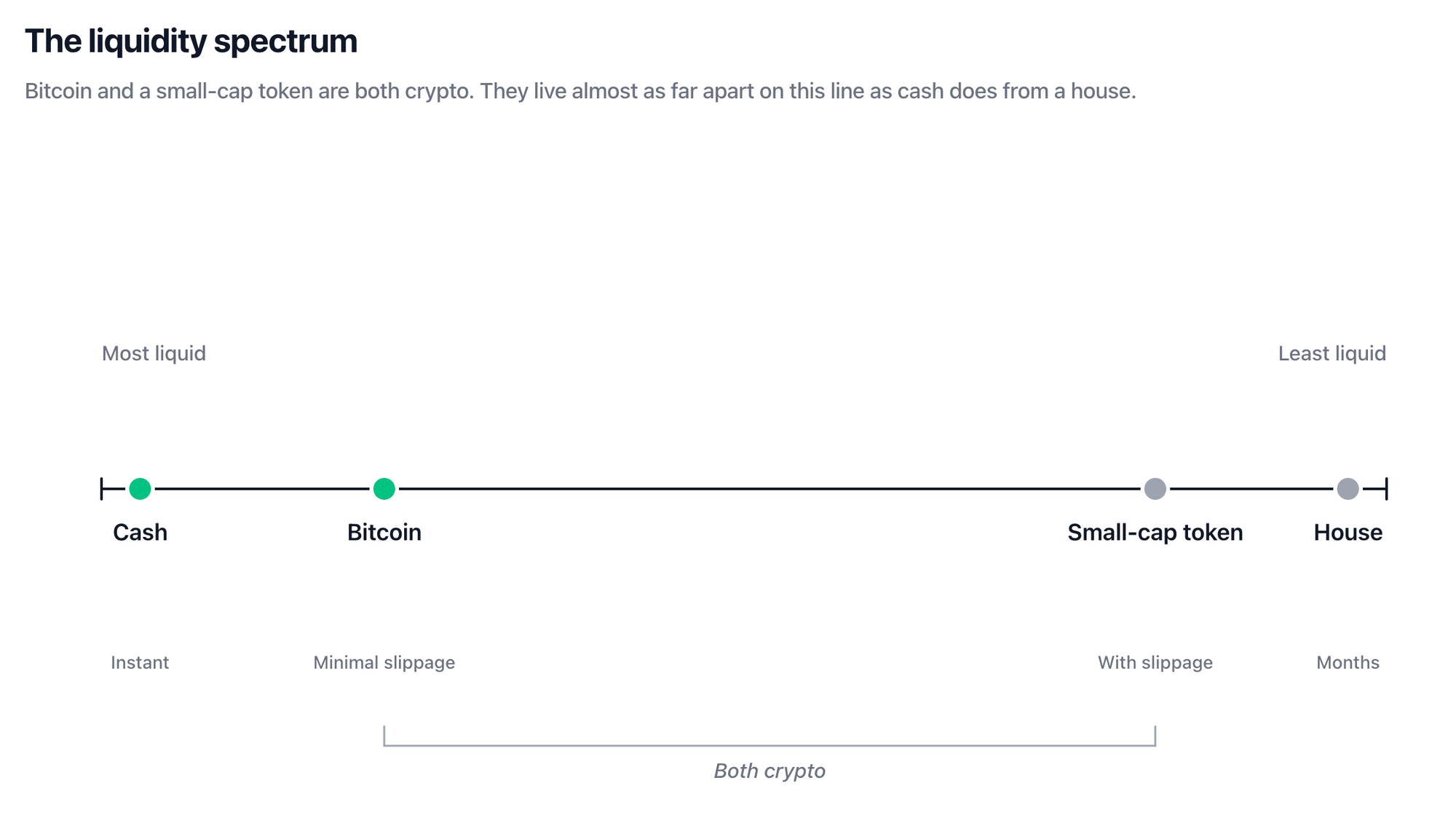
The distance between the most traded and least traded tokens is wide. A $1,000 sell can move a thin market by several percent, and that cost lands in the amount received rather than in any fee line.
Key takeaways
- Liquidity describes how much of an asset can be traded near its quoted price, and market depth measures that more directly than 24-hour volume.
- Price impact is the difference between a market's mid price and the price at which a trade executes
- A $1,000 sell into a constant product pool holding $50,000 of reserves executes about 3.8% below the quoted price before fees. The same sell into a pool holding $500,000 costs about 0.4%.
- DEX Screener publishes pool size and 24-hour volume for individual pairs, and CoinGecko publishes volume broken down by exchange.
How is crypto liquidity measured?
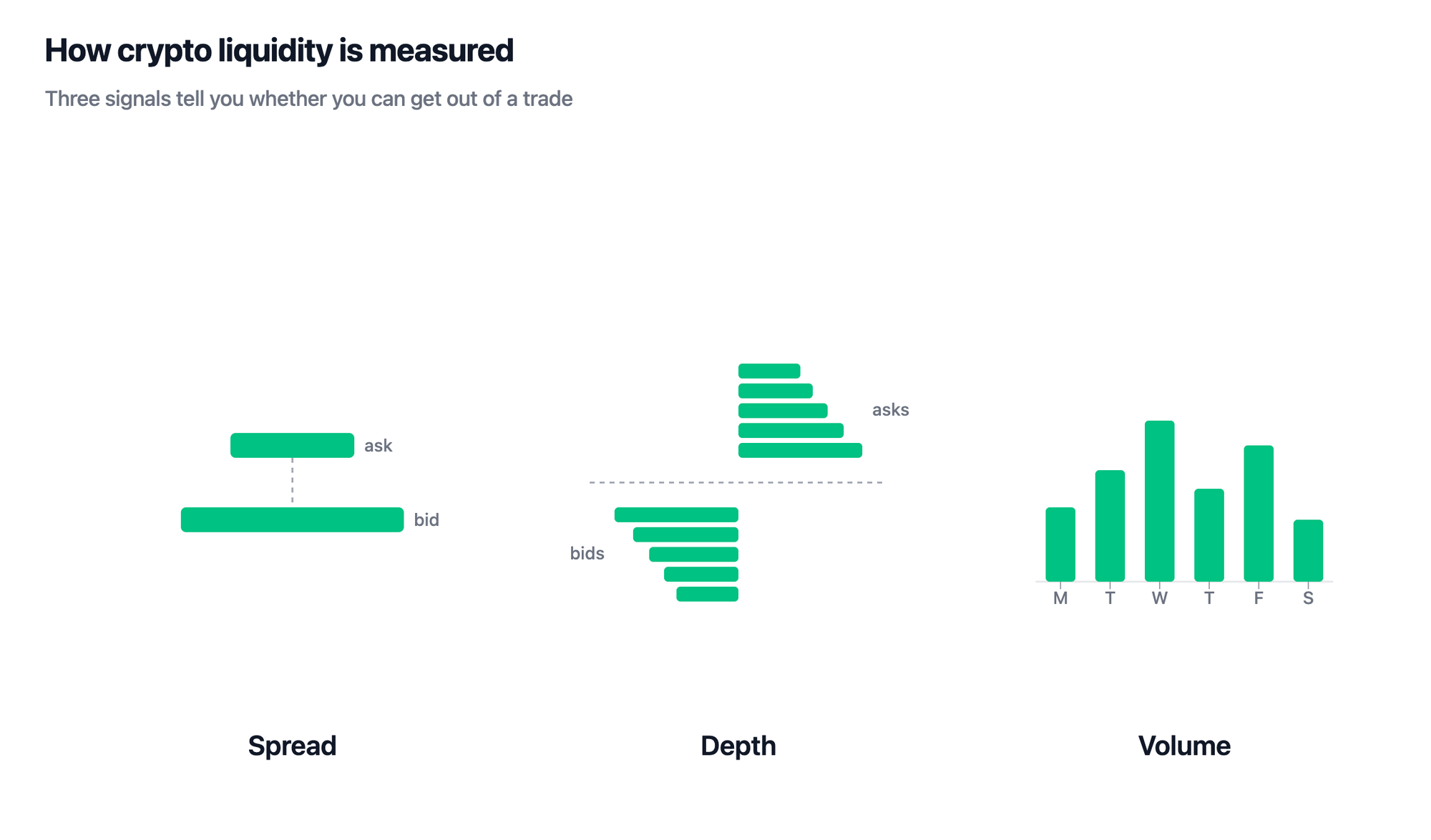
Three signals describe a market's liquidity: the bid-ask spread, the depth of the book or pool, and 24-hour trading volume. Depth is the most direct of the three, because it states how much can be bought or sold before the price moves. Spread and volume support that reading.
| Signal | Where it appears | What a liquid market looks like |
|---|---|---|
| Bid-ask spread | Centralized exchange order book, quoted as the gap between the highest bid and the lowest ask | Hundredths of a percent on the largest pairs, widening to whole percentage points on thinly traded tokens |
| Market depth | Order book depth on a centralized exchange, pool reserves on a decentralized exchange | Reserves or resting orders many times larger than the size of the intended trade |
| 24-hour volume | Exchange listings, CoinGecko, DEX Screener | Steady daily volume across several venues rather than a single spike on one pair |
Depth is the reading most retail investors skip. A token can quote a tight spread and still fail to absorb a larger order, because the quote only covers the first few hundred dollars of size.
What is the difference between price impact and slippage?
Price impact is the difference between the mid price of a market and the execution price of a trade. Slippage is the amount the price moves between the moment a transaction is submitted and the moment it executes. Both definitions come from Uniswap's protocol documentation, and both costs are larger in thin markets.
Price impact is caused by the trade itself. A large buy consumes the sell-side liquidity near the quote and a large sell consumes the buy-side liquidity, so the average executed price sits away from the quote. Slippage adds whatever the market did between submission and settlement. Most decentralized exchange interfaces let a trader set a maximum slippage tolerance, which cancels the trade if the final price falls outside that range. Slippage in crypto covers those settings.
Where does crypto liquidity come from?
Liquidity reaches a crypto asset through two market structures. Centralized exchanges such as Coinbase, Binance, and Kraken run order books, where trading firms called market makers post continuous buy and sell quotes and earn the spread between them. Competition between those firms keeps quotes tight on the assets they cover. Many pairs on these venues are quoted against a stablecoin rather than a national currency, which is why USDC and USDT carry heavy volume.
Decentralized exchanges hold reserves instead of orders. Anyone can deposit two assets into a pool, and trades execute against those reserves at a price set by a formula. Uniswap's pools use the constant product formula, written as x times y equals k, which means larger trades relative to pool depth move the price more. The same pooled-capital structure appears in DeFi lending, where depositors supply assets to a shared pool that borrowers draw from.
Liquidity is also concentrated in a small number of assets. CoinGecko listed 17,630 crypto assets on 23 July 2026. The two largest stablecoins and the two largest cryptocurrencies took the top four places by 24-hour trading volume that day, ranging from $42.9 billion down to $9.8 billion. The 50th asset on the same list traded $89 million.
What does thin liquidity cost on a $1,000 trade?
The constant product formula makes the cost of thin liquidity calculable in advance. Take a pool holding $25,000 of a token and $25,000 of a stablecoin, so the token is quoted at $1.00 and reserves total $50,000. Selling 1,000 tokens into that pool returns $961.54, which is 3.85% below the quoted $1,000. The 0.30% swap fee charged by Uniswap v2 pools brings the proceeds to $958.76, a total cost of 4.12%.
Run the same sell against a pool holding $250,000 on each side. The proceeds are $996.02 before fees, a cost of 0.40%, and $993.04 after the same fee. The trade is identical in both cases. The second pool is ten times deeper, and the price impact falls by roughly the same factor.
| Pool reserves | Proceeds on a $1,000 sell, before fees | Cost as a percentage | Proceeds after a 0.30% swap fee |
|---|---|---|---|
| $50,000 total ($25,000 each side) | $961.54 | 3.85% | $958.76 |
| $500,000 total ($250,000 each side) | $996.02 | 0.40% | $993.04 |
Figures calculated from the constant product formula, with the Uniswap v2 fee of 0.30% applied to the input amount. Uniswap v3 pools instead use fee tiers of 0.01%, 0.05%, 0.30%, and 1%, and v4 pools can be created at any fee. Network gas fees apply on top of both figures.
Does high trading volume mean a token is liquid?
High 24-hour volume is a supporting signal rather than a measure of liquidity. Volume records what has already traded. Depth records what can be traded now, near the quote, which is what an investor needs before placing an order.
Volume and depth separate in two common cases. A token can post a large one-day figure driven by a single event, then trade in a market where a $5,000 order moves the price several percent. Reported volume can also be inflated by wash trading, in which the same funds are traded back and forth to create the appearance of activity. Pool reserves are harder to fake, because the capital has to be present to be counted.
How can someone check a token's liquidity before buying?
A liquidity check takes four readings and about a minute.
- Look up the token's pool size or order book depth on CoinGecko or DEX Screener and compare it against the intended trade size. A sell equal to 1% of a pool's reserves of that token executes about 1% below the quoted price before fees, and the cost climbs from there.
- Check how many venues carry meaningful volume. A single pool on a single network is a concentration risk.
- Read the quoted price impact in the trading interface before confirming the trade.
- Set a slippage tolerance that reflects the depth found in step one.
Some investing apps run part of this check inside the interface. Glider marks assets with thin liquidity or low market capitalization with a warning naming the higher slippage and price impact those assets carry, so the reading appears at the point of the decision.
Crypto liquidity is the depth of capital standing on both sides of a market at a given moment. It determines the difference between the price on screen and the price received, it can be measured before a trade rather than discovered after one, and on a decentralized exchange it can be calculated exactly from the size of the pool and the size of the order.
FAQ
What does liquidity mean in crypto?
Liquidity in crypto is how easily an asset can be bought or sold near its quoted price. It comes from resting orders in an exchange order book or reserves in a liquidity pool. Bitcoin and Ethereum absorb large orders with small price moves, while thinly traded tokens move noticeably on small orders.
What is the most liquid cryptocurrency?
Tether posts the highest 24-hour trading volume of any crypto asset, because most other pairs are quoted against it. Among assets held as investments, Bitcoin is the most liquid, with the deepest order books and the highest volume, followed by Ethereum. On 23 July 2026 Bitcoin traded $28.0 billion against Ethereum's $9.8 billion.
How do I check if a crypto is liquid?
Three readings answer the question. The bid-ask spread shows the cost of entering and exiting immediately, and appears in the exchange's own order book. Market depth, shown as pool reserves on DEX Screener, shows how much can be traded before the price moves. The 24-hour volume, on CoinGecko, shows how active the market has been.
What is a good liquidity pool size for a token?
Pool size is judged against trade size rather than against a fixed threshold. Under the constant product formula, a sell equal to 1% of a pool's reserves of a token executes about 1% below the quoted price, and a sell equal to 4% of reserves executes about 3.85% below it. Cost rises faster than order size.
This article is for educational purposes only and is not investment, financial, tax, or legal advice. Crypto assets are volatile and carry risk, including the loss of the full amount invested. Figures are illustrative calculations from the constant product formula and do not describe any specific token or trade.