What Is Price Impact in Crypto Trading?
Price impact is the change in an asset's price caused by the trader's own order. A buy order takes the supply available at the current price, then reaches for supply priced higher, and the price rises as the order fills. The size of the move depends on how large the order is compared with the market absorbing it.
Every market has price impact. In most pool-based onchain venues the pricing formula is public, so the impact of an order can be calculated to the cent before it is placed.
Key takeaways
- Price impact appears in order books and liquidity pools alike, caused by the trader's own order rather than by the market moving.
- In a constant product pool it equals the order size divided by that size plus the pool's balance of the asset being spent.
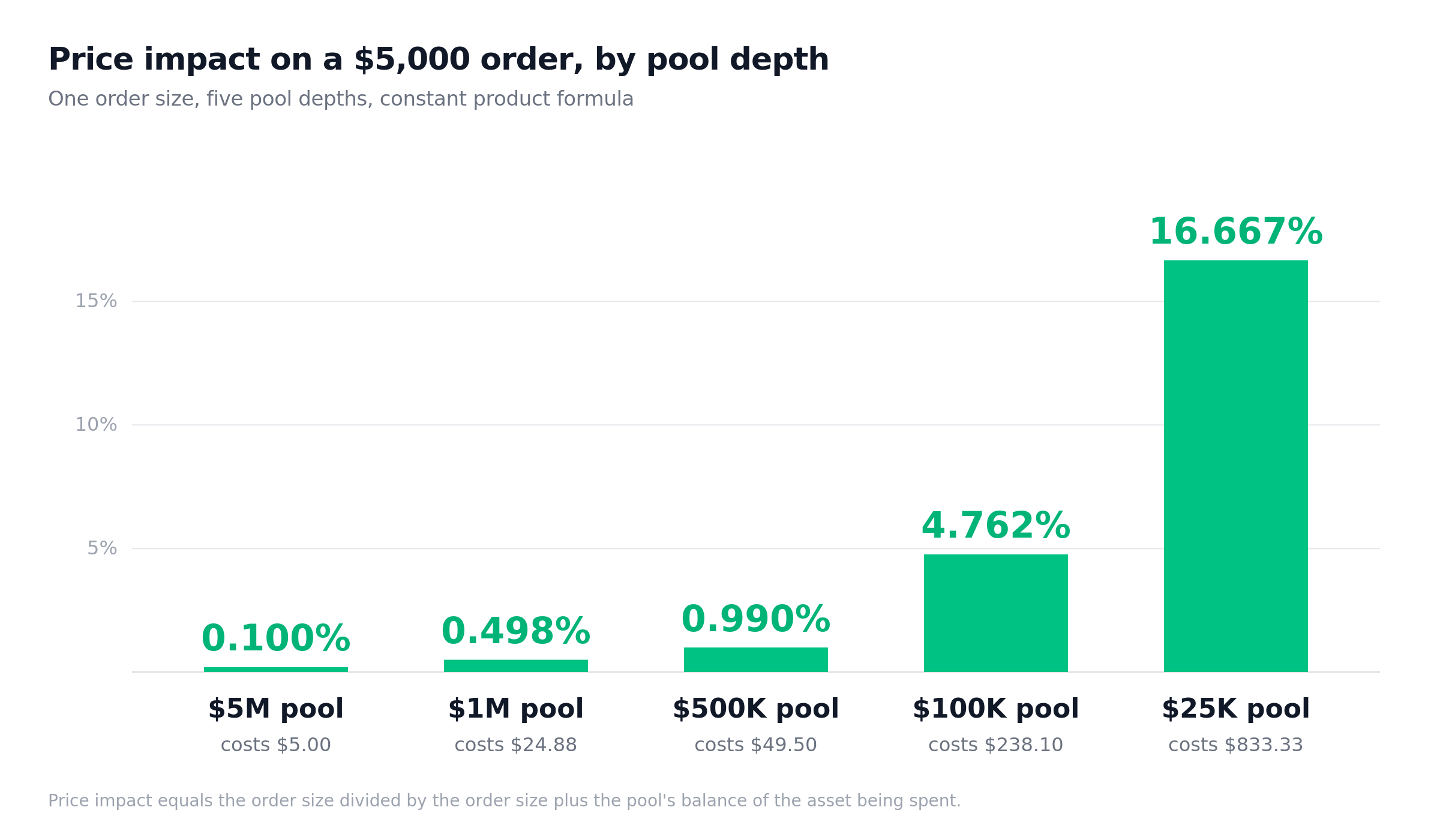
- A $5,000 purchase costs about $5 against a pool holding $5 million a side and $833 against one holding $25,000 a side.
- Splitting an order into ten pieces sent to one pool at once returns the identical number of tokens.
How does price impact work?
A trade is an exchange of one asset for another at a price both sides accept. Onchain it settles in one of two places. An order book is a running list of the buy and sell offers other traders have posted, with the quantity available at each price. A liquidity pool is a pot of two assets supplied by investors, where a formula sets the exchange rate from how much of each the pot holds.
Price impact looks the same in both. The price quoted before the order is one number, the average price the order pays is a worse number, and the gap widens as the order grows against what the venue can absorb.
The two examples below use illustrative figures. In each, a token starts at $1.00 and one buyer places a single order that nobody else competes with. The order sizes differ, 400 tokens in the order book and $100,000 in the pool.
How it appears in an order book
- The book lists offers at rising prices: 100 tokens at $1.00, 200 at $1.01 and 500 at $1.02.
- A buy order for 400 tokens takes all 100 units at $1.00 and all 200 at $1.01.
- The last 100 come from the $1.02 level.
- The total paid is $404, an average of $1.01 per token.
- The best offer beforehand was $1.00, so the price impact is 1%.
- Those offers stay gone until a market maker posts replacements.
How it appears in a liquidity pool
- The pool holds 1,000,000 units of a token and 1,000,000 USDC. Since the two balances are equal, the pool prices the token at $1.00.
- The formula keeps the product of the two balances constant, so any change to one balance forces a change in the other.
- A buyer spends $100,000, taking the USDC balance to 1,100,000.
- To hold the product constant, the token balance falls to 909,090.91.
- The buyer receives 90,909.09 tokens, an average price of $1.10.
- The price beforehand was $1.00, so the price impact is 9.09%.
- The pool's price finishes at $1.21, where the next buyer starts.
Price impact in a pool of this type equals the order size divided by the order size plus the pool's balance of the asset being spent: $100,000 divided by $1,100,000, or 9.09%. Constant product is one pool design among several. Pools built for assets meant to hold the same value, such as two dollar stablecoins, use a formula like Curve's stableswap, which keeps impact far flatter near that shared price.
| Feature | Order book | Liquidity pool |
|---|---|---|
| Where the depth comes from | Offers posted by market makers, withdrawable at any moment | Funds committed by liquidity providers, in place until removed |
| What the order leaves behind | An emptier book until new offers are posted | A changed ratio between the two balances, which is the new price |
| How the price recovers | New offers arrive at the old level | Traders arbitrage the pool against other venues until the gap closes |
What is the difference between price impact and slippage?
Price impact is the part of the cost the trader causes. Slippage is the total gap between the price shown at confirmation and the price the trade filled at, and price impact is one component of it.
| Feature | Price impact | Slippage |
|---|---|---|
| What it measures | The price move caused by the order itself | The full difference between the expected price and the filled price |
| What causes it | The order's size against the depth of the pool | Price impact, plus market movement and other orders during settlement |
| Direction | Always against the trader | Usually against the trader, occasionally in favor |
| Visible before confirming | Yes, calculated and displayed by most trading interfaces | No, only the tolerance limit can be set in advance |
| What controls it | Order size and pool depth | A slippage tolerance setting, which cancels the trade if the gap exceeds it |
A high slippage figure on a small order during calm trading points at thin liquidity in the pool. The same figure during a sharp market move points at volatility instead.
How much price impact is normal?
Price impact describes the venue an order reaches rather than the token being bought, so it varies from one trade to the next. Two people buying the same asset for the same amount on the same day can pay different average prices, because each order meets whatever depth happens to sit in the pool it routes to. No single percentage counts as normal.
The variation is wide. A $5,000 purchase costs about $5.00 against a pool holding $5 million of each asset and $833.33 against one holding $25,000, on the same formula. Only the figure a trading interface shows before confirmation describes the trade in front of it.
Does splitting an order reduce price impact?
Only when the pieces reach different pools or arrive at different times. Ten purchases of $10,000 sent into the pool above at once return 90,909.09 tokens in total, exactly what a single $100,000 purchase returns, because the constant product formula is path-independent. Adding a 0.30% fee, the Uniswap v2 default, gives 90,661.09 tokens either way. Other fee tiers run from 0.01% to 1% and change the totals without changing the result.
The two conditions that do change the outcome:
- Time. Once a pool's price moves away from other venues, traders buy where the asset is cheaper and sell where it is dearer until the gap closes, which refills the pool at the original price. Orders spaced hours or days apart meet a refilled pool each time.
- Routing. An order divided across several pools meets each pool's depth separately. A $50,000 order split evenly across five equal pools costs about what $10,000 costs in one of them.
Jean-Philippe Bouchaud of Capital Fund Management put it plainly in his 2009 paper Price Impact: for a trader, impact is "tantamount to a cost", since a second buy order is on average dearer than the first.
Can price impact be created on purpose?
Yes. A sandwich attack is a pair of trades built around somebody else's pending order. Orders on a public blockchain wait in a queue before settling, so a trader who spots a large buy waiting can purchase the same asset first, let the pending order fill at the raised price, then sell immediately after. The first trade manufactures price impact and the second collects it.
The order still fills, because the loss sits inside the slippage tolerance its owner set. A tighter tolerance caps how much can be taken, since an attack large enough to breach it cancels the trade.
How can price impact be kept small?
Price impact is kept small by matching the order size to the depth of the pool it will reach. Both are known before the trade is confirmed.
- Check the pool's depth before choosing the order size. CoinGecko and DEX Screener list pool sizes per trading pair, and the figure that matters is the balance of the asset being spent.
- Size the order against that depth, not against the account balance. An order worth under 0.1% of the spent-side balance keeps impact under a tenth of a percent.
- Buy in instalments rather than in one order. A position built through dollar-cost averaging meets a refilled pool each time, which is the version of splitting that works.
Price impact is the price move a trade causes on itself. In an order book it comes from working up through the offers; in a pool it follows from the formula pricing the two balances. The depth an order reaches sets the cost, so the same asset produces a different figure in a different venue.
FAQ
Does price impact apply to tokenized stocks and Treasuries?
Not in the same way. Tokenized stocks on Ondo Stocks are created and redeemed against shares held at regulated US firms rather than bought from a pool, so pricing follows the exchange those shares trade on. That runs around the clock for six of the most traded tokens and on a weekday schedule for the rest. These tokens are available to non-US persons only.
Is price impact a fee?
No. A fee is charged by a platform or paid to liquidity providers and appears as a stated percentage of the trade. Price impact is a worse execution price produced by the order's own size, and nobody collects it as revenue.
Can price impact be seen before a trade?
Yes. Trading interfaces calculate it from the pool's current balances and show it on the confirmation screen, often as a warning above a set percentage. MetaMask labels it a price difference. Routes filled by a solver show a quoted price instead of a calculated impact figure.
Does price impact apply to automated rebalancing?
Yes. A rebalance executes trades, and each trade meets the depth of the pool it reaches. Impact is calculated per trade rather than across the portfolio, so an app such as Glider, which returns a portfolio to its target mix on a cadence the user chooses, is moving several small amounts through separate pools rather than one large amount through one.
This article is for educational purposes only and is not investment, tax, or legal advice. Onchain investing carries risk, including the loss of capital. Tokenized stocks and ETFs are not available to US persons.