PAXG vs XAUT: How the Two Gold Tokens Compare
PAXG and XAUT are tokenized gold tokens that each represent one troy ounce of vaulted gold. They differ in issuer, regulation, fees, and which countries can buy them.
PAXG and XAUT are two tokenized gold tokens that each represent one fine troy ounce of physical gold held in a professional vault. PAXG is issued by Paxos, with gold vaulted in London. XAUT is issued by a Tether subsidiary, with gold vaulted in Switzerland. Both trade on major exchanges and differ mainly in issuer, regulation, fees, and which countries can buy them.
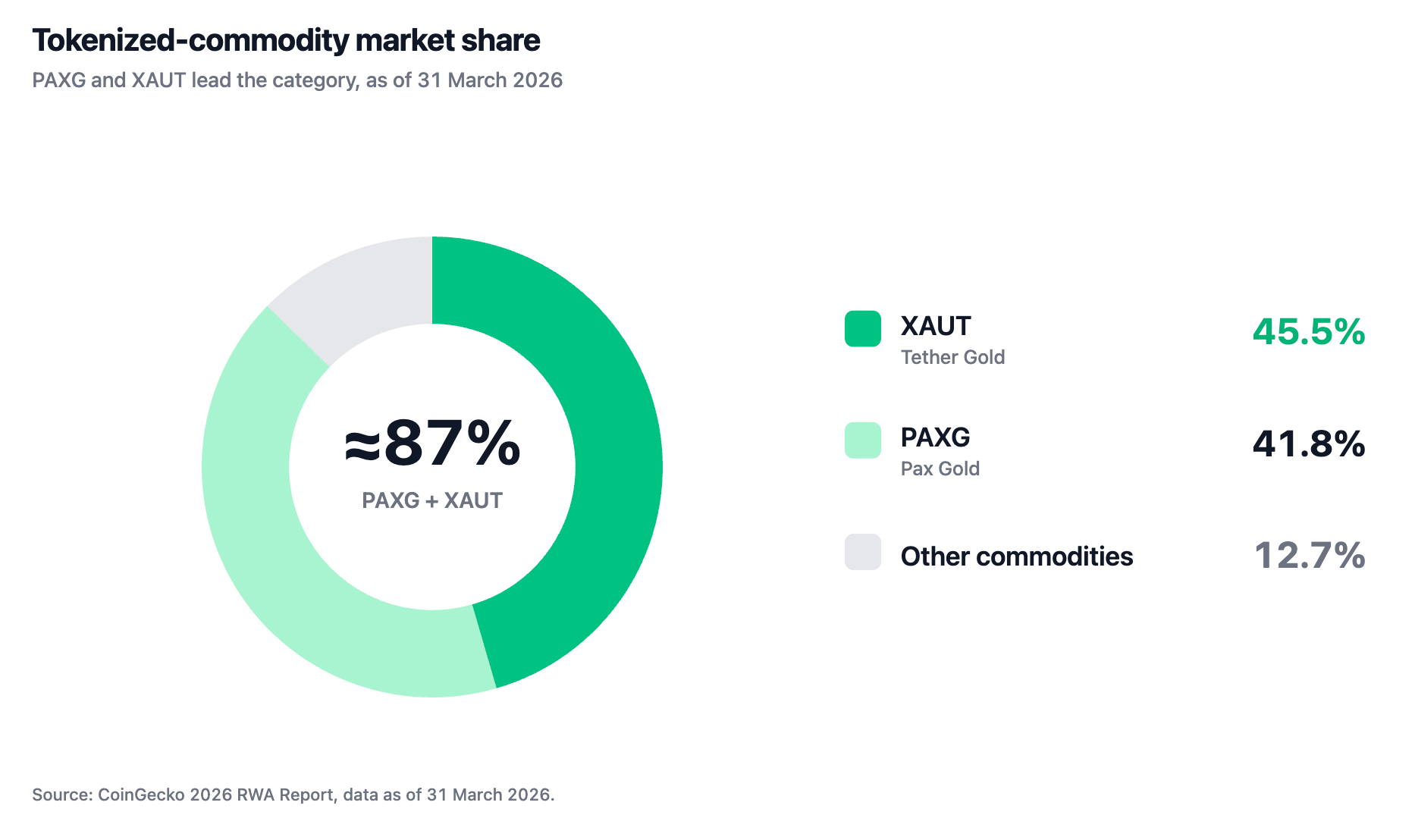
PAXG and XAUT are the two largest tokenized gold products, together close to 87% of the tokenized-commodity market, with XAUT the larger by market value and daily trading volume, according to CoinGecko's 2026 RWA report. For many buyers the choice narrows on region first, because the two tokens are not sold in the same countries.
Key takeaways
- Both PAXG and XAUT are backed one-for-one by an LBMA Good Delivery gold ounce and track the spot gold price.
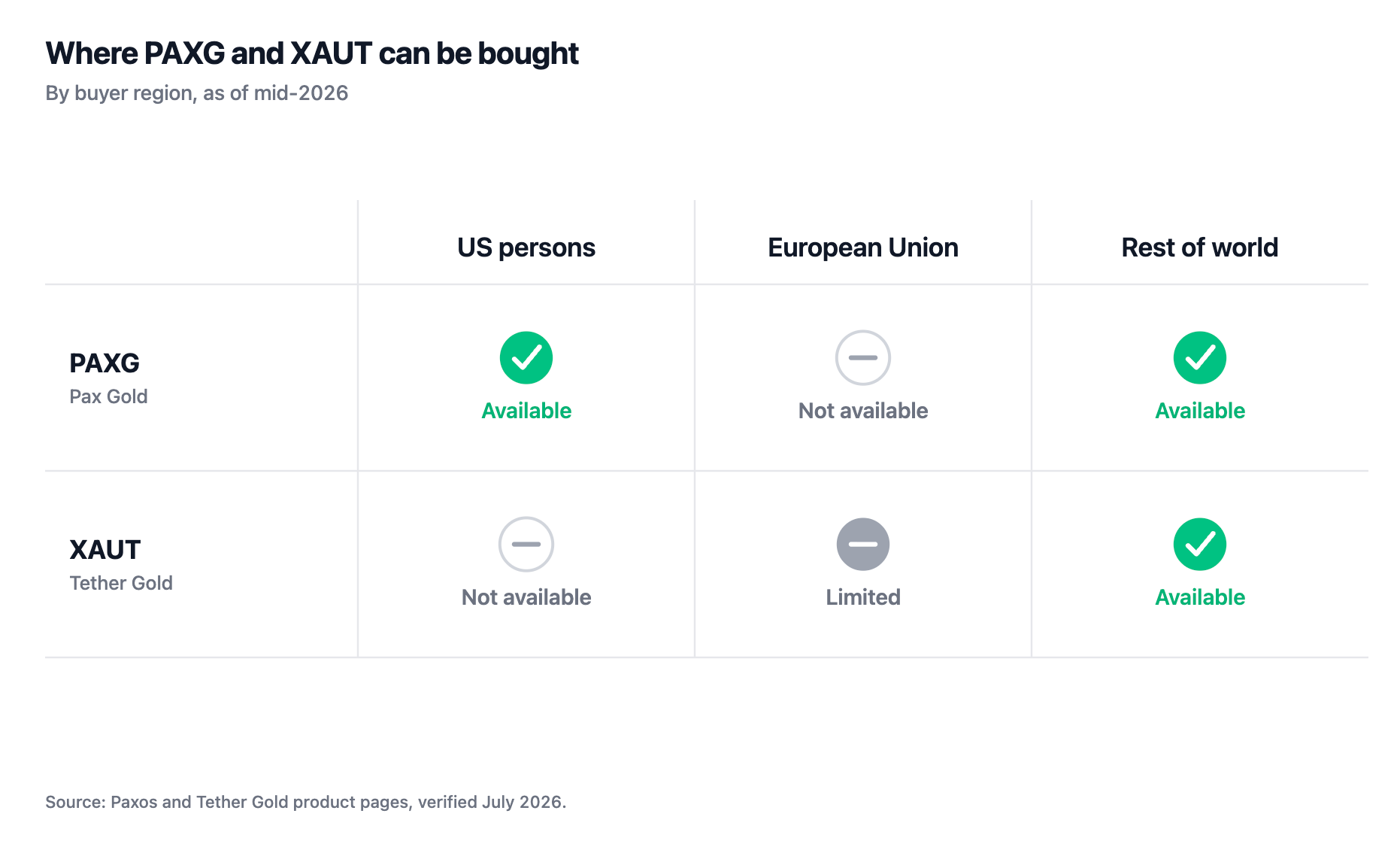
- PAXG is offered to US and global retail. It is currently unavailable in the European Union. XAUT is not offered to US persons.
- PAXG charges no on-chain transfer fee and no storage fee. XAUT charges a one-time 0.25% at purchase or redemption.
- Physical redemption on either token requires about 430 tokens, one full gold bar worth more than $1.7 million at mid-2026 gold prices.
What is the difference between PAXG and XAUT?
PAXG and XAUT hold the same asset to the same standard: one troy ounce of London Good Delivery gold per token, held in an allocated vault. The differences sit around that gold. The two tokens have different issuers, different regulators, different vault countries, and different fees, and each is sold to a different set of countries.
| Feature | PAXG (Pax Gold) | XAUT (Tether Gold) |
|---|---|---|
| Issuer | Paxos Trust Company, a US national trust company | TG Commodities, a Tether subsidiary |
| Regulator | US Office of the Comptroller of the Currency; originally chartered in New York | Not a US or EU financial regulator; authorized in El Salvador |
| What backs it | One troy ounce of LBMA Good Delivery gold, vaulted in London | One troy ounce of LBMA Good Delivery gold, vaulted in Switzerland |
| Blockchains | Ethereum and Solana | Ethereum and Tron, with an omnichain version on more networks |
| Direct fees | No transfer fee, no storage fee; a small creation fee when minted at Paxos | 0.25% one-time at purchase or redemption; no custody fee |
| Smallest direct purchase | 0.01 PAXG | 50 XAUT |
| Physical redemption | About 430 PAXG, delivered in the UK | About 430 XAUT, delivered in Switzerland |
| Sold to US persons | Yes | No |
| Sold in the EU | Currently no | Limited under MiCA |
Who issues each token, and where is the gold held?
Paxos Trust Company issues PAXG and is regulated by the US Office of the Comptroller of the Currency as a national trust company. PAXG launched in 2019 under a New York State trust charter, and Paxos later converted to the federal OCC charter it operates under now. The gold sits in Brink's vaults in London, meets the London Good Delivery standard, and is held as allocated bars, meaning specific serial-numbered bars assigned to holders. An accounting firm attests the reserves each month.
XAUT is issued by TG Commodities, a Tether subsidiary that no US or EU financial regulator oversees and that is authorized in El Salvador. Its gold is held in allocated form in Swiss vaults, with reserve reports and a live holdings dashboard. In both products the token is a claim on the issuer, and the attestations exist so a shortfall would be visible.
What are the fees for PAXG and XAUT?
PAXG and XAUT cost almost the same to hold, and neither charges an annual or storage fee. The main difference is the fee to buy or redeem directly from the issuer: XAUT charges a flat 0.25%, about $25 on a $10,000 purchase, while PAXG charges a small creation fee that varies with order size.
PAXG charges no on-chain transfer fee and no storage fee. Its creation fee applies only when tokens are minted or burned directly through a Paxos account and does not apply when PAXG is bought or sold on an exchange. Paxos ran a creation-fee waiver that ended in March 2026, so the standard schedule now applies to direct mints.
XAUT charges a one-time 0.25% fee at purchase or redemption directly from the issuer and no ongoing custody fee. New direct accounts also pay a 150 USDT verification deposit. On a secondary exchange, both tokens trade at a market spread, so for most buyers the cost is that spread rather than either issuer fee.
Can PAXG or XAUT be redeemed for physical gold?
Both tokens can be redeemed for physical gold. Redemption requires about 430 tokens, the size of one full London Good Delivery bar, the roughly 400-ounce gold bar used in the wholesale market. At gold prices near $4,000 an ounce in mid-2026, one bar is worth more than $1.7 million.
Below that amount, both issuers let a holder convert tokens to cash at the gold price instead. Direct purchases from Tether start at 50 XAUT. Most holders buy and sell the token on an exchange at the market price rather than redeem it for a bar.
Which blockchains are PAXG and XAUT on?
PAXG runs on Ethereum and, since June 2026, on Solana. XAUT runs on Ethereum and Tron, and a separate omnichain version extends it to further networks including TON, Solana, and Polygon. The network matters for two reasons. It sets the transfer cost, which is low on Tron and Solana and higher on Ethereum, and it decides which wallets, exchanges, and apps can hold the token. A buyer who already works on Tron leans toward XAUT, and a buyer on Solana can now hold either.
Is PAXG or XAUT available in the US and EU?
PAXG is offered to US and global retail. It is currently unavailable in the European Union, where no asset-referenced token of its type has been approved under the MiCA regime. XAUT is not offered to US persons, and its access in the European Union is limited under the same MiCA rules. This is the first thing to check, because a buyer's country often removes one of the two tokens from the decision entirely.
PAXG or XAUT: which one to buy?
A few clear differences drive the decision between PAXG and XAUT:
- Availability: PAXG is sold to US and global retail but not in the EU. XAUT is not sold to US persons. A buyer's country often settles the choice on its own.
- Issuer and regulation: Paxos, which issues PAXG, is a US OCC-regulated trust company. TG Commodities, which issues XAUT, is a Tether subsidiary that no US or EU financial regulator oversees.
- Vault country: PAXG's gold sits in London, XAUT's in Switzerland.
- Network: PAXG runs on Ethereum and Solana. XAUT runs on Ethereum and Tron, with an omnichain version reaching further networks. A buyer already working on Tron may prefer XAUT.
- Size and trading: XAUT is the larger token by market value and daily volume. It held about 45.5% of the tokenized-commodity market as of 31 March 2026, against 41.8% for PAXG, per CoinGecko's 2026 RWA report. Deeper trading can mean a tighter spread when buying or selling.
No token leads on every measure. Availability decides the choice for many buyers, and where both are available, it comes down to which issuer and vault a buyer trusts and which networks they use.
How to hold tokenized gold
Tokenized gold can be held in any wallet or app that lists it. On Glider, a user can hold both PAXG and XAUT in their own wallet, with no separate gas token required, and fund the account with any token or a card.
PAXG and XAUT are the same asset in two wrappers: one troy ounce of London Good Delivery gold, held in an allocated vault and tracked by a token. The gold and its price risk are identical in both. What differs is the issuer and its regulator, the country the vault sits in, the blockchains each runs on, the one-time fee to buy in, and the countries each is sold to. For most buyers, availability narrows the choice to a single token, and issuer trust, vault country, and network settle the rest.
Frequently asked questions
Which is bigger, PAXG or XAUT?
XAUT is the larger of the two. It held about 45.5% of the tokenized-commodity market as of 31 March 2026, against 41.8% for PAXG, according to CoinGecko's 2026 RWA report. Together the two tokens made up close to 87% of that market. XAUT also reports higher daily trading volume.
Does PAXG or XAUT pay interest or yield?
No. Both tokens track the price of gold and nothing else. Gold pays no interest or dividend, so neither token produces income. A holder's return comes only from a change in the gold price, which can move up or down.
Is PAXG or XAUT safer to hold?
Each token is a claim on its issuer, so the issuer is the main risk. Both hold allocated gold in LBMA vaults and publish attestations that let holders check the backing. PAXG is overseen by the US OCC. XAUT is not overseen by a US or EU financial regulator.
This article is for educational purposes only. It is not financial, tax, or investment advice. Tokenized assets carry risk, including the loss of capital. Anyone considering them should do their own research and consider consulting a licensed professional.