How to Invest in US Stocks from Nigeria

There are three ways to invest in US stocks from Nigeria: an SEC-licensed Nigerian investing app, tokenized US stocks held in a personal wallet, or a fund that holds US assets. A Nigerian resident can legally use any of them. The routes differ in what the investor owns, how it is funded, what it costs, and how it is taxed.
The three Nigerian platforms that sell US shares all now hold Securities and Exchange Commission registration. Inflation was 15.91% in June 2026 and the policy rate stood at 26.50% in July, so naira deposits currently pay a positive real return. The naira has also strengthened against the dollar since January. The case for US shares rests on reaching companies with no Nigerian listing and on holding assets priced in dollars. Investors in India, Indonesia and the Philippines reach US stocks through a similar set of routes, with different funding rails and tax rules.
Key takeaways
- Interactive Brokers does not accept clients resident in Nigeria, which closes the international brokerage route most Nigerian guides still recommend.
- US dividend withholding is a flat 30% for Nigerian investors, because there is no US-Nigeria tax treaty to reduce it.
- The Nigeria Tax Act 2025 taxes residents on worldwide gains at progressive rates reaching 25%, replacing the former flat 10% capital gains tax.
- Foreign dividends repatriated into Nigeria through government-approved channels are exempt from Nigerian tax.
- US estate tax starts at $60,000 of US assets and reaches 40%, and Nigeria has no estate tax treaty with the United States.
Is it legal to invest in US stocks from Nigeria?
Yes. A Nigerian resident may hold foreign securities and use a platform that offers them. The registration requirement applies to the platform rather than the investor. Income and gains are reported on the Nigerian tax return.
The Securities and Exchange Commission declared Bamboo, Trove, Chaka and Risevest illegal in April 2021 for offering foreign securities without registration. All have since come inside the framework. Bamboo holds a digital sub-broker licence. Trove acquired an SEC-licensed broker-dealer in January 2026. Risevest secured a Fund and Portfolio Manager licence in February 2026, after the Commission warned the public against the platform in early 2025. Chaka was acquired by Risevest in 2023 and is no longer the app for a new account.
The Investments and Securities Act 2025 classifies digital assets as securities under SEC jurisdiction, which brings the tokenized route into scope. The Commission has not registered any platform to offer tokenized US equities to Nigerian clients.
The three routes compared
Every route converts naira into dollars, and the rate applied is usually the largest cost. A ₦1,000,000 order converts to about $734 at the Central Bank rate of ₦1,362.09 on 24 July 2026, and to less at the rate an app or exchange quotes.
| Nigerian investing app | Tokenized stocks | Fund holding US assets | |
|---|---|---|---|
| What the investor owns | Real shares held by the platform's US partner broker | A note from an offshore issuer, backed 1:1 by real shares | Units in a fund that holds the assets |
| Funded with | Naira by card or bank transfer | Naira converted to a stablecoin | Naira locally, a wire abroad |
| Minimum | From $1, fractional | Fractional, no minimum | Varies by fund |
| Visible cost | Commission up to 1.5% each way, plus a deposit fee | Exchange spread and network fee | Annual management fee |
| Protection | SIPC where the executing broker is a US member | Collateral and a security agent, no SIPC | The fund's home regulator |
| Nigerian tax on gains | Progressive rates to 25% | Progressive rates to 25%, losses ring-fenced | Progressive rates to 25% |
| US estate tax | Applies above $60,000 | Not publicly settled | Not applicable to a non-US fund |
1. A Nigerian investing app
What it is. A mobile app registered with the Nigerian SEC that sells fractional shares of US-listed stocks and ETFs in naira. Bamboo, Trove and Risevest are the three in general use. Bamboo and Trove let a customer pick individual stocks. Risevest sells managed dollar portfolios rather than single names.
How to do it. Register with a Bank Verification Number and an ID, and pass identity verification. Fund the account in naira by card or bank transfer. Buy a stock or an ETF from $1. The app converts naira to dollars internally and holds the shares through a US broker-dealer partner rather than in the customer's own name.
Advantages. This is the lowest-friction route. There is no wire, no foreign bank account, and no minimum beyond the amount invested. Trove's entry point is ₦1,000. Each platform is registered with the Nigerian SEC, so a complaint has a domestic regulator behind it.
Disadvantages. Commission is charged on both legs. Bamboo takes 1.5% on a buy and 1.5% on a sell, with a $1 minimum on each, so a round trip costs 3% before any currency spread. Trove charges no commission on US trades and earns on the conversion rate instead. Deposits carry a separate fee, and Bamboo's naira card charge is 1.4%, capped at ₦2,000.
Best for beginners who want to start in naira with the fewest steps.
2. Tokenized US stocks
What it is. A tokenized stock is a token on a public blockchain that tracks the price and reinvested dividends of a US share. It is restricted to non-US persons, so a Nigerian resident is eligible to hold one while a US resident is not. The largest issuer serving non-US investors is Ondo Global Markets, which reported more than $1 billion across over 430 tokenized stocks and ETFs in July 2026.
An Ondo token is a structured note issued by an offshore company, backed one-for-one by real shares held at a US-registered broker-dealer. Ondo's published eligibility list does not name Nigeria among the jurisdictions it prohibits or restricts.
How to do it. Convert naira into a dollar stablecoin on a licensed Nigerian exchange, where Quidax and Busha hold provisional SEC licences and not every exchange is equally safe. Move the stablecoin to a personal wallet and buy the token. An app like Glider is one way to hold them, in a portfolio that rebalances on a cadence the holder chooses.
Advantages. No brokerage account and no wire are required. Nigeria received $92.1 billion in onchain value between July 2024 and June 2025 and ranks sixth on Chainalysis's global adoption index, so the stablecoin rail is familiar to many Nigerian investors. Dividends reinvest into the token rather than paying out as cash, and tokens transfer at any hour.
Disadvantages. The token is a claim on the issuer, so recovery in a failure runs through the security agent rather than a share register. There is no SIPC cover and no shareholder vote. Nigerian tax treats the token as a digital asset rather than a share, which changes how losses can be used and puts the trade on an exchange report to the tax authority.
Best for investors who already hold a stablecoin and accept holding a note rather than a share.
3. A fund that holds US assets
What it is. Units in a fund rather than the assets themselves. A fund domiciled outside the United States, such as an Ireland-based ETF tracking the S&P 500, is bought through a foreign broker. A local mutual fund with global holdings is bought in naira through a Nigerian fund manager.
How to do it. For a non-US-domiciled ETF, open an account with a broker that accepts Nigerian residents, then send a wire. For a local fund, register with an SEC-licensed fund manager and buy in naira, with the conversion handled inside the fund.
Advantages. One purchase provides holdings across many companies. A fund domiciled outside the United States is not a US-situated asset for estate tax, which removes the $60,000 problem entirely.
Disadvantages. The investor has no control over individual holdings, and management fees compound over long periods. Few brokers that accept Nigerian residents offer non-US-domiciled ETFs.
Best for investors who want one holding rather than many, and anyone whose portfolio is large enough for US estate tax to matter.
Why international brokers are mostly closed to Nigerian residents
Interactive Brokers does not open accounts for residents of Nigeria. Its published list of available countries includes Ghana, Kenya and South Africa, and does not include Nigeria. The foreign firms that do accept Nigerian clients largely sell contracts for difference rather than shares.
A contract for difference is an agreement with a broker to settle the change in a share price. No share is bought, and the broker is the other side of the trade. The broker usually lends against the position, so losses can exceed the amount deposited. XTB, Capital.com and Pepperstone accept Nigerian clients on this basis.
Nigerian residents who want a securities account abroad generally reach one through the US entities the local platforms partner with. Bamboo and Risevest both hold US broker-dealer licences, Risevest since February 2025.
How US stocks are taxed for Nigerian investors
The United States withholds 30% of dividends paid to a Nigerian investor, with no reduction available. The IRS treaty list names four African countries: Egypt, Morocco, South Africa and Tunisia. Nigeria is not among them, so the statutory rate applies in full. The United States generally does not tax a non-resident on the gain from selling a US share.
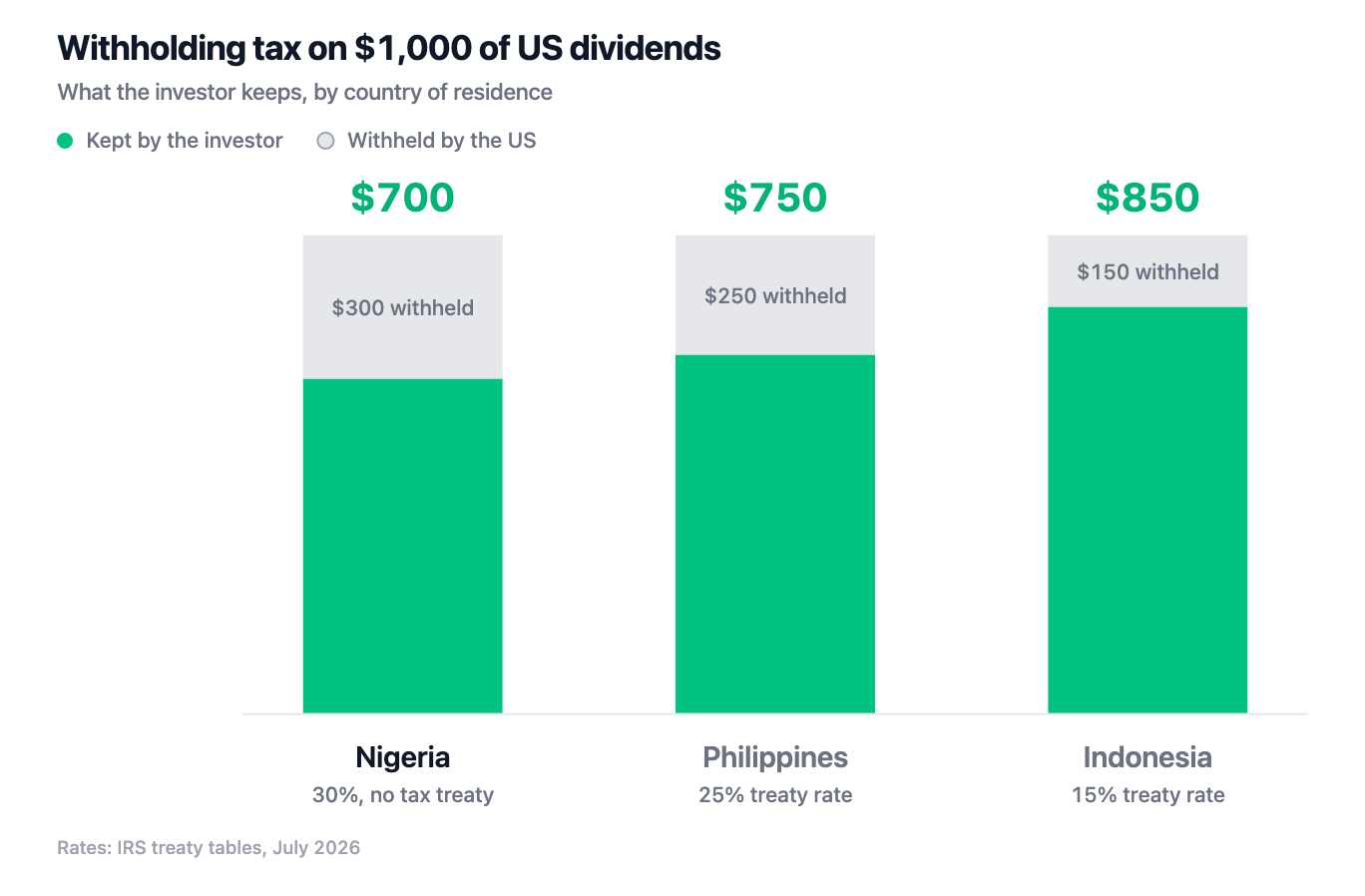
On $1,000 of US dividends a Nigerian investor keeps $700. An Indonesian investor keeps $850 under a 15% treaty rate, and a Filipino investor keeps $750 under a 25% rate. The gap comes from the treaty and applies on every route.
A Form W-8BEN is still required. It certifies non-US status and prevents withholding at higher backup rates, and for a Nigerian investor it does not lower the 30%. On tokenized stocks the withholding is applied at the issuer's custody level before dividends are reinvested, and the individual holder files no form.
What Nigeria taxes under the Nigeria Tax Act 2025
The Nigeria Tax Act 2025 took effect on 1 January 2026 and taxes residents on worldwide income and gains. The former flat 10% capital gains tax on individuals is gone: gains are added to income and taxed at the rates below. Residency turns on domicile, habitual abode, family and economic ties, or 183 days in Nigeria.
| Annual chargeable income | Rate |
|---|---|
| First ₦800,000 | 0% |
| Next ₦2,200,000 | 15% |
| Next ₦9,000,000 | 18% |
| Next ₦13,000,000 | 21% |
| Next ₦25,000,000 | 23% |
| Above ₦50,000,000 | 25% |
Dividends are treated separately. The Act exempts foreign dividends repatriated into Nigeria through government-approved channels. It also names digital assets, including security tokens, as chargeable property located in Nigeria where the owner is resident, and a loss on one can only offset a gain on another.
Relief for the 30% US withholding is not automatic where no treaty exists, and the Act's exemption thresholds for share disposals were drafted around shares in Nigerian companies. Both are worth putting to a Nigerian tax professional before a large disposal.
The $60,000 estate tax rule
A non-resident who dies holding US-situated assets receives a US estate tax exemption of only $60,000. Above that, the tax reaches 40%, and the executor files Form 706-NA within nine months of death. The threshold is not adjusted for inflation, and the One Big Beautiful Bill Act left it unchanged while setting the exemption for US citizens at $15 million.
US-situated assets include shares in US companies, US-domiciled ETFs, and cash in a US brokerage account. Holding them through a foreign platform does not change that status. The United States has estate tax treaties with fifteen countries, and Nigeria is not among them. A fund domiciled outside the United States falls outside the definition.
The three routes track the same US prices and grant different rights, costs and tax treatment. A Nigerian investing app is the quickest start in naira and the only route with a domestic regulator behind it. A tokenized stock reaches the market through a wallet, and carries the digital-asset tax rules with it. The flat 30% dividend withholding applies on all three, set by the absence of a US-Nigeria tax treaty.
Frequently asked questions
Can Nigerians legally invest in US stocks?
Yes. A Nigerian resident may hold foreign securities and use a platform that offers them. The registration requirement applies to the platform rather than the investor. Bamboo, Trove and Risevest are all now registered with the Nigerian Securities and Exchange Commission, following the Commission's 2021 finding that unregistered platforms were operating illegally.
Does Interactive Brokers work in Nigeria?
No. Interactive Brokers does not open accounts for residents of Nigeria, and Nigeria is absent from its published list of available countries, which includes Ghana, Kenya and South Africa. Foreign brokers that do accept Nigerian clients mostly offer contracts for difference, which track a share price without buying the share.
How much US tax is withheld on dividends for a Nigerian investor?
A flat 30%, with no reduction available. Treaty rates lower that figure for residents of countries holding a US income tax treaty, and Nigeria is not one of them. A Form W-8BEN certifies non-US status but does not reduce the rate. On $1,000 of dividends, $300 is withheld.
Are US stock gains taxable in Nigeria?
Yes. The Nigeria Tax Act 2025 taxes residents on worldwide gains from 1 January 2026, at the same progressive rates as income, reaching 25%. Gains on tokenized stocks fall under the Act's digital-asset rules, where a loss can only offset a gain on another digital asset.
Does US estate tax apply to Nigerian investors?
Yes, above $60,000 of US-situated assets, which include US shares, US-domiciled ETFs and cash in a US brokerage account, wherever the platform is located. Rates reach 40%, and Nigeria has no estate tax treaty with the United States. Funds domiciled outside the US fall outside the definition.
This article is for educational purposes only. It is not financial, legal, investment, or tax advice, and not a recommendation to buy or sell any asset. Tax treatment depends on individual circumstances and on rules that change, so anyone investing across borders should consult a qualified tax professional in Nigeria. Tokenized equities are not available to US persons. Figures are accurate as of the date shown.