
What Is a Crypto Wallet? A Plain Guide to How They Work
Owning crypto comes with one decision most people take lightly, which is who has access to your keys. A crypto wallet is the tool that holds those keys. It does not actually hold your coins, since those live on the blockchain itself, and the wallet is what proves the coins are yours and lets you move them. Almost everything else about a wallet, the type, the brand, the look of the app, matters less than that one question of who controls the keys. This guide covers what a crypto wallet really is, what the main types are, and the custodial versus non-custodial split that sits underneath all of them and quietly decides how much of your crypto is actually in your hands.
What a crypto wallet actually holds
A crypto wallet does not actually store your crypto. Your coins exist as entries on a blockchain, a shared record kept across thousands of computers, and they never leave it. What the wallet stores is your keys, which are what give you access to those entries and the right to change them.
There are two keys worth knowing:
- The private key is the important one. It proves the crypto is yours and authorizes any move you make with it, so it works a little like the password to an account, except there is no support desk that can reset it if it goes missing.
- The public key, usually shown as a wallet address, is the part you can share freely, since it is what other people use to send crypto to you.
Whoever holds the private key controls the wallet, and that single fact is what the rest of this comes back to.
What a wallet lets you do
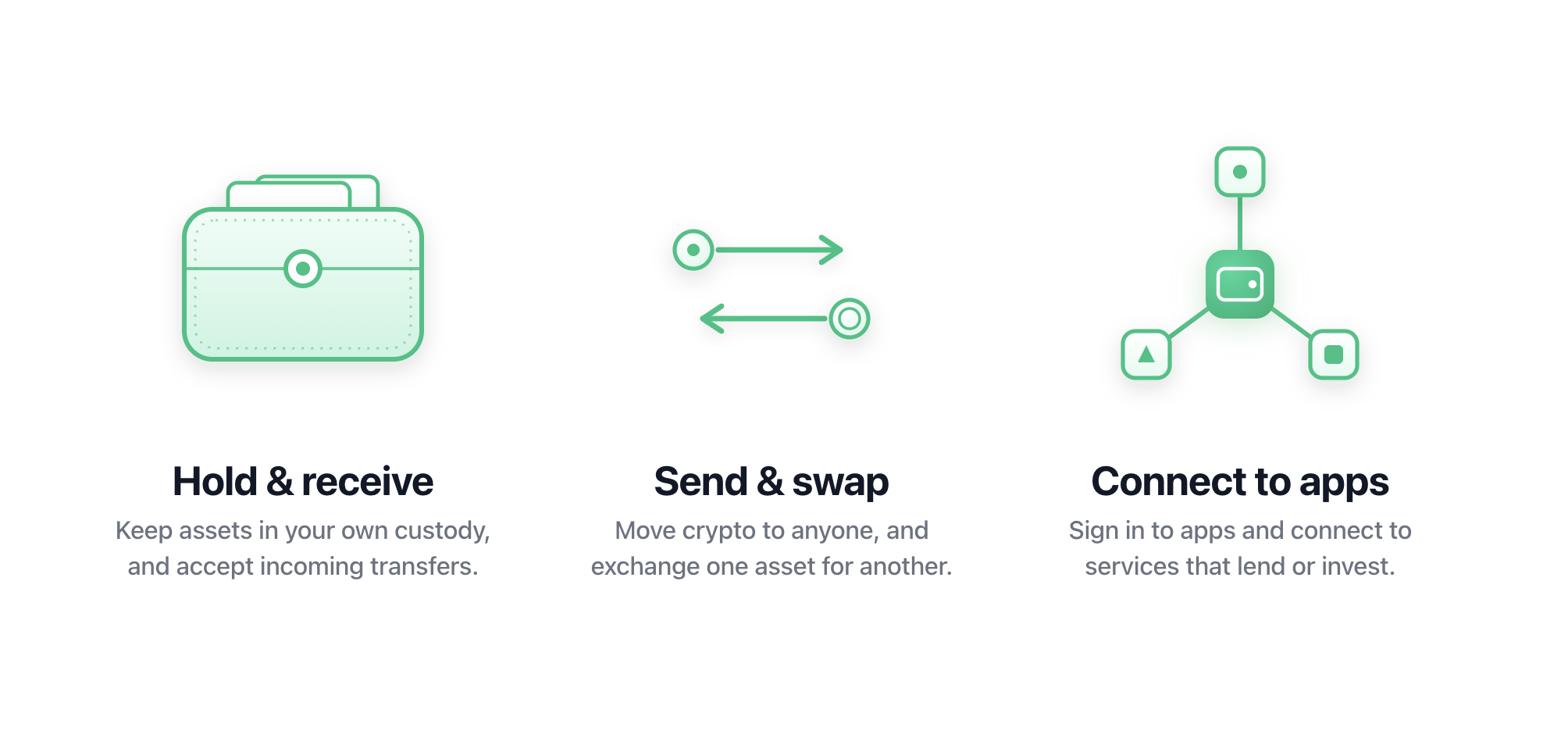
Day to day, a wallet is what you use to receive, hold, send, and swap crypto, and to sign in to apps or connect to services that lend or invest your assets. The point underneath is ownership, since a wallet lets you hold and move assets yourself rather than just watch a balance someone else keeps, and some newer wallets, called smart wallets, aim to make that smoother without changing the basic job.
The types of wallets
Wallets get sorted in a few overlapping ways, and you do not need all the labels to make a decision. A hot wallet is connected to the internet, which makes it convenient for everyday use, while a cold wallet is kept offline, which makes it safer for holding larger amounts over time. A hardware wallet is the most common cold option, a small physical device that keeps your keys off the internet and only connects when you approve something. An exchange wallet is the one you get by default when you buy crypto on a platform and leave it sitting there.
Those distinctions matter, but they describe the form a wallet takes more than the thing that decides how much control you actually have. Underneath all of them is a split that matters more than whether your wallet is an app, a device, or an account on an exchange.
The choice that matters: custodial vs non-custodial
Every crypto wallet is either custodial or non-custodial, and the difference is simply who holds the private key.
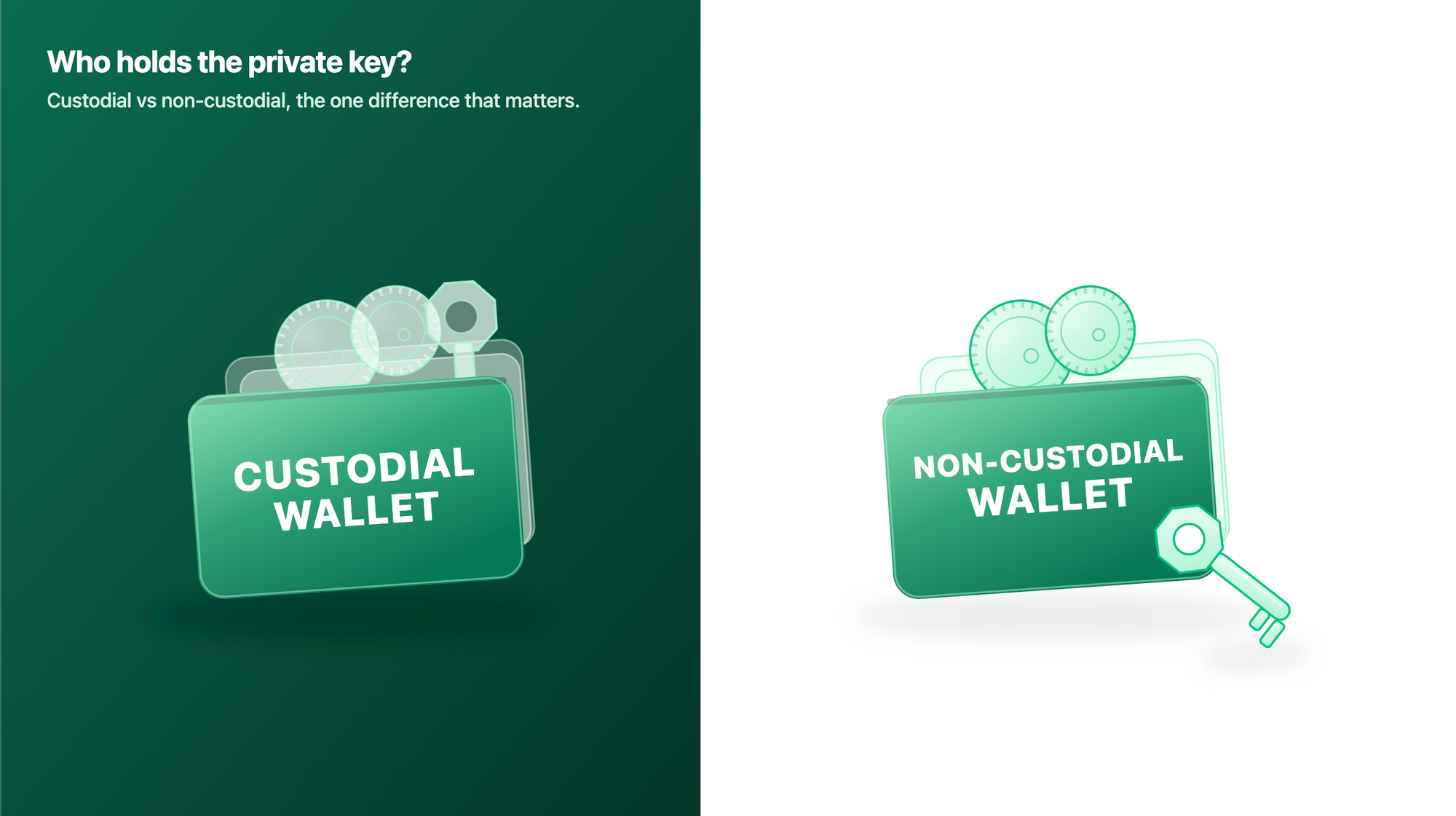
A custodial wallet means a third party holds the key for you. The wallet attached to your account on an exchange or a payment app is almost always custodial. The appeal is convenience. You can reset a password, you can contact support, and you are not the single point of failure, which makes custodial wallets an easy place to start. The tradeoff is that you are trusting that company, and that trust covers more than honesty. A custodial provider can freeze your access, limit withdrawals, be hacked, or run into financial trouble of its own, and in each of those cases your crypto is caught up in a decision you did not make. This is what the phrase not your keys, not your coins is pointing at.
A non-custodial wallet means you hold the key yourself. Nobody can freeze it, nobody can restrict it, and the assets are yours in the fullest sense. The cost of that control is responsibility. There is no reset and no support line, so if you lose your key or the recovery phrase that backs it up, the crypto is generally gone for good, and you are also the one dealing with networks and fees whenever you move things around. Non-custodial wallets give you everything and also hand you the entire job of not losing it.
The split is easier to see side by side:
| Custodial wallet | Non-custodial wallet | |
|---|---|---|
| Who holds the key | A company, for you | You |
| If you lose access | Password reset, support | No reset, generally gone for good |
| Who can freeze it | The provider can | No one |
| If the provider fails | Your crypto is exposed | Not their problem to lose |
| Best suited to | Starting out, hands-off | Full ownership, willing to manage it |
Neither one is the right answer for everyone. The honest version is that it comes down to how much control you want against how much responsibility you are willing to carry, and plenty of people use both, keeping spending money somewhere custodial and holding longer-term positions themselves. The gap between the two has also started to narrow, as some newer platforms keep you non-custodial while handling the gas and cross-chain steps that used to make doing it yourself a chore. Glider is one of them.
A crypto wallet sounds like a place you keep things, and that framing is most of why it confuses people. It is closer to a set of keys than a container, and the real question it puts in front of you is not which app to download but how much of the responsibility for your own money you want to hold. Custodial or non-custodial, convenient or fully yours, that has long been a real either-or. The part that is actually changing is that it is becoming less of one.
FAQ
Do you need a crypto wallet to buy crypto?
Not always. If you buy through an exchange or an app, it usually gives you a custodial wallet by default and holds the keys for you, so you can buy without setting anything up yourself. You only need your own wallet when you want to hold the keys rather than leave them with the platform.
Are crypto wallets free?
Most software wallets and exchange wallets are free to create and use. Hardware wallets are the exception, since they are physical devices you buy once, usually somewhere between $50 and $200. You may still pay network fees when you move crypto, but that is the cost of the transaction, not the wallet.
What is the difference between a custodial and non-custodial wallet?
A custodial wallet means a company holds your private key for you, which makes it convenient and recoverable but means you are trusting that company. A non-custodial wallet means you hold the key yourself, which gives you full control and no one who can freeze you, along with full responsibility if you lose access. The whole difference comes down to who holds the key.
Can you lose crypto stored in a wallet?
Yes, mainly in two ways. With a non-custodial wallet, losing your private key or recovery phrase usually means the crypto is gone for good, since there is no reset. With a custodial wallet, the bigger risk is the company itself being hacked, freezing your access, or failing.