Stablecoin Yield: How to Earn on Dollars Without a Bank Account
Stablecoin yield is the interest a lender earns by lending dollar-pegged coins such as USDC to borrowers through a lending platform. The coin itself pays nothing. The interest comes from borrowers, who lock collateral worth more than they take out and pay a rate that floats with how much of the available supply is being borrowed.
On 23 July 2026, USDC lent through Aave on Ethereum paid a 3.19% supply rate. The FDIC national average savings rate was 0.38% in June 2026, and the highest-paying US savings accounts paid about 4.15% in July 2026. Both sets of rates move constantly, and a US savings account is open only to a customer a US bank will accept.
Key takeaways
- Stablecoin yield is paid by borrowers, who pay interest to borrow the coins, and the lending platform passes most of that interest to the lender.
- The GENIUS Act, signed on 18 July 2025, bars stablecoin issuers from paying interest to holders, so holding USDC by itself pays nothing.
- Aave's USDC market on Ethereum showed a 3.19% supply rate and a 3.92% borrow rate on 23 July 2026, with $2.13 billion supplied and $1.93 billion borrowed.
- The FDIC national average savings rate was 0.38% in June 2026, against about 4.15% at the highest-paying US banks in July 2026.
- Stablecoin balances carry no deposit insurance, while US bank deposits are insured to $250,000 per depositor, per bank, per ownership category.
Where does stablecoin yield come from?
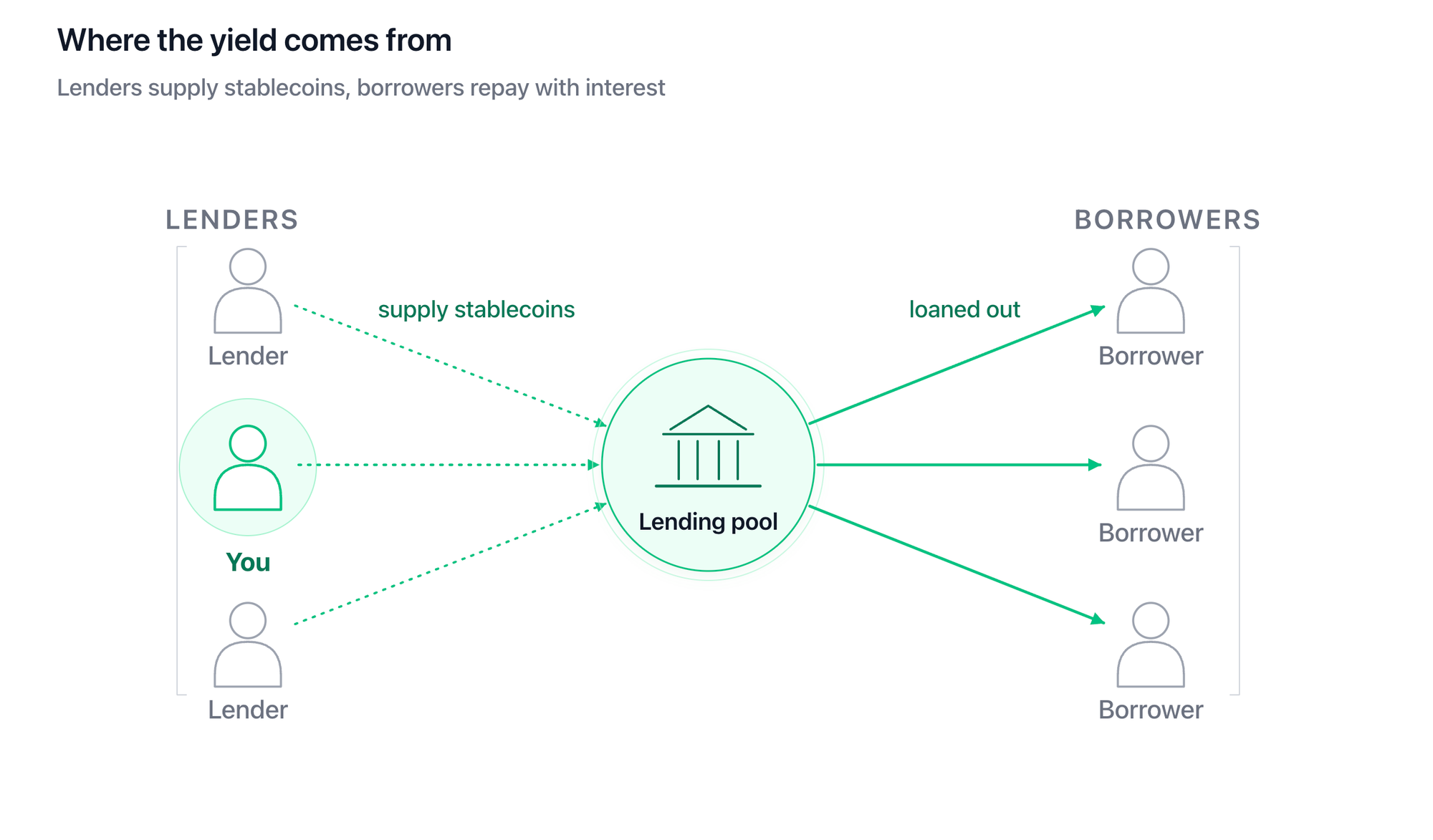
Stablecoin yield comes from borrowers. A lender deposits USDC into a lending platform such as Aave. Borrowers take that USDC out, having first locked collateral worth more than the loan, and the interest they pay is credited to the lender's balance. The platform keeps a small share and passes the rest through.
Borrowing demand sets the rate. On 23 July 2026, Aave's USDC market on Ethereum held $2.13 billion supplied against $1.93 billion borrowed, paid lenders 3.19%, and charged borrowers 3.92%. As more of the pool gets borrowed, the supply rate rises. As borrowing falls away, the rate falls with it, sometimes within a single day.
Collateral replaces the credit check. A borrower locks a larger amount of another asset before receiving the USDC, and if that collateral drops in value the platform sells it automatically to repay the loan. This arrangement is called DeFi lending, and it sits behind most of the rates advertised on stablecoin balances.
Why does holding a stablecoin pay nothing?
Holding a stablecoin pays nothing because the issuer keeps the income its reserves produce. Circle backs USDC with cash and short-dated US Treasury bills, most of it inside a government money market fund managed by BlackRock and custodied at BNY Mellon. The interest those assets earn belongs to Circle.
US law now states this directly. The GENIUS Act, signed on 18 July 2025, bars a permitted payment stablecoin issuer from paying a holder any form of interest or yield solely in connection with holding the coin. The Federal Reserve Bank of Richmond summarised the same restriction alongside the law's full-reserve and monthly-disclosure requirements. A return therefore has to come from a separate arrangement, which in practice means lending the coin out.
In early 2026 the Office of the Comptroller of the Currency proposed extending that prohibition to affiliates and related third parties, a rule that remains a proposal. Reserve quality varies across the roughly $312 billion of stablecoins in circulation on 23 July 2026, and USDC and USDT hold different assets and report on different schedules.
How does stablecoin yield compare with a savings account?
A savings account pays a rate the bank sets and insures the balance up to a legal limit. A stablecoin lending position pays a rate set by borrowing demand and insures nothing. On 23 July 2026 the onchain rate sat well above the US savings average and below the best US savings accounts.
| Feature | Lending USDC on Aave | US savings account |
|---|---|---|
| Rate on 23 July 2026 | 3.19% a year, variable, resetting with borrowing demand | 0.38% national average, and about 4.15% at the highest-paying banks |
| Who can open one | Anyone with a wallet and an internet connection | A customer a US bank accepts, which normally means a US address and taxpayer number |
| Protection if it fails | None; the claim runs against the lending platform's code and the collateral it holds | FDIC insurance to $250,000 per depositor, per bank, per ownership category |
| Access to the money | Usually immediate, and slower when almost all of the pool is borrowed | Same day to a few days |
| What sets the rate | The share of the pool currently borrowed | The bank |
Rates are quoted as an annual percentage yield, which assumes the interest is compounded rather than withdrawn. Held for one year at the July 2026 rates, $5,000 ends at $5,019.00 in an average US savings account, at $5,159.50 lent as USDC on Aave, and at $5,207.50 in a 4.15% high-yield savings account. Bank rate surveys differ, and Fortune's Curinos data put the best available rate at 4.50% on 20 July 2026.
Those US rates reach only US bank customers, which is the constraint the onchain version removes. In a survey of 2,541 crypto users across Brazil, India, Indonesia, Nigeria, and Turkey, run by Castle Island Ventures and Brevan Howard Digital and sponsored by Visa, 47% named saving in dollars as a reason they hold stablecoins, second only to trading.
What are the risks of stablecoin yield?
The three main risks are the lending platform failing, the coin losing its peg, and the rate falling. No deposit insurance covers any of them. A lender's claim runs against the lending platform's code and the collateral it holds, with no company balance sheet standing behind the position.
Peg risk is documented. In March 2023, Circle confirmed that $3.3 billion of the roughly $40 billion backing USDC sat at Silicon Valley Bank when regulators closed it. USDC fell below $0.87 and returned to a dollar about three days later, once US regulators guaranteed the bank's deposits. A coin backed by trading strategies rather than reserves, such as Ethena's USDe, carries larger risks again.
Higher advertised rates usually mean a different borrower. Tokenized private credit pays more because the loans go to companies rather than to traders posting collateral onchain, and the lender absorbs credit losses. A rate far above what the largest lending platforms pay is a signal to check who the borrower is and what secures the loan.
How does someone earn yield on stablecoins?
Earning stablecoin yield takes three steps: hold a fully reserved coin such as USDC, choose a lending platform with a public record and published reserves, and accept that the rate floats. A lender receives whatever the market pays each day, which will differ from the rate shown when they deposited.
An app like Glider is one way to do this. Stablecoins held in the account earn a variable rate through its Lending feature, the assets stay in the user's own account rather than the company's, and network fees are handled in the background. Cash can sit there while a user decides what to buy, then move into a portfolio.
Stablecoin yield is interest paid by borrowers to whoever lends dollar-pegged coins through a lending platform. The rate floats with borrowing demand, no deposit insurance covers the balance, and the coin on its own pays nothing because US law prevents the issuer from passing on what its reserves earn. Aave's USDC market paid 3.19% on 23 July 2026, against a 0.38% US savings average. What the arrangement changes is that no bank has to approve the account first.
FAQ
Is stablecoin yield safe?
It carries risks a savings account does not. The lending platform can fail, the coin can trade below a dollar, and no deposit insurance covers either outcome. Using a fully reserved coin such as USDC and a lending platform with a long public record and published reserves reduces the risk without removing it.
Where does stablecoin yield come from?
It comes from borrowers who lock collateral and pay interest to borrow stablecoins. The lending platform credits most of that interest to lenders and keeps a small share. Stablecoin issuers are barred by US law from paying interest to holders, so holding a coin outside a lending platform pays nothing.
Can someone lose money earning stablecoin yield?
Yes. A failure in the lending platform's code or its collateral rules can cost lenders their deposits, and a coin can lose its peg without fully recovering. USDC fell below $0.87 in March 2023 and returned to a dollar within about three days. Neither outcome is insured.
Is a bank account needed to earn stablecoin yield?
No. Lending stablecoins requires a crypto wallet and an internet connection rather than a bank relationship, which is why the rate is reachable from countries where dollar savings accounts are hard to open. Moving local currency into a stablecoin still involves an exchange or an onramp.
This article is for educational purposes only and is not investment, financial, tax, or legal advice. Rates shown are variable and were accurate on the dates stated. Digital assets carry risk, including the loss of principal, and stablecoin balances are not covered by deposit insurance.