What Are Gas Fees in Crypto?
Gas fees in crypto are the charge a blockchain applies to process a transaction, paid in that network's own coin and set by how much computational work the transaction requires. Ethereum charges gas in ETH, Solana in SOL, and Polygon in POL. The median Ethereum mainnet transaction fee was $0.012 in the first quarter of 2026.
That figure is down 99.68% from $3.79 in the first quarter of 2024. The dollar cost of a single transaction has collapsed. The requirement to keep a balance of the network's own coin has not changed.
Key takeaways
- Gas is priced per unit of computational work, and a standard ETH transfer always consumes 21,000 gas units.
- Ethereum mainnet's median transaction fee fell from $3.79 in Q1 2024 to $0.012 in Q1 2026, a decline of 99.68%, following the Dencun, Pectra, and Fusaka upgrades.
- Every network charges gas in its own coin: ETH on Ethereum, SOL on Solana, and POL on Polygon, which replaced MATIC as the Polygon gas token in September 2024.
- Median transaction fees in Q1 2026 were $0.0016 on Base, $0.0022 on Arbitrum One, and $0.0005 on Solana.
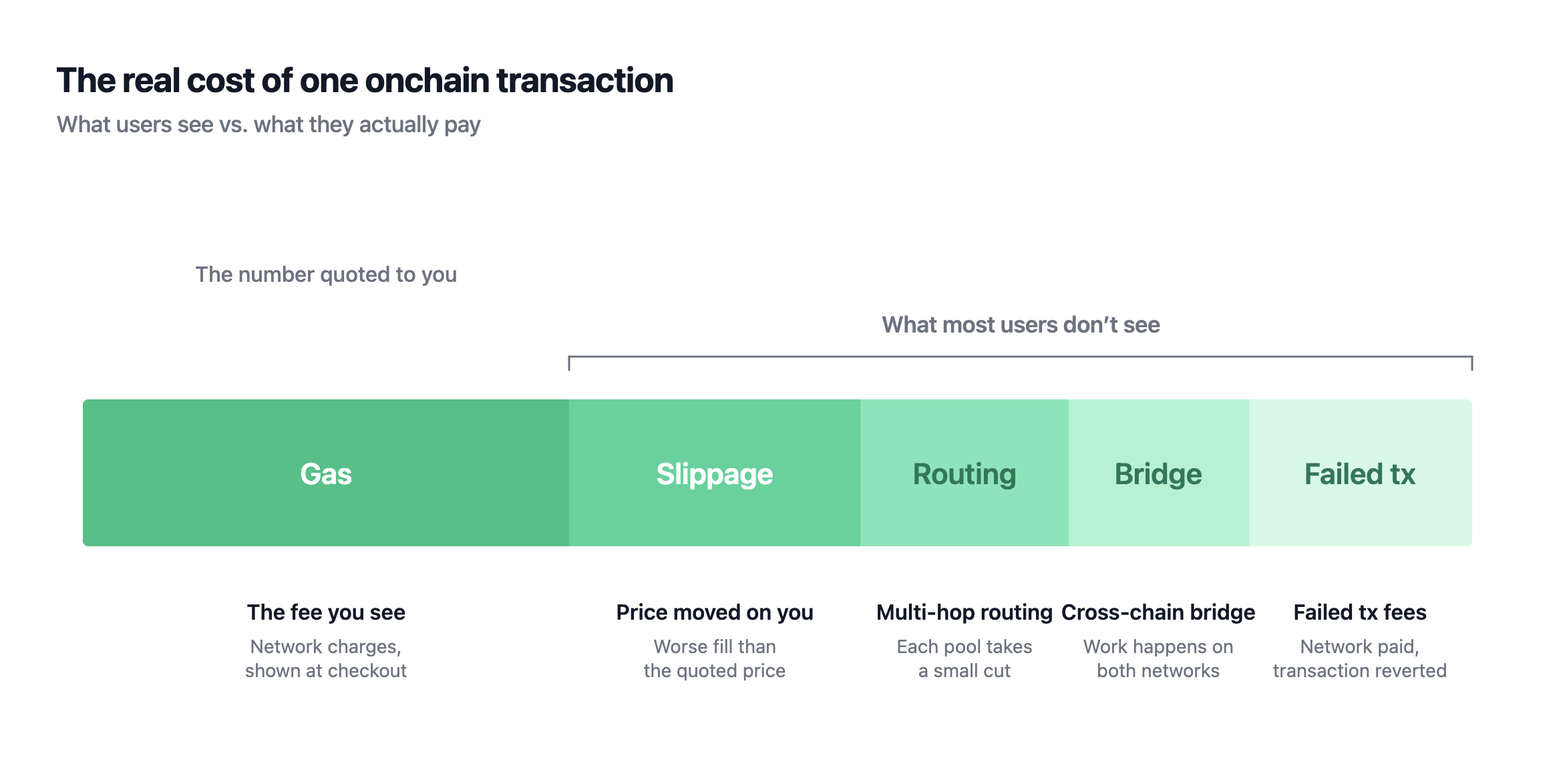
- Gas is one of several costs inside an onchain transaction, alongside slippage, routing fees, bridge fees, and gas spent on transactions that fail.
What is gas, and what is it paying for?
Gas is the unit a blockchain uses to measure computational work. Every operation a transaction performs carries a fixed gas cost, and the fee is the total gas consumed multiplied by the price per unit at that moment. The payment goes to the validators who process the transaction and record it on the public ledger.
Gas amounts are deterministic, which makes them checkable. A standard ETH transfer consumes exactly 21,000 gas units, every time, on every block. A swap through a decentralized exchange consumes several times that, because it touches more contract code. A multi-step interaction with a lending protocol consumes more again.
Gas prices are quoted in gwei, a unit equal to one billionth of one ETH. The gas amount reflects the work. The gwei price reflects competition for space in the next block.
Why does every network charge fees in its own coin?
Each network settles fees in the coin it issues, so a wallet needs a balance of that coin before it can send anything else. An account holding $500 of stablecoins on Ethereum cannot move them without also holding ETH. A stablecoin is a cryptocurrency designed to hold a steady value, usually one US dollar.
The balance requirement applies per network. An account that holds assets on three networks needs a small amount of three different coins to transact on them. This is the friction that outlasted the fee decline: at a median of $0.012 per transaction, the dollar amount stopped mattering long before the balance requirement did.
Some wallets remove the requirement. A smart wallet runs as a program on the network and can have its fees paid by a third party, so the holder never needs the native coin in the account at all.
What makes a gas fee go up or down?
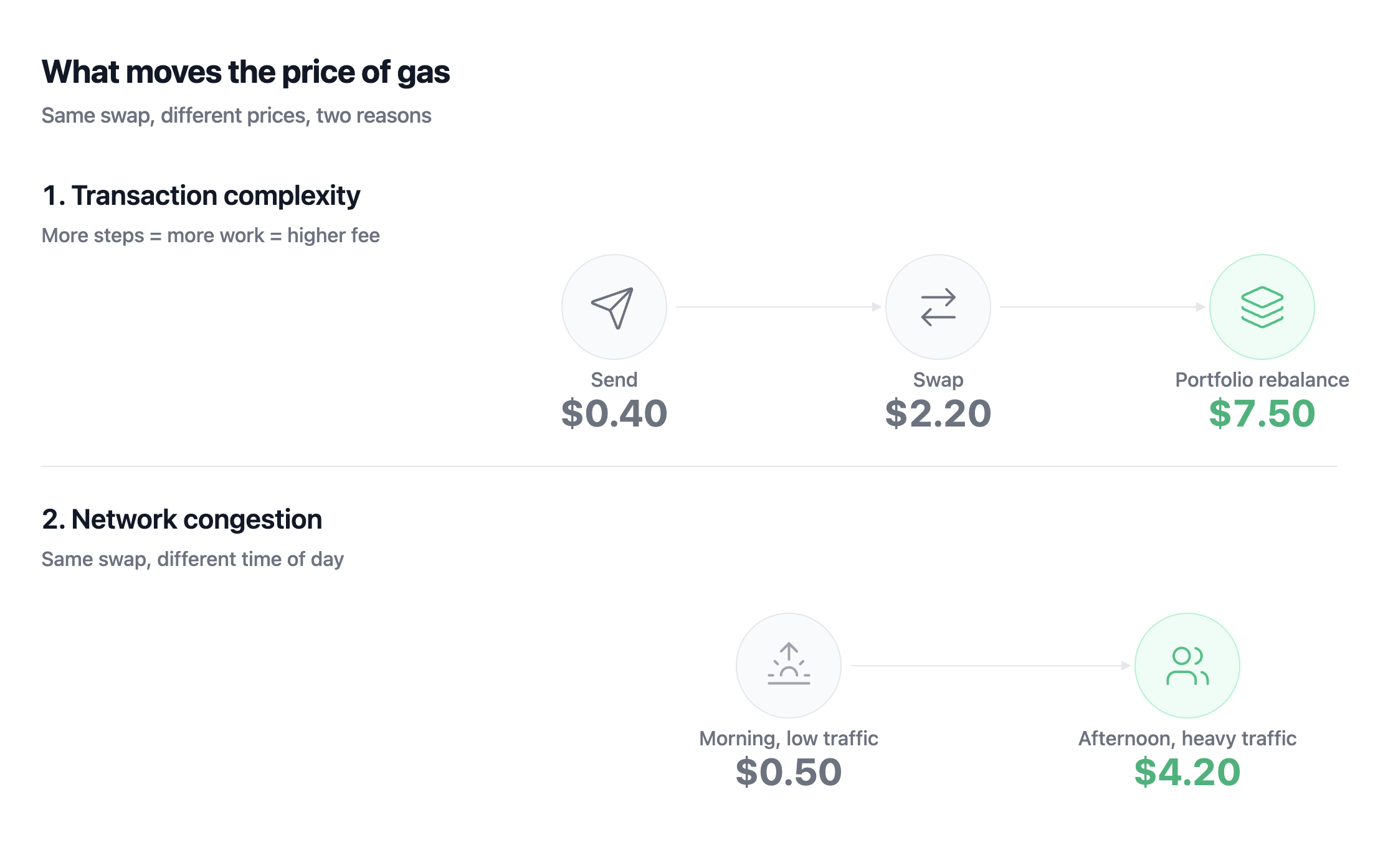
Two inputs set the fee. The first is how much work the transaction performs, measured in gas units. The second is the price per unit, which rises when demand for block space exceeds supply and falls when it does not. Under the fee model Ethereum adopted in 2021, a base fee adjusts automatically block by block.
The arithmetic is worth running once. A standard transfer consumes 21,000 gas units. On 31 July 2026 the Etherscan gas tracker showed an average price of 1.099 gwei, with ETH at $1,886. That transfer cost about $0.04. At 10 gwei, a level the network reaches during busy periods, the same transfer costs about $0.40.
The work performed is identical in both cases. Only the going rate for it changed.
What does a transaction actually cost in 2026?
Fees fell across every major network between 2024 and 2026. Ethereum's Dencun upgrade in March 2024 introduced blobs, a cheaper lane for rollup data. Pectra in May 2025 and Fusaka in December 2025 expanded that capacity further and raised the block gas limit to 60 million.
Median transaction fees by network, first quarter of 2026, measured by Ambrosia and Mizrach at Rutgers University across the complete transaction history of each chain:
| Network | Coin used for gas | Median transaction fee, Q1 2026 |
|---|---|---|
| Ethereum mainnet | ETH | $0.0123 |
| Polygon PoS | POL | $0.0069 |
| Arbitrum One | ETH | $0.0022 |
| Base | ETH | $0.0016 |
| Solana | SOL | $0.0005 |
| Optimism | ETH | $0.00003 |
Solana prices fees differently. It charges a fixed base fee of 0.000005 SOL per signature plus an optional priority fee, so the floor is known in advance and only the priority component moves.
Polygon is the one network in the group where fees rose, climbing 19.62% between Q1 2024 and Q1 2026 as activity on the chain increased.
What costs does the gas fee not include?
The gas fee covers network processing. Four other costs sit inside a typical onchain transaction and none of them appear in the gas number.
Slippage is the gap between the price shown at the moment of the order and the price the transaction executes at. It widens on markets with less depth.
Routing costs apply when a swap passes through more than one pool to reach a better rate. Each pool takes its own fee, and the total is reflected in the final price rather than shown separately. Pools with thinner liquidity, meaning less capital available to trade against at the shown price, produce worse fills.
Bridge fees apply when assets move between networks, because the bridge performs work on both sides.
Failed transactions still consume gas. The network performed the computation up to the point of failure and charges for it, even though the transaction reverted.
These costs also compound with transaction count. A portfolio that rebalances executes a trade per adjustment, and each one carries its own gas, slippage, and routing cost.
How can someone avoid paying gas?
Three options exist, and they differ in how much they actually solve.
- Transacting at quieter times. Gas prices fall when block space is less contested. This was worth real money when the median mainnet fee was $3.79. At $0.012, waiting for a quieter block saves a fraction of a cent, and the effort rarely justifies the saving.
- Using a cheaper network. Base, Arbitrum One, Optimism, and Solana all settle transactions for well under a cent. The native-coin balance requirement follows to whichever network gets picked, so this lowers the cost without removing the friction.
- Using a platform that sponsors the fee. A small number of platforms pay gas on their users' behalf. This is the only option that addresses both the cost and the balance requirement, and it produces the experience of a conventional investing app, where no separate token is needed to make an account work.
Glider sponsors gas for its users. An account holder deposits, selects what to hold, and never needs an ETH or SOL balance to transact. Gas-free access applies across portfolios, lending, and tokenized stocks, which are available to non-US persons only.
Frequently asked questions
Why do gas fees exist?
Gas fees pay the validators who run the computers that process transactions and maintain the network's records. They also price block space, which prevents anyone from flooding the network with worthless transactions at no cost. A network with no transaction fee has no defence against that and no way to fund its own operation.
Can a transaction be sent without paying gas?
Every transaction on a public blockchain consumes gas, but the holder does not always pay it. Fee sponsorship lets an application or a smart wallet cover the charge on the user's behalf. The network still receives the fee. The account sending the transaction simply is not the one funding it.
What happens when a transaction runs out of gas?
The transaction reverts and the network keeps the gas already consumed. Nothing the transaction attempted takes effect, and the assets stay where they were, but the fee is not returned. Wallets estimate the required gas in advance, and the common cause of failure is a large price movement between the estimate and execution.
Which blockchain has the lowest fees?
Optimism recorded the lowest median transaction fee among major networks in the first quarter of 2026 at $0.00003, followed by Solana at $0.0005 and Base at $0.0016. Ethereum mainnet remains the most expensive of the group at $0.0123, though that is down from $3.79 two years earlier.
Why is gas charged in ETH instead of a stablecoin?
The fee model is written into the protocol, which settles in the coin it issues and can verify natively. Charging in an outside asset would require the network to trust a price feed and an issuer. Applications built on top can accept a stablecoin from the user and pay the network in ETH themselves.
A gas fee is the price a network charges for the computational work a transaction requires, calculated as the work performed multiplied by the going rate for it. That rate moves with demand for block space. On Ethereum mainnet the median fee is now measured in cents rather than dollars, down 99.68% in two years. The balance of the network's own coin is still required to transact, and fee sponsorship removes it.
This article is for educational purposes only. It is not financial, legal, or tax advice, and it is not a recommendation to buy or sell any asset. Figures are accurate as of 31 July 2026 and change over time.