What Is Tokenized Gold?
Tokenized gold is a digital token that represents one troy ounce of physical gold held in a vault, backed one for one by the real metal. Also called digital gold or a gold-backed token, it tracks the international spot price of gold and can be traded onchain or redeemed. Its value moves with gold, so it is not a dollar stablecoin.
Gold trades in US dollars and tends to hold its value when a local currency slips, which makes it a long-standing hedge for investors outside the United States. That hedge is the main reason many of them turn to tokenized gold instead of a domestic gold product. Access is rarely the issue, since most can already buy gold at home, but the local versions are a more expensive and less precise way to hold it. Funds in markets like India often charge 0.50% to 1.00% a year, against 0.10% to 0.40% for the large international funds, and their prices reflect local import duties and seasonal demand more than the international spot rate. Tokenized gold holds the same metal as a dollar-priced asset, can be bought in fractions, charges no recurring storage fee, and is reachable through an app rather than a bank or broker.
Key takeaways
- Tokenized gold is a blockchain token backed one for one by one troy ounce of vaulted physical gold. Its price tracks spot gold, so it is not a dollar stablecoin.
- Two products hold most of the market: PAX Gold (PAXG) from Paxos, with gold vaulted in London, and Tether Gold (XAUt) from Tether, with gold vaulted in Switzerland.
- A token can be redeemed for physical metal, but generally only at a full bar of about 430 ounces. Smaller holders sell the token for cash instead.
- Tokenized gold carries no recurring storage fee, against roughly 0.10% to 0.40% a year for physically backed gold ETFs.
- The risks stack: the issuer's solvency and reserves, the token's smart contract, custody of the keys, and gold's own price swings.
- US persons can hold PAXG but not XAUt. Non-US holders can access both.
How does tokenized gold work?
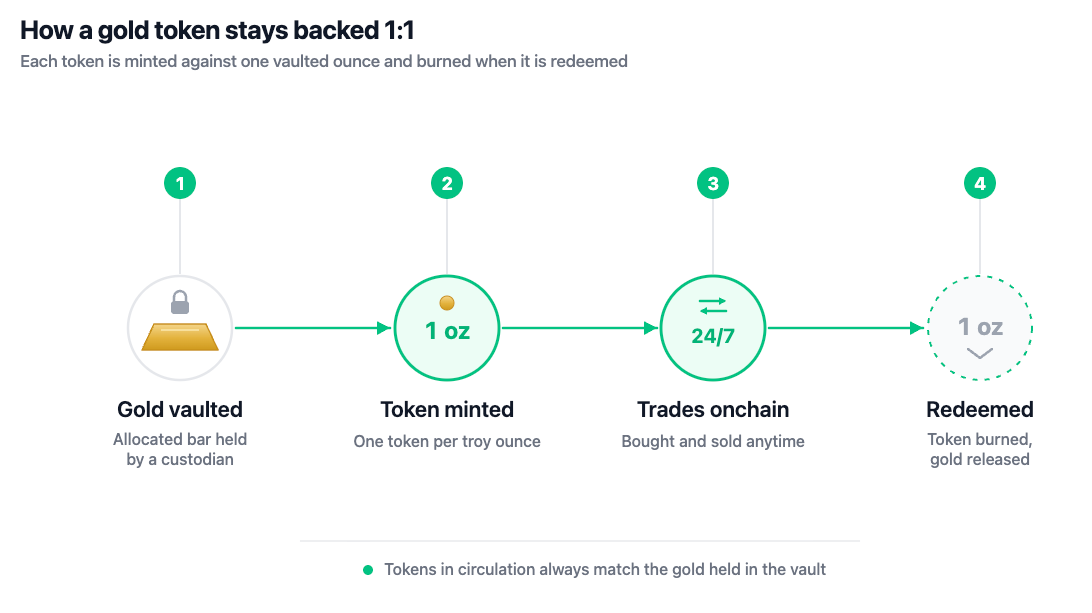
Tokenized gold works on a mint-on-deposit model. An issuer buys physical gold and stores it with a custodian, the firm that holds the metal, such as Brink's. It then mints one token on a blockchain for each troy ounce in storage, the troy ounce being the 31.1-gram unit used to weigh precious metals. The token trades and transfers around the clock, and redeeming it burns the token so the supply always matches the gold held.
The bars in the vault meet the London Good Delivery standard, the London Bullion Market Association's benchmark for large wholesale bars, which sets minimum purity and weight. Issuers hold that gold in one of two ways.
- Allocated gold means specific, serial-numbered bars that belong to the holder and sit apart from the issuer's own assets. If the issuer fails, allocated bars remain the holder's property.
- Unallocated gold means a general claim on a shared pool. The holder is an unsecured creditor and ranks behind other claims if the issuer fails.
Reputable products use allocated gold and let holders check the specific bars backing their tokens.
Most issuers publish an attestation, in which an accounting firm confirms that the tokens outstanding match the gold held on a given date. That confirmation is a snapshot of one date and carries less assurance than a full financial audit.
The two main tokens: PAX Gold and Tether Gold
Two tokens hold the large majority of the tokenized-gold market, which stands at about $5 billion. PAX Gold (PAXG) is issued by Paxos with gold vaulted in London. Tether Gold (XAUt) is issued by Tether with gold vaulted in Switzerland. Each token equals one troy ounce, and both trade on major exchanges.
PAX Gold (PAXG) launched in 2019. Paxos holds the gold in Brink's vaults in London and operates under a US national trust charter from the Office of the Comptroller of the Currency. An accounting firm attests the reserves monthly. PAXG carries no storage fee, and US persons can hold it. Its market value is about $1.8 billion.
Tether Gold (XAUt) launched in 2020. Its issuer, a Tether subsidiary, vaults the gold in Switzerland and publishes periodic reserve reports. XAUt carries no storage fee. US persons are barred from buying or redeeming it. Its market value is about $2.4 billion, the largest single tokenized-gold product.
Smaller gold tokens exist, including products from Kinesis and Matrixdock, but they hold a small share of the market. PAXG and XAUt are the two a mainstream investor is most likely to meet.
How tokenized gold compares to other ways to own gold
Gold can be held in several ways, and they differ on what the holder actually owns, when it trades, whether the metal can be claimed, and the recurring cost. A physically backed ETF holds bullion and trades as a fund share. A mining stock is company equity. Physical bullion is the metal itself. Tokenized gold is a wallet-held claim on a vaulted ounce.
| Route | Named examples | What the holder owns | Trading hours | Redeem for metal | Recurring fee |
|---|---|---|---|---|---|
| Physically backed gold ETF | SPDR Gold Shares (GLD), iShares Gold Trust (IAU), Franklin Responsibly Sourced Gold ETF (FGDL) | Shares in a trust that holds bullion | Market hours | No, for retail holders | 0.40% / 0.25% / 0.15% a year |
| Gold mining stock | B2Gold | Equity in a gold producer | Market hours | No | None, but carries company and operating risk |
| Physical bullion | Coins and bars | The metal itself | Dealer hours | Held directly | Storage and insurance |
| Tokenized gold | PAX Gold (PAXG), Tether Gold (XAUt) | A token equal to one vaulted ounce | 24/7 | Yes, at a full bar | None |
Expense ratios from each fund's issuer: State Street for GLD, iShares for IAU, and Franklin Templeton for FGDL.
A gold ETF is simple to hold inside a brokerage account, and the major funds track gold closely. The tradeoff is the annual expense ratio and the fact that retail shareholders cannot take delivery of metal. A mining stock such as B2Gold moves with gold, and it also moves with the company's costs, production, and debt, so it reflects the business as well as the metal. Physical bullion removes counterparty risk and adds storage, insurance, and dealer premiums. Tokenized gold trades at any hour and divides into very small fractions, with no recurring storage fee, while adding the issuer and smart-contract risks covered next.
Tokenized gold is one example of a real-world asset issued onchain. The same approach produces tokenized stocks and tokenized bonds, which, unlike gold, are typically structured as security tokens.
Is tokenized gold safe?
How safe tokenized gold is comes down to four things: the issuer's solvency, the realness of its reserves, the custody arrangement, and how the holder stores the token. A regulated, well-attested issuer with allocated custody covers the first three. The last one is on the holder.
The main risks:
- Issuer and counterparty risk. The token is only as sound as the issuer and its reserves. Allocated, bankruptcy-remote structures are designed to keep customer gold the holder's property if the issuer fails. An unallocated claim does not offer that protection.
- Attestation limits. An attestation confirms the tokens match the gold on a single date. It carries stated limits and offers less assurance than a full audit.
- Regulation differs by issuer. PAXG sits under US national-trust oversight. XAUt sits under a different regime and bars US persons. The protections are not the same.
- Custody and key risk. Self-custody puts the holder in full control and full responsibility for the private keys. Platform custody is easier and adds the platform as a point of failure.
- Liquidity and price drift. The token usually tracks spot gold through creation and redemption. In thin trading it can carry a short-term premium or discount to spot.
- Gold's own volatility. The token carries gold's price risk. The one-for-one backing ties it to the metal's market price, which can move sharply over short periods, and the token rises and falls with it.
How to buy and hold tokenized gold
Tokenized gold can be bought on a centralized exchange, on an onchain app such as a decentralized exchange, or inside an investing app. The usual path is the same: fund an account, buy the token, and hold it on the platform or in a personal wallet. Non-US holders can use both PAXG and XAUt, while US persons can use PAXG but not XAUt.
Costs to expect are trading fees, network or gas fees, the bid-ask spread, and any issuer fee on creation or redemption. The custody choice is the main decision. Holding the token in a personal wallet gives full control and full responsibility for the keys. Holding it on a platform is more convenient and adds platform risk.
Glider is one investing app of this kind, where tokenized gold and crypto can be bought and held in a single portfolio.
Tokenization changes how gold is held, turning a vaulted ounce into a token in a wallet that stays fully backed and trades around the clock. What it is worth still tracks the gold price, and how safe it is still rests on the issuer, the reserves, the custody, and the holder's keys.
Frequently Asked Questions
Is tokenized gold backed by real gold?
Yes, for the major products. Each PAXG or XAUt token is backed one for one by physical gold held in a vault, and the issuer publishes regular third-party attestations confirming the tokens match the gold.
Can tokenized gold be redeemed for physical gold?
Yes, but with high minimums. Full-bar redemption generally requires about 430 ounces, so most small holders sell the token for cash instead, or use a partner retailer for fractional redemption where one is offered.
What is the difference between PAXG and XAUt?
Both are backed one for one by one troy ounce of gold. They differ mainly on vault location (London for PAXG, Switzerland for XAUt), regulator, supported blockchains, and US availability. US persons can hold PAXG but not XAUt.
Is tokenized gold a good investment?
It is a way to hold gold-price exposure with crypto convenience and no recurring storage fee. Whether it suits a given investor depends on goals, time horizon, and risk tolerance. It tracks gold, so it carries gold's price swings and is usually treated as a diversifier rather than a growth holding.
How is tokenized gold taxed?
Tax treatment varies by country, and gold sometimes gets special treatment. Many places tax tokenized gold as a digital asset subject to capital gains. Local rules decide, so this is a question for a local tax source or adviser.
Tokenized gold or a gold ETF, which fits when?
A gold ETF fits an investor who already has a brokerage account and wants regulated simplicity. Tokenized gold fits one who wants 24/7 trading, fractional sizing, no recurring storage fee, and access from a wallet without a brokerage. The right choice depends on which of those matters more.
This article is for educational purposes only and is not financial, investment, legal, or tax advice. Tokenized assets carry risk, including the loss of capital. Anyone considering them should do their own research and consider consulting a licensed professional.