What Is a Smart Wallet? A Plain Guide for Investors
In 2011, a programmer named Stefan Thomas was paid 7,002 bitcoin for making a short video. He saved the coins on a small encrypted drive, but lost the paper on which he wrote the password. The drive locks itself after ten wrong guesses, and he has used eight. A fortune sits a few keystrokes away, and he cannot reach it.
His case is extreme, but the cause is ordinary. A Chainalysis estimate puts the amount of bitcoin lost for good at around 3.7 million coins, close to 1/5 of all the existing bitcoin. With the wallet most people start on, an app like MetaMask or Phantom, one forgotten phrase means the money is gone, with no reset link and nobody who can let you back in.
And losing access is only the most dramatic problem.
- A regular wallet only does one thing per tap, and only when you tap.
- It cannot invest on a schedule, buy more of something after it drops, or turn away a payment you never approved.
- Getting started means guarding a string of words for years.
A smart wallet is a crypto wallet that runs on a small program of its own, so it can follow rules you set, pay its own network fees, and recover access if a key is lost, instead of only signing one action at a time. That ability to act on its own is why it is becoming the wallet people use to invest, not just to hold.
What is a smart wallet?
A smart wallet gets its full name from what it's made of: a smart contract wallet. A smart contract is a small program that lives on the blockchain and runs exactly as written when its conditions are met, with no manual input needed. A smart wallet is built from one of those programs, which is what lets it hold a rule and act on its own.
Because the wallet is yours, the rules are yours. You decide what it does and when. You might tell it:
- to put $50 into your portfolio every Friday
- to sell a little of anything that has grown into too big a share of your portfolio
- to buy more of anything that has dropped, so your mix stays close to what you picked
- to block any payment to an address you have not approved
You set it once, and the wallet carries it out on its own. You never see the code behind it, the same way you never think about the software inside a card reader when you tap to pay.
Underneath, a wallet does not actually hold your coins. The money lives on the blockchain, and the wallet holds the keys that prove it is yours and let you move it. That is true of every wallet, and if it is new to you, our guide to what a crypto wallet is covers it. What makes a smart wallet different is what sits around the key.
How does a smart wallet work?
In a regular wallet, the key is the whole account, and it can do exactly one thing: approve or reject a single action when you ask. There is nowhere to keep a rule, a backup, or a limit, because an account that is only a key has nowhere to put them.
A smart wallet changes this by making the account itself a small program rather than a bare key, an upgrade called account abstraction. Your key still does the signing, but a program now sits around it and holds instructions of its own, turning an account that could only say yes or no into one that can act on the rules you set.
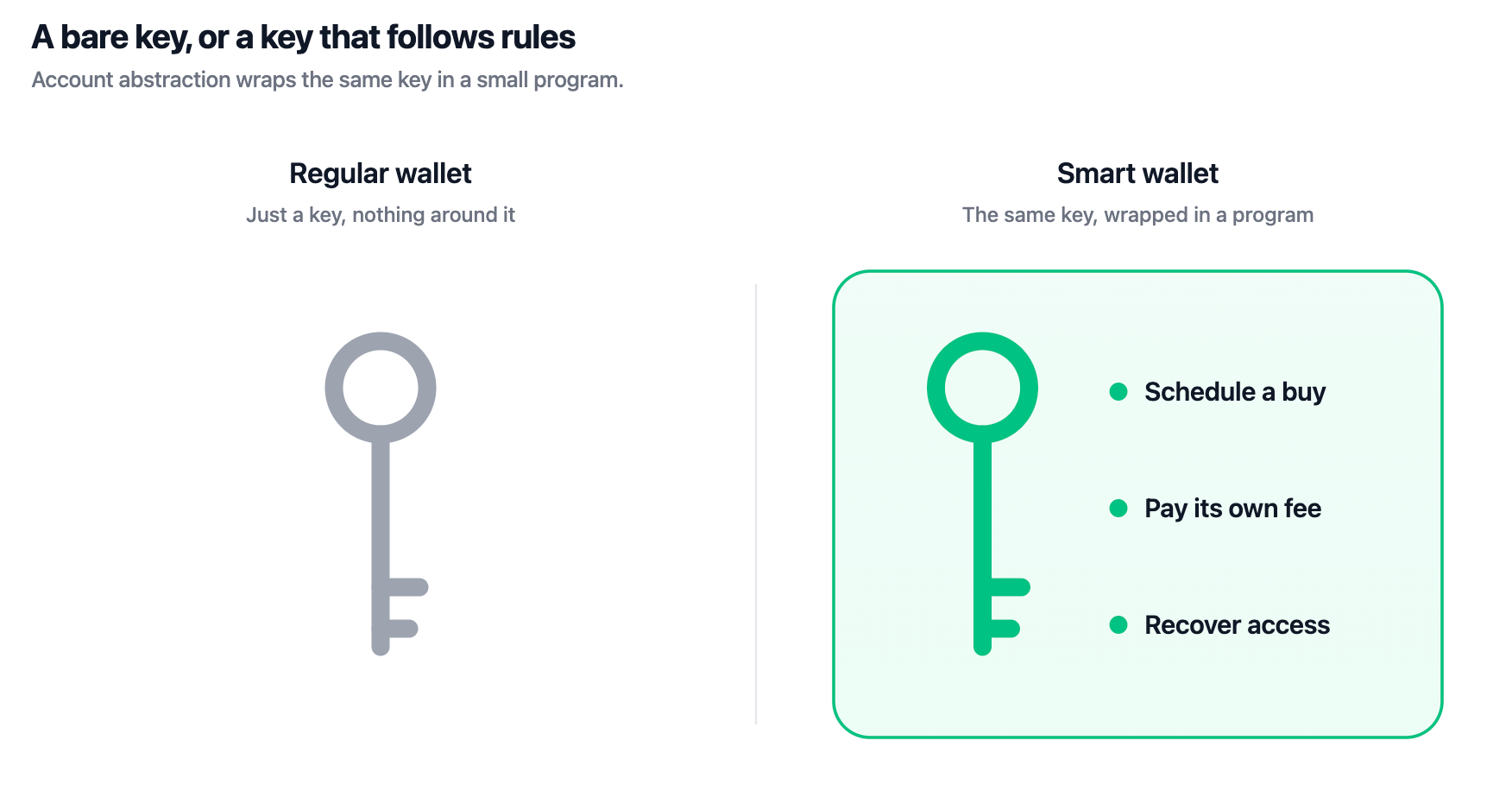
A regular crypto wallet vs a smart wallet
Say you are holding 100 USDC and want to put it to work, here is how the two compare:
| A regular crypto wallet | A smart wallet | |
|---|---|---|
| Who pays the network fee | You do, by hand | The wallet, in the background |
| What the fee is paid in | The network's own coin, like ETH | Whatever you already hold |
| If you don't hold that coin | Your money is stuck until you buy some | Nothing changes, it still moves |
| Acting on a schedule or rule | Every step is on you | Set it once, the wallet keeps it going |
| Day-to-day upkeep | Yours to manage | Handled for you |
On a regular crypto wallet the effort and the risk are yours to carry, and on a smart wallet the wallet carries them for you.
Are smart wallets safe?
Yes, and the reassuring part is that the money stays yours. No company can freeze it, drain it, or lock you out, because you hold the keys rather than a business that could fail or change its rules. For anyone who has had an account frozen or a withdrawal held up, that alone is a real difference.
Where safety varies is the code. A smart wallet runs a little code of its own, so the risk lives in a poorly built one that nobody independent has checked and that leaves you no way back in. A good one is the opposite, and it is the thing that finally fixes the lost-phrase problem the whole story started with.
💡 How to tell a safe smart wallet from a risky one: its code has been independently reviewed, it is already widely used, and it gives you a built-in way to recover access if you lose a key.
Where you'd actually use a smart wallet
A smart wallet earns its place wherever you want the same actions to repeat without doing each one by hand, and investing is the clearest case. Investing well is mostly maintenance, the buying, the rebalancing, the fees, and not letting one bad week undo a year of patience, which is the part most people quietly stop doing. The wallet stops being something you tend and becomes something that tends the plan for you.
That is the kind of wallet Glider runs on. Your money stays in a smart wallet only you control, and Glider uses what that wallet can do to keep a portfolio going for you: the recurring buys, the drift back toward your chosen mix, and the fees handled in the background with no separate coin needed to pay them. Auto investing apps are the category built on top of what a smart wallet can do.
For years, holding your own money onchain meant every part of looking after it fell to you, and the only alternative was handing it to a company that could lock you out. A smart wallet closes that gap, letting you keep full control without the upkeep that used to come with it. The choice between owning your money and not having to babysit it has quietly stopped being a choice.
FAQ
Is a smart wallet the same as a smart contract wallet?
Yes. "Smart contract wallet" is the full technical name, and "smart wallet" is the everyday shorthand for the same thing. The wallet is built from a smart contract, which is what lets it follow rules you set instead of only signing one action at a time.
What is the difference between a smart wallet and a hardware wallet?
A hardware wallet is a physical device that keeps your private key offline for safekeeping, and that is mostly all it does. A smart wallet is about what the account can do once it is in use: follow rules, pay its own fees, and let you recover access. The two are not rivals, and a hardware device can even act as one of the keys that controls a smart wallet.
Do you need a smart wallet to invest in crypto?
No, you can invest with a regular wallet, but you take on more of the manual work and the risk. A smart wallet matters most when you want actions to repeat on their own, like buying on a schedule or keeping your mix steady, without doing each step by hand. For long-term investing, that is usually the difference between a plan you set and a plan you have to babysit.
Can a smart wallet be hacked?
The bigger risk in any wallet is losing access or approving something you shouldn't, not a break-in, since no company holds your money to be breached. With a smart wallet the safety question comes down to the code: one whose code has been independently reviewed and is widely used is far lower risk than an untested one. Choosing a well-reviewed wallet with a built-in recovery option removes most of the worry.