What Are Tokenized Bonds and How Do They Work?
US Treasuries are a cornerstone of the global financial system. They are debt issued by the US government. An investor lends the government money and earns a set return, with the full amount repaid on a fixed date. Because the US has repaid this debt reliably for generations, and that debt carries the full faith and credit of the government, Treasuries are treated as the closest thing to a risk-free investment, which is why people around the world use them to hold cash safely and earn a steady, predictable return. The catch is that buying them has only ever been simple for people living in the US. From abroad, it gets awkward:
- A US brokerage often won't open an account for a non-resident.
- There is tax paperwork to clear first.
- Some brokers want a US address before granting access.
- Every conversion from local currency into dollars and back loses a little on the exchange rate.
Treasuries are just one kind of bond, and tokenized bonds get around all of this. A tokenized bond is a real bond represented by a digital token on a blockchain. It can be held and moved like any other token in a wallet, with no brokerage account required.
How do tokenized bonds work?
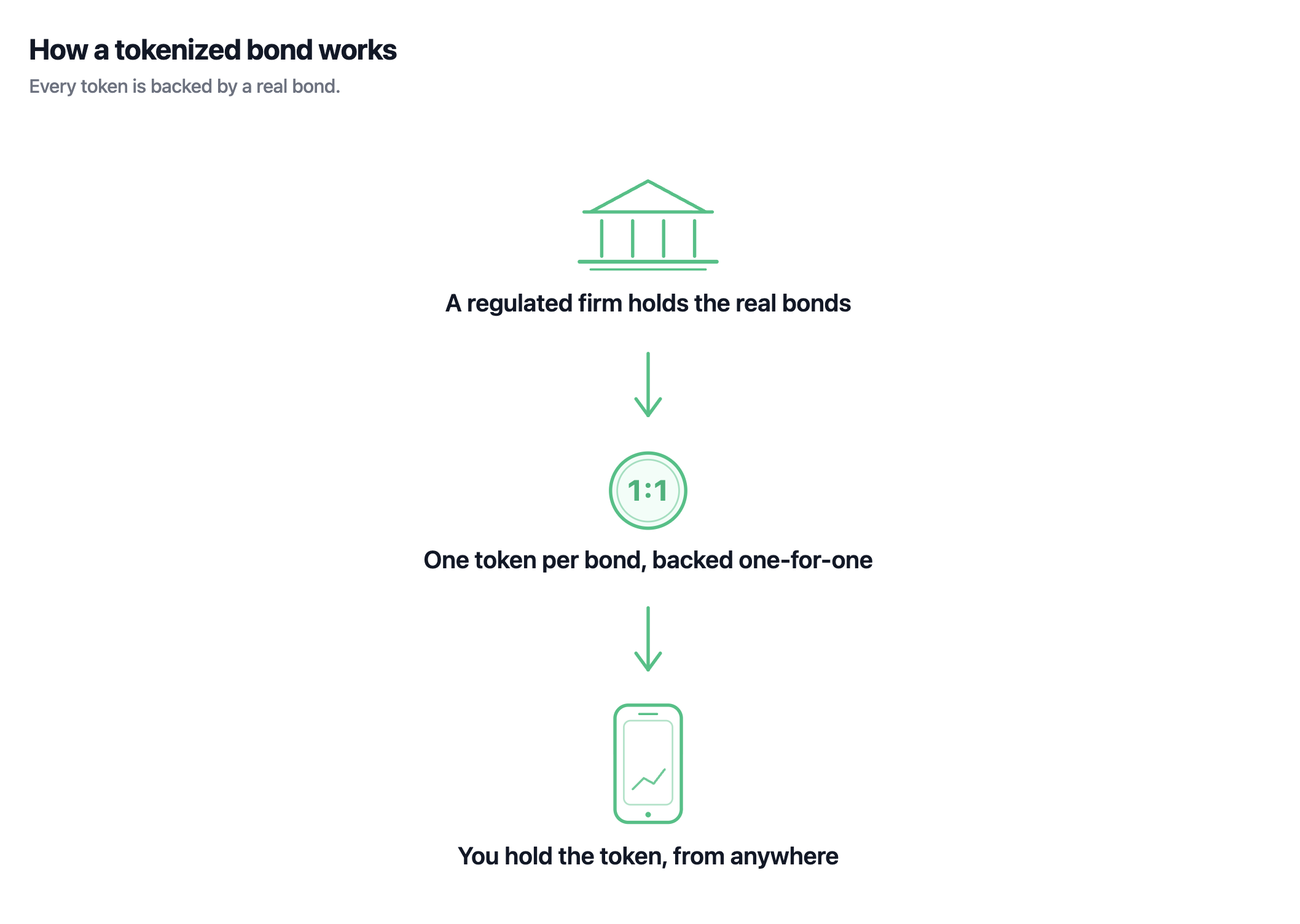
A regulated firm buys the actual bonds and keeps them with licensed custodians, then issues tokens backed one-for-one by what it holds, so nothing is floating free. Each token tracks the value of the bonds behind it and passes their interest through to whoever holds the token. The result is a bond that can be held and moved like any other token.
How that interest reaches you depends on the token. Some reinvest it automatically, so the value of what you hold grows instead of paying cash into your account. Others pass it straight through to the holder.
These tokens can be minted and redeemed around the clock from 8am Eastern on Monday to 8pm Eastern on Friday, and transferred between holders at any hour, weekends included, unlike the Treasury market, which keeps set trading hours.
An example: tokenized short-term US Treasuries
Take SGOV, an ETF that holds US Treasury bills due within three months. T-bills are the shortest and safest government debt there is. Its tokenized version, SGOVon, is issued by Ondo Finance and offers the same exposure in a single token.
SGOVon tracks the value of SGOV, which barely moves. It sits close to $100.50, because the bills underneath hold their value, and the return comes from the interest they pay, recently around 3.5% a year, reinvested into your position rather than paid out. So instead of a price that swings around, what you hold edges quietly upward as that interest accrues, with none of the ups and downs a stock would show. That steady, low-drama line is what holding short-term Treasuries looks like.
SGOV is a US fund, so buying it the normal way from abroad runs into every problem from the top of this page. SGOVon, on the other hand, is a token anyone can buy from a wallet. Same exposure, no brokerage, no paperwork.
Why do some bonds pay more than others?
A bond's return is the reward for the risk it carries. The safer the loan, the less it pays. The riskier it is, the more it has to pay to be worth holding. This plays out right inside US Treasuries, where SGOVon pays the least because it takes the least risk.
SGOVon barely moves because its bills mature in weeks. TLTon, the tokenized iShares 20+ Year Treasury Bond ETF, lends to the same government for decades, so it pays more but its price swings a lot when interest rates move. AGGon, a broad mix of US bonds, sits in the middle. Here is the rough picture:
| Token | What it holds | Typical yield | Price swings |
|---|---|---|---|
| SGOVon | Short US T-bills (0 to 3 months) | Lowest | Tiny |
| AGGon | A broad mix of US bonds | Middling | Moderate |
| TLTon | Long US Treasuries (20+ years) | Higher | Large |
Other countries push the trade further. There are tokenized versions of Brazilian government bonds (TESOURO) and Mexican government bonds (CETES) that pay noticeably more than US Treasuries. This is because of a higher risk, and the higher yield comes with the chance the country runs into trouble, plus the chance its currency slides against the dollar.
Who can buy tokenized bonds?
These tokens are built for investors outside the US. Every one of them carries a notice that it is not available in the United States, because they are not registered with US regulators and cannot be sold to US persons. Investors should check the rules in their own country before assuming access.
What are the risks?
There are two main risks when it comes to tokenized bonds. The first is the wrapper. A token is only as good as the firm behind it, so the real protection is the issuer holding the actual bonds and the custodians keeping them safe. Two things follow from that:
- There is no SIPC safety net like a US brokerage account has.
- Prices can drift in quiet trading, since the token trades almost around the clock but the bond market it follows does not.
The second one is the bond itself, which carries its usual risks no matter how it is held:
- Rising rates drag older bonds down, worst at the long end.
- An issuer can hit trouble.
- Foreign debt carries currency risk.
Tokenizing changes who can hold the bond and how easily. The bond itself is the same as it ever was.
How to invest in tokenized bonds
A few apps now list them. On Glider, an investor can hold tokenized US Treasuries like SGOVon and TLTon, broad US bond exposure through AGGon, and higher-yielding government debt from Brazil and Mexico through TESOURO, CETES, and the Global Treasury Yield basket, all in one place.
Bonds, the underlying asset, haven't changed. They earn interest and pay back the principal the way they always have. What changed is who is allowed to own one. The safe, boring, income-paying corner of investing used to stop at the US border. Now it fits in a wallet.
What is a tokenized bond in simple terms?
It is a real bond turned into a token on a blockchain. A regulated firm holds the actual bond and issues a token backed one-for-one by it. You hold the token like any other, earn the bond's return, and need no brokerage account.
Do tokenized bonds pay interest?
Yes. A tokenized bond passes through the interest the bond underneath earns. With some, that interest is reinvested automatically, so the value of what you hold grows over time instead of cash arriving in your account. Others pay it out to you as it accrues, so check which way a token works before you buy.
Are tokenized bonds safe?
The bond underneath carries its usual risks, and the safest of them, like short-term government bills, are among the safest assets anywhere. The added risks come from the wrapper: you rely on the issuer and custodian rather than brokerage protections, there is no SIPC coverage, and the token's price can drift from the real bond during off hours.
How is a tokenized bond different from a stablecoin?
A stablecoin is designed to hold a fixed price, usually one dollar. A tokenized bond is designed to give you a bond's return, including its interest, and its value moves with the bond it tracks.