What Are Auto Investing Apps and How Do They Work?
Auto investing apps are applications that place investment orders on a schedule the user sets, or hold a chosen mix of assets by rebalancing back to it as prices move. Some automate the contribution, some automate the mix, and some do both. The category covers robo-advisors, round-up apps, and automated portfolio platforms.
The fee structure matters most on small balances, where a flat monthly charge can take several percent of the account each year.
Key takeaways
- The three groups are robo-advisors that select the portfolio, round-up apps that invest spare change, and automated portfolio platforms where the investor sets the mix.
- Betterment and Wealthfront charge 0.25% a year. Acorns charges a flat $3 to $12 a month.
- A flat $3 monthly fee is 7.2% a year on a $500 balance and 0.25% a year on a $14,400 balance.
- Morningstar measured a 1.2 percentage point annual gap between what US funds returned and what the average dollar invested in them earned over the ten years to 31 December 2024.
- Betterment, Wealthfront, and Acorns serve US residents. Tokenized US stocks are issued to non-US persons only.
What are the three types of auto investing apps?
Auto investing apps fall into three groups. 'Robo-advisors' build and manage the portfolio for the investor. Round-up apps invest the spare change from everyday card purchases. Automated portfolio platforms let the investor pick the assets and the weights, then handle the buying and the rebalancing. The groups differ in who selects the assets.
| Type | Who selects the assets | What it automates | Typical fee | Examples |
|---|---|---|---|---|
| Robo-advisor | The app, from the investor's answers on goals and risk | The whole portfolio, including rebalancing and dividend reinvestment | 0.25% a year on the balance | Betterment, Wealthfront, Schwab Intelligent Portfolios |
| Round-up app | The app, from a small set of prebuilt ETF portfolios | Contributions, by rounding card purchases up to the next dollar | Flat $3 to $12 a month | Acorns, Stash |
| Automated portfolio platform | The investor, choosing each asset and its weight | Order execution and rebalancing back to the chosen weights | Varies by platform | M1 Finance, Public, Glider |
US robo-advisors often add retirement account types such as IRAs and run tax-loss harvesting, selling a losing position and buying a similar one so the loss can be set against gains. Betterment states that its fee covers rebalancing and dividend reinvestment, with no separate trading charge.
What does an auto investing app cost?
Two fee structures dominate the category. Robo-advisors charge a percentage of the balance, commonly 0.25% a year at Betterment and Wealthfront. Round-up apps charge a flat monthly subscription, $3 to $12 a month at Acorns. A percentage fee stays proportional at every balance. A flat fee takes a larger share of a small account.
Acorns publishes the breakpoints for its own $3 Bronze tier, which comes to $36 a year. On a $500 balance that is 7.2% a year. At $14,400 it reaches 0.25%, matching the standard robo-advisor rate. The arithmetic reverses above that point: at $100,000 the $36 subscription is 0.04% a year, against $250 for a fee of 0.25%.
Betterment applies a flat charge from the other direction. Its rate is 0.25% a year on balances above $24,000, or where recurring deposits reach $250 a month. Below that the charge is $5 a month, or $60 a year, which is 1.2% of a $5,000 balance.
| Balance | Acorns Bronze, $36 a year | Robo-advisor at 0.25% |
|---|---|---|
| $500 | $36, or 7.2% a year | $1.25, or 0.25% a year |
| $5,000 | $36, or 0.72% a year | $12.50, or 0.25% a year |
| $14,400 | $36, or 0.25% a year | $36, or 0.25% a year |
| $50,000 | $36, or 0.07% a year | $125, or 0.25% a year |
| $100,000 | $36, or 0.04% a year | $250, or 0.25% a year |
Does automating contributions improve investment results?
Research measures a gap between what funds return and what the investors in them earn, and disagrees about the cause. Morningstar attributes it to the timing and size of investor transactions. A 2024 academic re-analysis of the same data attributes almost all of it to how the measure is built.
Morningstar's Mind the Gap 2025 study found that the average dollar invested in US mutual funds and exchange-traded funds earned 7.0% a year over the ten years to 31 December 2024, against an aggregate total return of 8.2% a year for the funds themselves. The 1.2 percentage point gap is roughly 15% of the total return those funds generated, and Morningstar reports similar gaps for every ten-year period ending between 2020 and 2024. Jon Fulkerson, Bradford Jordan, Timothy Riley, and Qing Yan re-ran the same sample and found that poor timing costs fund investors about 0.10 percentage points a year, with the remainder explained by the construction of the measure.
Vanguard's research answers a separate question. Its 2023 paper by Megan Finlay and Josef Zorn found that investing an available lump sum immediately beat spreading it across 12 months in roughly two-thirds of periods from 1976 to 2022, across US, UK, and Australian markets. That result applies to money already in hand. A recurring buy applies to income as it arrives, where the alternative is holding it as cash, and falls under dollar-cost averaging.
What should an investor check before choosing an auto investing app?
Three checks decide whether an app fits: whether it accepts residents of the investor's country, what assets it can hold, and which parts of the process it automates. How a fee scales with the balance is the fourth, and carries more weight than the headline rate.
Eligibility rules out the most options for an investor outside the United States. Betterment, Wealthfront, and Acorns require a US Social Security number and a US bank account. Investors elsewhere reach US assets through routes that vary by country. For example, the options open to an investor in the Philippines differ from those open to an investor in India on funding rails, cost, and tax.
Automation comes in two forms that apps support unevenly. A recurring buy commits a fixed amount to a chosen asset on a set cadence. Portfolio rebalancing sells what has grown past its target weight and buys what has fallen below it. An app that automates only contributions leaves the rebalancing to the investor.
Can one app hold stocks, gold, and crypto in the same account?
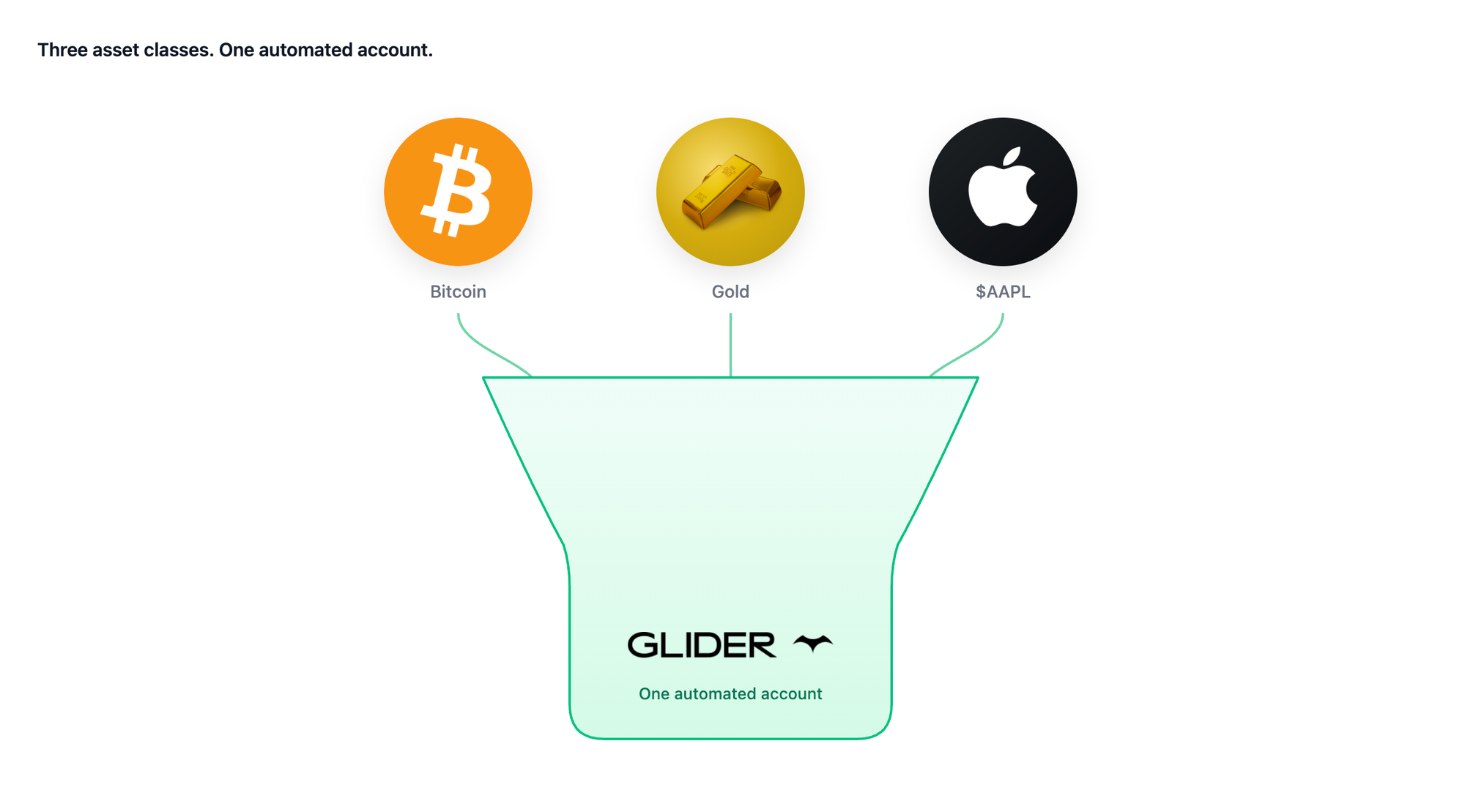
Traditional auto investing apps hold a fixed menu of US stocks, US ETFs, and cash. A separate category holds tokenized assets, where a token on a public blockchain is backed one-for-one by a real asset held by a regulated firm. Stocks, gold, Treasuries, and cryptocurrency can then sit in one account and be automated together.
Tokenized US stocks are issued to investors outside the United States. Ondo Finance issues tokens such as $AAPLon and $SPYon, each backed by a real share held at a US broker-dealer, a regulated firm that holds securities for others. Ondo reinvests each dividend into the token's value, net of withholding tax, so a holder receives no cash payment and no shareholder vote. Tokenized gold follows the same design, with one token per troy ounce held in a vault.
Glider is one app in this shape. A user picks the assets and the weights, funds the account, and the app executes and rebalances back to that mix on a cadence the user chooses. Recurring buys run on an asset, an amount, and a cadence the user sets. Network fees are handled in the background, and the assets sit in the user's own account rather than the company's. The tokenized stocks and ETFs come from Ondo Finance and are available to non-US persons only.
An auto investing app places the orders an investor has already decided on, and returns the account to a chosen mix as prices move. The three categories differ in who selects the assets and whether the fee is a percentage of the balance or a flat monthly subscription. What determines the result is the asset menu the app can reach and the fee measured against the size of the account, since $36 a year is 7.2% of a $500 balance and 0.04% of a $100,000 one.
FAQ
What is an auto investing app?
An auto investing app places investment orders on a schedule the user sets, or holds a chosen mix of assets by rebalancing back to it as prices move. Robo-advisors, round-up apps, and automated portfolio platforms sit in the category, and the buying happens without the user placing each order.
How much do auto investing apps charge?
Betterment and Wealthfront charge 0.25% a year on the balance. Acorns charges a flat $3 to $12 a month, which is $36 to $144 a year at any account size. A flat fee weighs heaviest on small balances, at 7.2% a year on $500 and 0.04% on $100,000.
Is a recurring buy better than investing a lump sum?
Vanguard studied US, UK, and Australian market data from 1976 to 2022 and found that investing an available lump sum immediately beat spreading it over 12 months in roughly two-thirds of periods. That result applies to a lump sum already held, while a recurring buy applies to income arriving each month.
Can someone outside the United States use an auto investing app?
Betterment, Wealthfront, and Acorns require a US Social Security number and a US bank account. Apps holding tokenized US stocks serve investors outside the United States, because those tokens are issued to non-US persons only. Funding method and tax treatment vary by country.
This article is for educational purposes only and does not constitute financial, investment, legal, or tax advice. Tokenized stocks and ETFs are available to non-US persons only. The value of investments can fall as well as rise, and past results do not indicate future results.