How to Buy US Stocks from Malaysia (2026): Three Routes Compared
A Malaysian resident can buy US stocks through an SC-licensed broker, tokenized stocks in a personal wallet, or a fund. What each route owns, costs, and pays in tax, with verified 2026 figures.
A Malaysian resident can buy US stocks in three ways: through a Securities Commission Malaysia-licensed broker such as moomoo, Rakuten Trade, or FSMOne; through tokenized US stocks held in a personal wallet; or through a fund that holds US assets. The routes differ in what the investor owns, what it costs, and how it is taxed. Figures verified against platform pages in August 2026.
The path, compressed: pick a route, open and verify an account, fund it in ringgit (the platform converts to US dollars), and buy whole or fractional shares from amounts as small as $1. The route choice matters more than the broker choice, because each route owns something different.
The stake: the largest cost on this journey is usually not the commission but the currency conversion, and the largest surprise is usually tax, which this guide covers after the routes.
Route 1: A Malaysian-licensed broker with US access
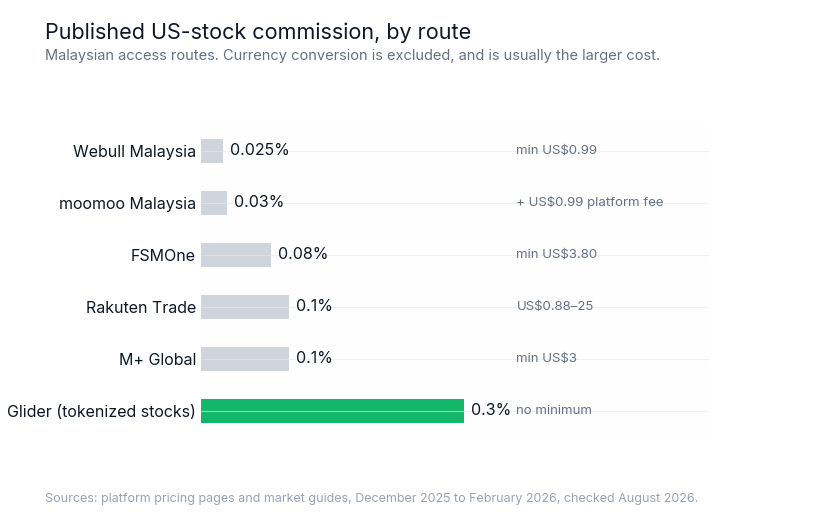
Several brokers licensed by the Securities Commission Malaysia sell US-listed shares directly in ringgit. The main options, with published fees as of early 2026:
| Broker | US stock commission | Fractional shares | Notes |
|---|---|---|---|
| moomoo Malaysia | 0% for new users' first 180 days, then 0.03% plus a US$0.99 platform fee per order | Yes | Five markets: MY, US, SG, HK, CN |
| Rakuten Trade | 0.1% of trade value, from US$0.88 to US$25 per trade | Yes | Malaysia's first fully online equities broker; MY, US, HK |
| FSMOne | 0.08%, minimum US$3.80 | Yes | Also unit trusts, bonds, and managed portfolios |
| Webull Malaysia | 0.025%, minimum US$0.99 | Yes | MY and US markets |
| M+ Global | 0.1%, minimum US$3 | No | HK and US access from a long-established Malaysian broker |
How it works. Open an account with a MyKad and complete identity verification. Fund in ringgit by bank transfer. The broker converts ringgit to US dollars at its quoted rate and holds the shares in a custodian account with a US partner broker. Orders can be fractional at most of these platforms, so a $500 share can be bought $20 at a time.
What to watch. Commissions are visible and small. The conversion spread is neither: converting ringgit to dollars and back at an app-quoted rate can cost more than the commission on both legs. Statutory fees on US trades, such as the SEC's sell-side fee, apply at small amounts regardless of broker.
Best for the investor who wants to pick individual US shares with a local, licensed counterparty.
Route 2: Tokenized US stocks in a personal wallet
Tokenized US stocks are onchain tokens backed one-for-one by shares held at a regulated firm. The investor buys them with a stablecoin, holds them in a personal wallet rather than at a broker, and can combine them with crypto and tokenized gold in a single automated portfolio on a platform such as Glider, which rebalances on a cadence the user chooses and charges 0.30% of automated trading volume with no minimum.
Tokenized stocks are available to non-US persons only, and they carry a different protection structure from a brokerage account: collateral and a security agent rather than SIPC coverage. Dividends are reinvested into the token's value net of withholding rather than paid as cash. Glider's tokenized stocks explainer covers the structure, and the comparison with CFDs covers what tokenized stocks are not.
Best for the investor who wants US exposure inside a managed, self-custodied portfolio rather than a brokerage account.
Route 3: A fund that holds US assets
The oldest route needs no brokerage account at all: a unit trust or robo-advisor portfolio with US or global equity exposure, bought in ringgit. Malaysian robo-advisors such as StashAway, MYTHEO, and Wahed build portfolios from global ETFs, and conventional unit trusts with US mandates sell through most banks and fund platforms. The investor owns fund units, not shares; the fund's manager owns and manages the stocks.
What to watch. Annual management fees, typically 0.2% to 1% at the robo-advisors and often higher at traditional unit trusts, come out of returns every year regardless of performance. The fund's home regulator, not a US one, governs the product.
Best for the investor who wants US exposure as one ingredient in a managed ringgit portfolio and never wants to think about tickers.
The tax position for Malaysian investors
Three rules cover most of it, as of August 2026:
- US dividend withholding is 30%. Malaysia has no income tax treaty with the United States, so the statutory rate applies in full. A W-8BEN form certifies non-US status and prevents higher backup withholding, but it does not reduce the 30%. On $1,000 of dividends, $300 is withheld.
- The US generally does not tax a non-resident's capital gains from selling US shares. Malaysian tax on foreign-sourced gains depends on current Inland Revenue Board rules, which have shifted in recent years; a Malaysian tax professional is worth the fee before a large disposal.
- US estate tax starts at $60,000 of US-situated assets, including US shares and cash in a US brokerage account, with rates reaching 40%. Malaysia has no estate tax treaty with the United States.
How to choose between the routes
Three questions. First, control: picking individual shares points to a licensed broker; holding a managed allocation points to a fund or to Glider. Second, cost shape: brokers charge per trade plus conversion spreads, funds charge annually on the balance, and Glider charges 0.30% of what trades. Third, custody: brokers and funds hold the assets; tokenized stocks sit in the investor's own wallet. For the broader regional picture, Glider's guides to buying US stocks from the Philippines and from Nigeria show how the same three routes play out under different rules.
The three routes suit three different investors: a broker for hands-on stock picking, a fund for managed ringgit exposure, tokenized stocks for self-custodied, automated allocation. For most Malaysians who want US exposure without a foreign brokerage account or a large activation deposit, tokenized stocks through Glider are the simplest route: fractional access with no minimum, rebalancing handled automatically on a chosen cadence, and assets held in the investor's own wallet.
Frequently asked questions
Can Malaysians legally buy US stocks?
Yes. A Malaysian resident may hold foreign securities, and several brokers licensed by the Securities Commission Malaysia, including moomoo, Rakuten Trade, and FSMOne, sell US-listed shares in ringgit. Tokenized US stocks are a second legal route, available to non-US persons only, held in a personal wallet rather than at a broker.
What is the cheapest way to buy US stocks from Malaysia?
For small balances, tokenized US stocks through Glider are the cheapest route overall: no minimum, no annual fee on the balance, and a 0.30% charge only when the portfolio trades, so a RM1,000 allocation costs about RM3 to establish. On commission alone, Webull's 0.025% and moomoo's 0.03% are the lowest published broker rates as of early 2026, but the larger cost is usually the ringgit-to-dollar conversion spread, applied when funding and again when selling. Comparing the quoted exchange rate matters more than comparing commissions.
What is the minimum to buy US stocks from Malaysia?
On Glider there is no minimum at all: tokenized US stocks are fractional and available to non-US persons, so any amount buys in. Fractional broker shares start near $1 at moomoo, Rakuten Trade, and FSMOne, and funds holding US assets start around RM100 at most robo-advisors.
How are US stock dividends taxed for Malaysians?
The United States withholds 30% of dividends paid to a Malaysian investor, with no treaty reduction available. A W-8BEN form certifies non-US status but does not lower the rate. On $1,000 of dividends, $700 arrives. Capital gains are generally not taxed by the US for non-residents.
Is a tokenized US stock the same as a real US stock?
Economically, close: the token is backed one-for-one by a real share held at a regulated firm, and its price tracks that share with dividends reinvested net of withholding. Legally, the holder owns an onchain note rather than the share itself, with no voting rights and no SIPC coverage. The trade is brokerless custody for a different protection structure.
Buying US stocks from Malaysia is a solved problem three times over: a licensed broker for stock picking, a fund for managed ringgit exposure, or tokenized stocks for self-custodied, automated allocation. The right route is the one whose ownership, cost shape, and custody model match what the investor wants to hold.
See how Glider works and start a portfolio with no minimum.
Fees verified against platform pricing pages and market guides as of August 2026, with broker rates published between December 2025 and February 2026. This article is for education only and is not tax advice; cross-border tax rules change and individual circumstances differ.