What is Portfolio Rebalancing?
Portfolio rebalancing is the process of returning a portfolio to the weights its owner originally chose. It means selling part of any holding that has grown beyond its target percentage and buying more of any holding that has fallen below it, until each position matches the allocation set at the start.
Weights move on their own, because holdings grow at different rates. Rebalancing is the correction, and the main reason to run it is risk control rather than higher returns.
Key takeaways
- Rebalancing brings each holding back to its target percentage by selling what has grown and buying what has lagged.
- Its purpose is keeping risk at the level the investor chose. It does not reliably raise returns and often slightly lowers them.
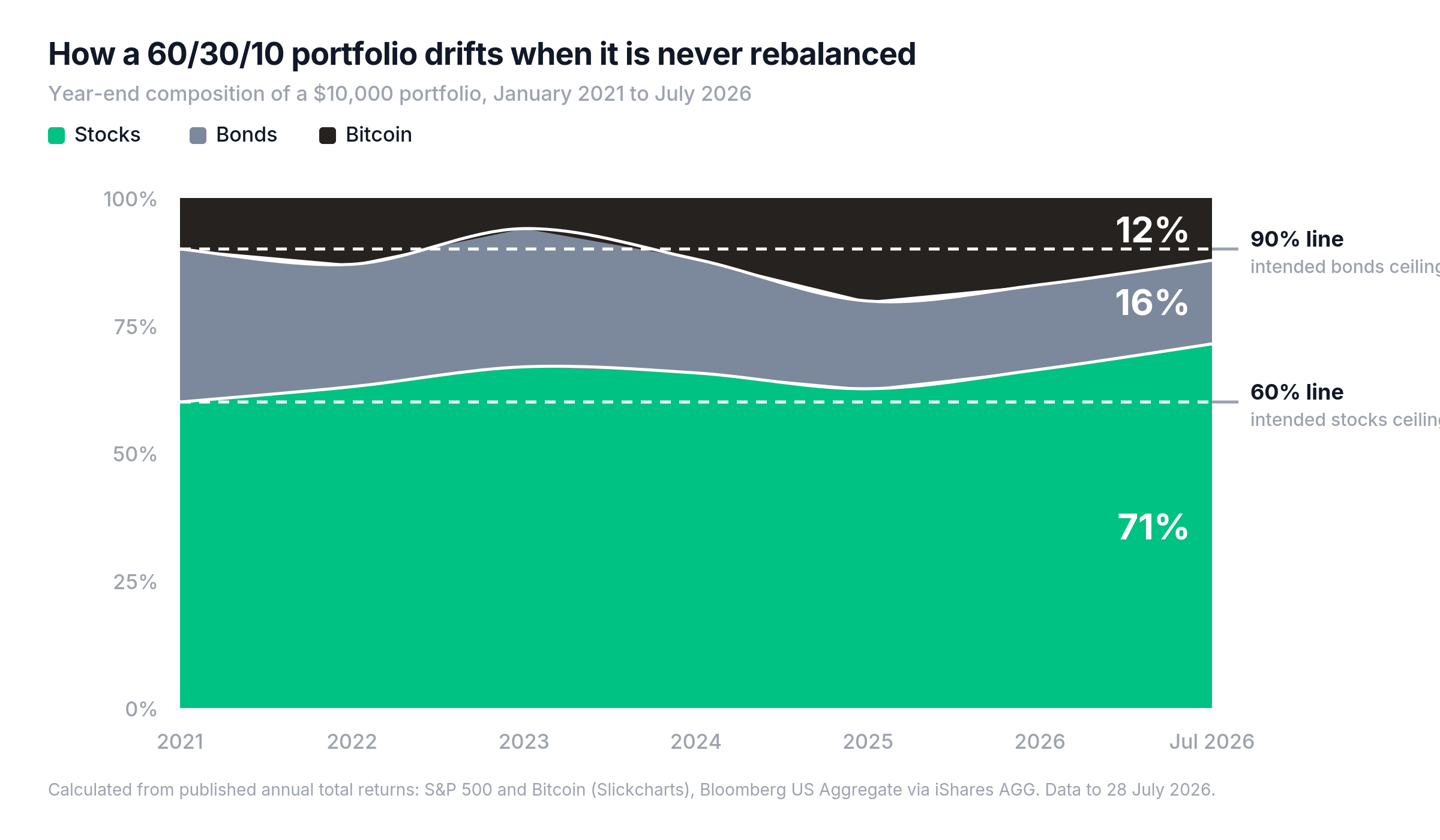
- A 60/30/10 portfolio left untouched from January 2021 held 71/16/12 by late July 2026, roughly halving its bond weight.
- The three common approaches are calendar, threshold, and a combination, with Vanguard putting an annual rebalance at the practical optimum for most investors.
How does portfolio rebalancing work?
An investor sets a target percentage for each holding, then compares the actual percentages against them periodically. Holdings above target are trimmed, and the proceeds top up the holdings below target.
For example, a portfolio set at 60% stocks, 30% bonds, and 10% gold might drift to 70/20/10 after a strong run in stocks. Rebalancing sells enough stock to bring it back to 60% and buys bonds with the proceeds. The portfolio's value does not change at the moment of the trade. Only its composition does.
Why does a portfolio drift?
Holdings compound at different rates, so the fastest-growing one takes a larger share of the total each year while the slowest takes less. No trade is required for this, and it stays invisible on a statement that reports balances rather than percentages.
The last five and a half years show the size of the effect.
- Stocks. The S&P 500 returned about 114% since January 2021, including reinvested dividends.
- Bonds. US investment grade bonds finished roughly where they started, about 1% below.
- Bitcoin. Gained 60% in 2021, lost 64% in 2022, gained 155% in 2023 and 121% in 2024, then fell 6% in 2025 and 27% through late July 2026.
A 60/30/10 portfolio holding those three, left alone since January 2021, held 71% stocks, 16% bonds, and 12% Bitcoin by 28 July 2026. The bond position never fell sharply. It held its value while stocks more than doubled, which halved its share of the total.
Why rebalance?
- It holds risk at the chosen level. A portfolio that drifts toward its riskiest holding becomes more aggressive than its owner agreed to. The 60/30/10 example above ended with an equity weight 11 points above target and half its intended bond cushion.
- It restores diversification. Drift concentrates a portfolio in whatever has performed best recently, which is the opposite of what a mixed allocation is for.
- It removes a repeated decision. A rule specifies what to sell and what to buy in advance, at the moments when judgment is least reliable. Trimming a holding that has just risen is the trade most investors avoid.
When is rebalancing not worth it?
- Tax. In a taxable account, selling an appreciated holding realises a capital gain. Most jurisdictions tax a position held under a year more heavily than a longer-held one. Rebalancing inside a tax-sheltered account carries no such charge.
- Trading cost. Correcting a 5 percentage point drift on an $18,000 portfolio moves roughly $900, so a 0.5% round-trip spread costs about $4.50. Frequent rebalancing in a volatile market multiplies that.
- Returns. Rebalancing sells whatever has performed best, so in a long run for one holding it lags leaving the portfolio alone. Morningstar's analysis of a 9.5-year period through July 2024 found rebalancing reduced returns across most asset pairings it tested. In the 2021 to 2026 example above an annual rebalance happened to finish about 5% ahead, because it trimmed Bitcoin before two losing years. Neither outcome is predictable in advance.
How to rebalance a portfolio
- Work out the current weights. Divide each holding's value by the portfolio total.
- Compare against the target. List which holdings sit above their target percentage and which sit below.
- Size the trades. Calculate the amount to sell from each overweight holding and the amount to buy of each underweight one.
- Place the trades, or use new money instead. Directing the next contribution into the underweight holding restores the target without selling anything, which avoids the tax entirely.
How often should a portfolio be rebalanced?
| Method | Trigger | What it requires | Main trade-off |
|---|---|---|---|
| Calendar | A fixed date, most often annual | One reminder a year, acted on | Simple to run; weights can drift wide between dates |
| Threshold | A holding moving a set distance from target | Every holding checked regularly | Tracks targets closely; Vanguard notes regular monitoring is impractical for self-directed investors |
| Combined | A scheduled check that trades only if the band is breached | The scheduled check, then trades only when triggered | Fewer trades than a calendar rule; the check still has to happen |
The best-known threshold setting is Larry Swedroe's 5/25 rule, which rebalances a holding when it moves 5 percentage points or 25% of its target weight, whichever is smaller. Vanguard's testing finds monthly and quarterly schedules trade more than the tighter tracking is worth, and that intervals beyond two years let weights run too far.
Does rebalancing have to be manual?
No. Target-date funds have rebalanced inside retirement plans for decades, robo-advisors brought the same feature to brokerage accounts, and scheduled rebalancing is now standard on auto investing apps. It runs alongside the recurring contributions behind dollar-cost averaging, which sets the buying schedule rather than the target weights.
Automation matters because the manual version is skipped. Vanguard's How America Saves 2026, covering nearly five million retirement accounts, records that only 5% of participants traded during volatile stretches.
Investors outside the US, or holding assets a brokerage account does not carry such as tokenized gold, have fewer of these options. On Glider a user sets a target mix once and the app rebalances back to it on a cadence the user sets, with the assets held in the user's own account rather than the company's.
Portfolio rebalancing returns each holding to the percentage its owner set, by selling what has outgrown its target and buying what has fallen behind. It holds risk at the chosen level rather than raising returns, and it costs tax in a taxable account. For most investors a single annual pass, or a rule that redirects new contributions to the underweight holding, is enough to do the job.
Frequently asked questions
Does rebalancing increase returns?
No, not reliably. Rebalancing sells whatever has performed best, so over long runs for a single asset it trails a portfolio left alone. Morningstar found it reduced returns across most asset pairings over a 9.5-year test through July 2024. Its purpose is holding risk at the chosen level, which is a different objective from maximising return.
What happens if a portfolio is never rebalanced?
The portfolio keeps whatever weights the market produces and drifts toward its best-performing holding. A 60/30/10 portfolio left untouched from January 2021 held 71/16/12 by July 2026, with roughly half its intended bond cushion. Returns may end up higher or lower. The risk level is no longer the one chosen.
Should a portfolio be rebalanced during a market crash?
A downturn is when a rebalance moves the most capital, because it buys the holdings that have fallen and trims those that held their value. The obstacle is behavioural rather than mathematical. Vanguard's 2026 retirement data records only 5% of participants trading during volatile stretches, so it is the trade most investors skip.
What is the 5/25 rule for rebalancing?
The 5/25 rule, from Larry Swedroe, rebalances a holding when its allocation moves by 5 percentage points or by 25% of its target weight, whichever distance is smaller. The two are equal at a 20% target. A 60% allocation therefore trades at 55% or 65%, and a 5% allocation at 3.75% or 6.25%.
Does rebalancing trigger taxes?
In a taxable account, yes, whenever an appreciated holding is sold at a profit. Positions held under a year are usually taxed at a higher rate. Rebalancing inside a tax-sheltered retirement account triggers nothing. Directing new contributions to the underweight holding rebalances without selling, which avoids the charge.
This article is for educational purposes only. It does not constitute financial, investment, or legal advice, or a solicitation to buy or sell any asset. Investing carries risk, including possible loss of principal. Readers should do their own research.