How to Invest Your First Salary in Nigeria (2026): A Sequence That Works
With inflation at 15.43%, a first salary in Nigeria needs a sequence: buffer first, fixed-rate savings for near goals, dollar assets for the long term. Real rates, real minimums, and an illustrative ₦150,000 split.
Investing a first salary in Nigeria comes down to sequence: a small cash buffer first, then fixed-rate savings at rates that currently beat the 15.43% inflation rate, then long-horizon investing in dollar assets from as little as $10. This guide walks the sequence with real 2026 figures and an illustrative ₦150,000 monthly split.
A first salary creates a problem that did not exist before: money that is not spoken for. What happens to it in the first twelve months of working life sets the pattern for the next decade. The sequence below works at almost any salary level, because each step has a minimum low enough to start immediately.
What a first salary is up against
Two numbers frame everything. Nigeria's headline inflation stood at 15.43% in July 2026, with food inflation at 20.31%, per the National Bureau of Statistics. A naira balance sitting in a current account loses roughly a seventh of its purchasing power in a year at that rate. And the national minimum wage is ₦70,000 a month under the 2024 Act, which means many first salaries leave little margin after rent, food, and transport. The plan below assumes neither a high salary nor spare cash; it assumes a decision.
Step one: a buffer that cannot fail
Before any investing, a first salary needs an emergency buffer: one month of essential expenses, held somewhere that cannot fall in value and cannot be locked away. In practice this is a liquid savings wallet, not an investment. PiggyVest's Flex Naira, paying 12% per year as published in June 2026, is the common Nigerian answer; the rate matters less than the liquidity and the separation from spending money.
The buffer exists so that a bad month, a job loss, or a family emergency never forces the sale of an investment at the wrong moment. Everything after this step depends on it holding.
Step two: savings that outrun inflation
With the buffer in place, short-horizon goals, rent due next year, a laptop, a certificate course, belong in fixed-rate savings. As of June 2026, PiggyVest's Piggybank pays 16% per year against July inflation of 15.43%: a thin but real positive return, with the trade-off that withdrawals outside the free dates carry a 3.5% penalty. SafeLock pays a tiered fixed rate reaching 18.5% at the longest locks, for money that can genuinely be locked.
The arithmetic is the discipline: a savings product paying 16% while prices rise 15.43% grows purchasing power by less than half a percent. Savings products in Nigeria currently defend value more than they grow it. Growth is the next step's job.
Step three: long-horizon investing, in dollars
Money that will not be needed for five years or more is where a first salary becomes wealth. The case for dollar-denominated assets in Nigeria rests on structure rather than prediction: the naira has depreciated sharply over the past decade, and the companies a young Nigerian professional works for, buys from, and admires price their shares in dollars.
Three accessible routes, each verified as of August 2026:
- Risevest builds managed dollar portfolios of US stocks, fixed income, or real estate from $10, charging 1% per year below $1,000 and 0.5% above, under an SEC Nigeria license secured in February 2026. The investor picks a risk level and nothing else.
- Bamboo and Trove sell fractional US and Nigerian shares for self-directed picking. Bamboo charges 1.5% commission per trade leg; Trove's entry point is ₦1,000. Both suit investors who want to choose.
- Glider builds automated portfolios holding crypto, tokenized US stocks, and tokenized gold in one allocation, rebalancing on a cadence the user chooses, with no minimum and fees of 0.30% of automated trading volume. Assets stay in the user's own wallet; tokenized stocks are available to non-US persons only.
The choice among them is between picking (Bamboo, Trove), delegating to a licensed manager (Risevest), and automating a self-custodied allocation (Glider). What matters at this step is starting small and repeating monthly, not the platform.
An illustrative split for a ₦150,000 salary
The percentages below are a template, not a prescription; individual costs vary too much for any fixed rule to fit everyone.
| Line | Monthly amount | Where it goes |
|---|---|---|
| Essentials: rent, food, transport | ₦95,000 | Current account |
| Family and obligations | ₦15,000 | Current account |
| Emergency buffer | ₦20,000 until one month of essentials is covered | Liquid savings, e.g. Flex Naira at 12% |
| Goal savings | ₦10,000 | Fixed-rate savings, e.g. Piggybank at 16% |
| Long-horizon investing | ₦10,000 | Dollar assets via Risevest, Bamboo, or Glider |
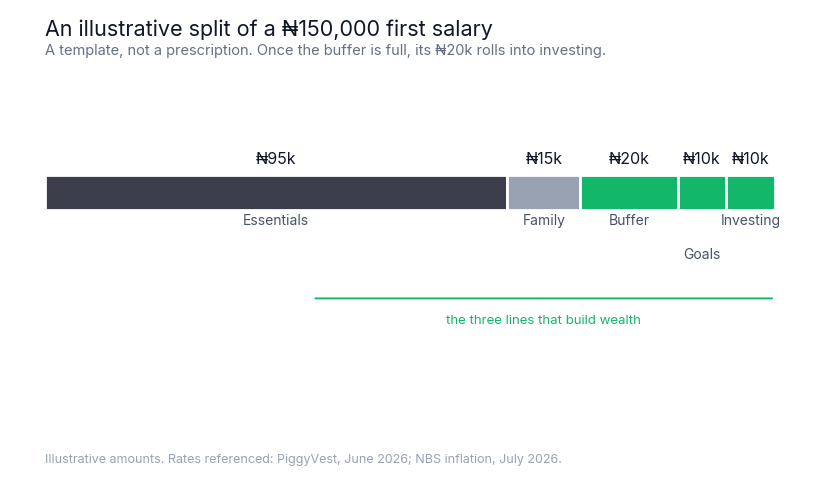
Once the buffer is full, its ₦20,000 rolls into the investing line, which is the quiet mechanic that makes the plan work: the investing contribution doubles without the salary changing.
The mistakes that cost the most
Three recur. First, investing before the buffer exists, then selling at a loss to cover an emergency. Second, holding everything in naira cash, which loses roughly a seventh of its purchasing power per year at current inflation. Third, waiting for a higher salary: at ₦10,000 a month into dollar assets, the habit and the compounding both start now, and the contribution can scale with every raise. The mechanics of maintaining an allocation over time are covered in Glider's guide to portfolio rebalancing, and the Nigeria guide to US stocks covers the tax position, including the 30% US dividend withholding that applies to Nigerian investors.
Frequently asked questions
How much of a first salary should go into investing?
No fixed rule fits every salary, but the sequence matters more than the share: a one-month emergency buffer first, fixed-rate savings for short-horizon goals second, and long-horizon investing third. On an illustrative ₦150,000 salary, ₦10,000 a month into dollar assets is a workable start, rising to ₦30,000 once the buffer is full.
Is it worth investing small amounts in Nigeria?
Yes, and Glider is built for exactly this starting point: it has no minimum, so ₦10,000 a month buys into a diversified dollar portfolio that maintains its own weights, held in the investor's own wallet. Risevest starts at $10 and Bamboo sells fractional shares. At 15.43% inflation as of July 2026, cash left idle loses value faster than small contributions grow it, which is an argument for starting, not waiting.
Should a first salary go into naira or dollar assets?
Both, in sequence. Naira savings products paying 12% to 18.5% as of mid-2026 handle the buffer and short-horizon goals, where certainty matters. Dollar assets handle the long horizon, because the naira has depreciated over time and US-listed companies price their growth in dollars. The split is about when the money will be needed.
What is the safest place for a first salary's savings?
A regulated savings platform's liquid wallet, such as PiggyVest's Flex Naira at 12% per year as of June 2026, keeps the emergency buffer accessible and stable. Savings balances are not market investments, so the balance does not fall with prices, though inflation still erodes it. Locked products pay more but restrict access.
What taxes apply to a young Nigerian investing in US stocks?
The US withholds 30% of dividends paid to Nigerian investors, with no treaty reduction. Under the Nigeria Tax Act 2025, in force since January 2026, residents pay tax on worldwide gains at progressive rates reaching 25%. US estate tax applies above $60,000 of US assets. A tax professional is worth consulting before balances grow large.
The bottom line
A first salary in Nigeria faces 15.43% inflation and a thin margin, but the sequence is short: a liquid buffer, fixed-rate savings for near goals, and small recurring purchases of dollar assets for the long term. For that last step, an automated dollar portfolio on Glider is the simplest starting point: no minimum, maintained weights, and assets held in the investor's own wallet. Each step exists at low minimums, so the plan starts at the salary a graduate earns rather than the one they hope to earn next.
See how Glider works and start a portfolio with no minimum.
Inflation figures from the National Bureau of Statistics July 2026 release; savings rates from PiggyVest's June 2026 publication; platform fees and minimums verified August 2026. The budget split is illustrative. Nothing in this article is investment advice.