A Vault Runs a Strategy. An ATP Owns the Portfolio.
An onchain vault pools deposits into one yield strategy. An Automated Token Portfolio, designed by Bitwise and implemented by Glider, keeps a whole managed portfolio in the investor's own wallet. The difference is a component versus a container.
An onchain vault pools deposits into a shared contract running a single yield strategy. An Automated Token Portfolio (ATP) is a published, rules-based model portfolio, designed by Bitwise and implemented by Glider. Assets in an ATP sit in the investor's own wallet. One is a strategy; the other is a whole portfolio.
What is an Automated Token Portfolio?
An ATP is a model portfolio. Bitwise publishes the strategy: which assets the portfolio holds and at what weights, under a rules-based methodology. Coinbase issues the holdings as tokenized US stocks, backed one-for-one by real shares. Under authority granted by the investor, Glider executes the published strategy directly in the investor's own wallet, buying and rebalancing holdings on their behalf. Nothing is pooled, and neither Bitwise nor Glider takes custody of anything. Where a holding itself generates a return, that return accrues in the investor's wallet rather than through a platform's pool.
The first ATP is the Bitwise Mag7X, eight of the world's largest companies at equal weight. Because an ATP is a container rather than a single strategy, a model can combine tokenized stocks, crypto assets, tokenized gold, and vault positions in one allocation, across chains. ATPs are available to eligible non-US persons only.
What is an onchain vault?
A vault is a smart contract that accepts deposits, pools them with everyone else's, and puts the pool to work in a single defined strategy: lending against collateral, providing liquidity, running a structured trade. Depositors receive vault shares representing their slice of the pool, and a curator sets the strategy's risk parameters. Vaults are a mature, standardized building block of onchain finance, and the good ones publish their strategy, their contracts, and their risk settings openly.
The structure, however, carries all depositor risk in one specific place. Because deposits are pooled inside the strategy's contracts, a flaw in the strategy or its code can drain the entire pool at once, and onchain exploits move faster than any response. The depositor's exposure is to the strategy and its curator, not only to the market.
ATPs vs vaults at a glance
| Onchain vault | Automated Token Portfolio | |
|---|---|---|
| What it is | A shared smart contract running one yield strategy | A published model portfolio executed in the investor's own wallet |
| What the investor holds | Vault shares, a claim on the pool | The assets themselves, as tokens in a personal wallet |
| Where the assets sit | Inside the vault's contracts, pooled with other depositors | In the investor's wallet; never pooled |
| Return source | The strategy's yield: lending interest, fees, incentives | The market prices of the portfolio's assets |
| Breadth | One strategy, usually one or two assets | Many assets across classes: stocks, crypto, gold, and vault positions |
| Who manages it | A curator setting risk parameters, often pseudonymous or little-known | Bitwise designs the model; Glider rebalances the wallet to it |
| Cost shape | Fees set by each vault's strategy and curator, plus network gas on every deposit and withdrawal | 0.15% methodology access fee to Bitwise plus 0.30% of trading volume to Glider, with gas and aggregator fees covered |
| Main failure mode | A strategy or contract exploit draining the pool | Market prices falling; onchain execution risk |
| Availability | Global and permissionless | Eligible non-US persons, through Glider and partner platforms |
The container & the component
The cleanest way to view the relationship between vaults and ATPs is that a vault can be one ingredient inside an ATP, and an ATP can never fit inside a vault. A vault runs a strategy. An ATP allocates across assets and strategies, keeps the weights maintained, and leaves the assets in the wallet where the investor can still act on them individually, selling a single position or posting it as collateral at the investor's own initiative.
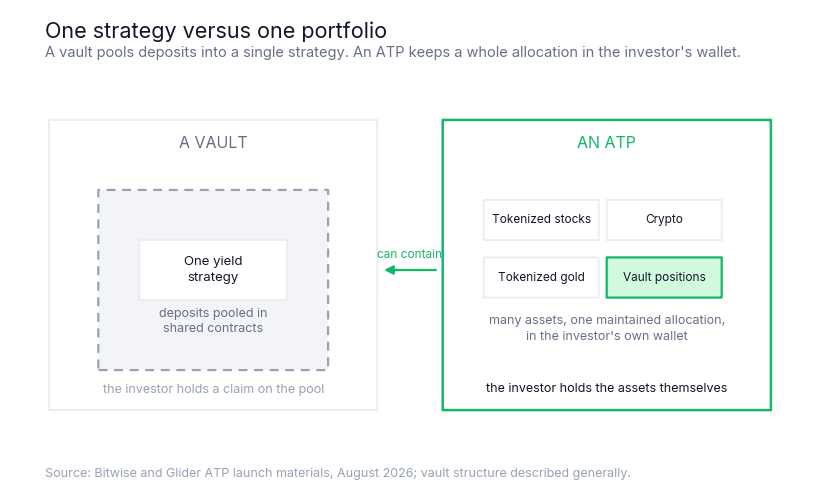
The risk shapes differ in kind. A vault's distinctive risk is concentration of failure: one strategy, one set of contracts, one curator, and a shared pool that an exploit can empty in a single transaction. Vault's are often forced to take exogenous risk outside of their control like onchain oracles or correlated pricing risk.
An ATP's distinctive risks are market risk and onchain execution risk. With the markets, the tokens inside an ATP move with their prices in both directions. Separately, ATPs operate through smart contracts and onchain transactions, which are generally irreversible. What an ATP does not add is a third-party strategy contract holding the funds. The assets sit in the wallet; no pool exists to drain.
What ownership unlocks
Because the assets sit in the investor's own wallet, every position stays individually usable: sell one holding without touching the rest, or post it as collateral in an onchain lending app at the investor's own initiative. And because Glider covers all gas fees and DEX aggregator fees, allocations and rebalances arrive without per-transaction charges, where a vault depositor pays network gas on every deposit and withdrawal. If Glider disappears tomorrow, the investor maintains ownership of their assets with no platform risk.
The difference extends to who stands behind the allocation. An ATP's model is designed and published by Bitwise, an investment adviser registered with the SEC for its fund business. That registration does not extend regulatory protection to ATP users, but it does mark the difference between a named institutional manager and a curator who may be pseudonymous.
What each is built for
A vault answers a narrow question well: how to put one asset to work in one strategy. For an investor holding a stablecoin who wants lending interest on it and nothing else, a well-audited vault is the direct, mature, standardized tool for the job, and vaults are open to anyone, anywhere, with no eligibility screen.
An ATP answers the wider question: how to own a managed portfolio across asset classes without handing the assets to anyone. Allocation across stocks, crypto, gold, and yield positions, weights maintained automatically, custody never leaving the investor's wallet. Many onchain investors will end up using both, and an ATP is one of the few structures that can hold a vault position inside a wider portfolio. Glider's tokenized stocks explainer and rebalancing guide cover the mechanics.
Frequently asked questions
Is an ATP a kind of vault?
No. A vault is a shared contract pooling deposits into one yield strategy. An ATP is a published model portfolio whose assets sit in the investor's own wallet, never pooled. The two can overlap in one direction: an ATP model can include a vault position as one holding among many.
Which is riskier, a vault or an ATP?
They carry different risks rather than more or less. A vault concentrates failure in one strategy and one pool, which an exploit can drain at once. An ATP's holdings move with market prices, in both directions, and its onchain execution layer carries smart-contract risk, as Bitwise's disclosures state. Neither is insured; both can lose value.
Do vaults and ATPs pay a yield?
A vault's return is a yield from its strategy, such as lending interest. An ATP's return is the price movement of its assets; it is a portfolio, not a yield product. An investor wanting income-style returns on a single asset is describing a vault. An investor wanting a managed allocation is describing an ATP.
Who manages each one?
A vault is managed by its curator, who sets risk parameters and may be pseudonymous. An ATP's model is designed and published by Bitwise, an investment adviser registered with the SEC for its fund business, and implemented in the wallet by Glider. That registration covers Bitwise's fund business; it does not extend regulatory protection to ATP users.
Can an ATP include a vault?
Yes. Because an ATP is a portfolio container, a model can hold vault positions alongside tokenized stocks, crypto, and tokenized gold. A vault, being a single strategy, cannot hold an ATP. The relationship runs one way: vaults are components, ATPs are containers.
Who can invest in each?
Vaults are permissionless and accept anyone. ATPs are available to eligible non-US persons only, through Glider today and through additional partner platforms over time, including apps outside the crypto ecosystem that integrate the models.
When is a vault the right choice?
When the goal is a yield on one asset and the investor has reviewed the strategy, its audits, and its curator. Vaults are the simpler, older, more standardized tool for that job. When the goal is a whole managed allocation, the vault becomes the ingredient rather than the answer.
The bottom line
A vault puts one asset to work in one strategy. An ATP owns a managed portfolio across asset classes without handing the assets to anyone: the strategy is published by Bitwise, the holdings are issued as tokenized stocks, the wallet is rebalanced by Glider, and the positions become usable one by one. The vault pools; the portfolio holds.
See the first ATPs on Glider, available to eligible non-US investors.
ATP structure, roles, fees, and eligibility verified against Bitwise's published ATP materials and the Glider launch post as of August 2026. Vault characteristics described structurally; specific strategies and fees vary by vault. ATPs are available only to eligible non-US persons and involve risk of loss, including total loss. Nothing in this article is investment advice.