Why an ATP Is Not an ETF
An ETF pools investor money into a registered fund. An Automated Token Portfolio, designed by Bitwise and implemented by Glider, delivers the assets into the investor's own wallet. Here is what that difference actually changes.
An exchange-traded fund pools investor money into a registered fund and lists its shares on a stock exchange. An Automated Token Portfolio (ATP) is a published, rules-based model portfolio, designed by Bitwise and implemented by Glider, whose holdings land directly in the investor's own wallet. Both deliver a managed portfolio; what differs is who holds the assets, who can access them, and what the manager/holder can do with them.
What is an Automated Token Portfolio?
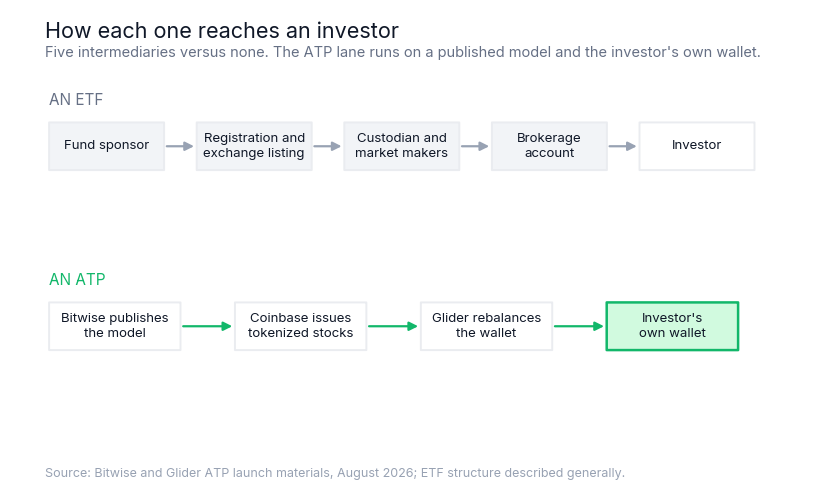
An ATP is a model portfolio. Bitwise publishes the strategy: which assets it holds and at what weights, set by a rules-based methodology. Coinbase issues the holdings as tokenized US stocks, backed one-for-one by real shares. Glider implements the model in the investor's own wallet, rebalancing the holdings so the wallet keeps tracking the published weights. Neither Bitwise nor Glider takes custody of anything.
The first ATP is the Bitwise Mag7X: eight of the largest companies in the world at equal weight, the Magnificent 7 plus SpaceX, with further models announced to follow. ATPs are available to eligible non-US persons, through Glider today and through additional platforms later under a non-exclusive arrangement.
"There's no rule saying onchain asset management has to look like traditional asset management," said Matt Hougan, Bitwise's chief investment officer, at the August 2026 launch. "YouTube isn't just NBC on the internet."
What is an ETF?
An exchange-traded fund is a pooled vehicle. Investors buy shares in the fund, the fund holds the underlying assets through custodians, and market makers keep the share price near the value of the pool. The structure has run since 1993, sits under securities regulation in every major market, and carries the deepest liquidity in investing. A broad index ETF is also the cheapest wrapper in traditional finance: Vanguard's VOO charges 0.03%, about $3 a year per $10,000.
The structure's limits are access and time. Buying a US-listed ETF requires a brokerage account that accepts the investor's country of residence, which is the exact barrier facing first-time investors in Manila, Lagos, and Kuala Lumpur. And launching a new ETF takes months of filings and listing arrangements, so themes reach investors long after the theme is news.
ATPs vs ETFs at a glance
| ETF | Automated Token Portfolio | |
|---|---|---|
| What it is | A registered investment fund that pools money and lists shares on an exchange | A published, rules-based model portfolio executed in the investor's own wallet |
| What the investor holds | Shares in the fund, a claim on a pool | The assets themselves, as tokens in a personal wallet |
| Who manages it | The fund's issuer, under a regulatory mandate | Bitwise designs the model and weights; Glider rebalances the wallet to match them |
| Custody | A chain of custodian, broker, and exchange | Non-custodial; neither Bitwise nor Glider holds the assets |
| How to buy | A brokerage account, during market hours, where the broker operates | A wallet and an internet connection, for eligible non-US persons |
| Cost shape | An annual expense ratio on the balance | 0.15% methodology access fee to Bitwise plus 0.30% of trading volume to Glider, with gas and aggregator fees covered |
| Time to launch a new strategy | Months of registration and listing work | As fast as the holdings can be published |
| Protections | Fund regulation, exchange rules, broker protections such as SIPC | None of those; onchain infrastructure with collateral-backed tokens |
What changes when the investor owns the assets
An ETF holder owns a claim on a pool and can do two things with it: buy it and sell it. An ATP holder owns the tokenized stocks themselves. Individual positions can be sold separately, at a loss to offset gains elsewhere where local tax rules allow, or used as collateral in onchain lending apps at the holder's own initiative (or that of the ATP model provider). The portfolio is a set of assets, not a ticker. Where a holding itself generates a return, that return accrues in the investor's wallet rather than through a platform's pool.
Access & speed
ETFs are global in theory and national in practice: availability depends on the investor's broker, country, and account type. ATPs are available to anyone with an internet connection who is an eligible non-US person, with no brokerage account and no market hours. The investor in Lagos or Manila whom the brokerage system declines is the investor ATPs serve first.
The same structural gap decides how fast a new idea becomes a portfolio. A new ETF theme requires registration, middlemen like custodians, an exchange listing, and market-making arrangements. A new ATP requires a published model and existing tokenized assets. When an election, a product launch, or an event creates a theme, the ATP structure can put a portfolio in front of investors while the ETF structure is still drafting filings.
How the costs work
The two structures price different things. An ETF charges an annual expense ratio on the balance, and at the index end that ratio is a few hundredths of a percent. An ATP charges for access and execution: 0.30% of the traded volume to Glider, $30 on a $10,000 position, plus Bitwise's 0.15% methodology access fee, $15 on the same amount, with gas and DEX aggregator fees covered by Glider rather than passed on. Later rebalances pay the 0.30% only on the volume actually traded. The ETF's fee buys a share in a regulated pool. The ATP's fees buy direct ownership of the assets, global access without a brokerage, and strategies an exchange cannot yet list.
What each structure is built for
The ETF was built in 1993 for investors inside the brokerage system, and it does that job extremely well: a regulated wrapper, deep liquidity, and the cheapest index exposure ever offered. An investor with a good brokerage account and plain index needs is holding exactly what the structure was designed to deliver.
The ATP was built for the onchain system: for the investor the brokerage system serves poorly or not at all, for the holder who wants the assets in their own wallet and usable one by one, and for strategies too new or too narrow for an exchange listing. The machinery underneath is different because the job is different. Glider's tokenized stocks explainer covers the underlying assets, and the launch post covers the first portfolios.
Frequently asked questions
Is an ATP an ETF?
No. An ETF is a registered fund that pools investor money and lists shares on an exchange. An ATP is a published, rules-based model portfolio designed by Bitwise and implemented by Glider, with holdings delivered directly into the investor's own wallet. There is no fund, no pool, and no exchange listing; the investor holds the assets themselves.
Are ATPs available in the United States?
No. ATPs are available only to eligible non-US persons under Regulation S, and the tokenized US stocks inside them carry the same restriction. The structure was built for investors outside the US whom the traditional brokerage system serves poorly or not at all.
What does an ATP cost compared with an ETF?
A broad index ETF charges a small annual expense ratio: Vanguard's VOO charges 0.03%, about $3 a year per $10,000. An ATP on Glider costs 0.30% of trading volume plus Bitwise's 0.15% methodology access fee, about $45 to establish a $10,000 position, with gas and aggregator fees covered by Glider. The ETF fee buys a share in a pool; the ATP fees buy direct ownership and global access.
Are ATPs protected like ETFs are?
No, and the difference matters. ETFs carry fund regulation, exchange rules, and broker protections such as SIPC. ATPs carry none of these: Bitwise's disclosures state the portfolios are not insured, involve risk of total loss, and are not covered by Bitwise's investment adviser registration. The two structures protect investors in different ways.
Who manages an ATP?
Bitwise designs each model and sets its constituents and weights under a published methodology. Coinbase issues the tokenized US stocks the portfolios hold. Glider implements the model, rebalancing the investor's wallet to the published weights through credentials the investor authorizes. Bitwise neither custodies assets nor advises the investor directly.
Can an ATP hold things an ETF cannot?
Yes, in two senses. It can combine assets no single fund packages: tokenized stocks, crypto, and tokenized gold in one allocation. And it can exist at all where a fund cannot launch fast enough or cannot find exchange and custodian support for a niche theme. Anything tokenizable can enter a model.
What is the first ATP?
The Bitwise Mag7X ATP, launched August 2026: eight of the world's largest companies at equal weight, the Magnificent 7 plus SpaceX, held as tokenized stocks in the investor's wallet. Further Bitwise models have been announced to follow.
The bottom line
The ETF is the wrapper the traditional system perfected: regulated, liquid, and for the investors that system already serves. The ATP is what a portfolio looks like rebuilt for the onchain system: the assets in the investor's own wallet, the strategy published rather than pooled, global access for eligible non-US persons, and a launch speed the exchange structure cannot match. Same portfolio job, two different machines built for two different systems.
See the first ATPs on Glider, available to eligible non-US investors.
ATP structure, roles, fees, and eligibility verified against Bitwise's published ATP materials and the Glider launch post as of August 2026. ETF characteristics described structurally; specific fund fees vary. ATPs are available only to eligible non-US persons and involve risk of loss, including total loss. Nothing in this article is investment advice.