You Don't Need a Fund to Launch a Portfolio Anymore
Publishing a model portfolio no longer requires building a fund around it. The issuer designs the methodology; implementing platforms execute it in each investor's own wallet. The wrapper disappeared.

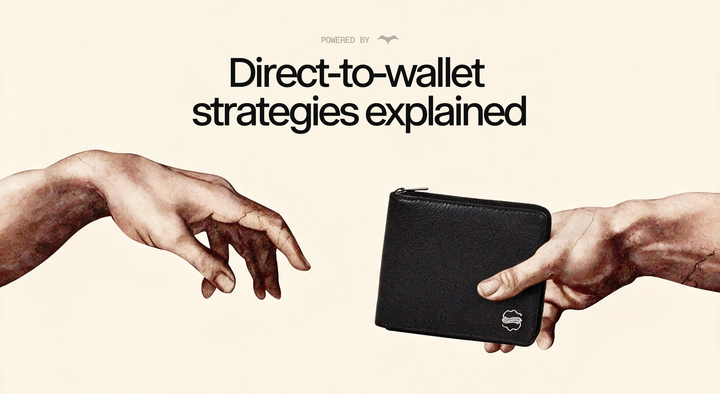
For a century, turning an investment strategy into a product meant building a fund around it: registration, custody, administration, listing. Direct-to-Wallet Strategies removed the wrapper. A manager now publishes the model itself, and platforms like Glider execute it directly in each investor's own wallet. This piece is for asset managers and issuers considering what publishing a model portfolio involves. Structural facts verified against Bitwise's published materials and the Glider Developer Portal in August 2026.
The architecture that made this possible
Automated Token Portfolios exist because of a prior invention: the Direct-to-Wallet Strategy, an institutionally managed portfolio whose assets never leave the investor's own wallet. The architecture separates three roles by construction. A manager designs and publishes the strategy. An issuer tokenizes the underlying assets. Glider's infrastructure keeps every enrolled wallet aligned to the manager's published weights, through credentials each investor authorizes. ATPs are the first strategies built on it, from Bitwise, with Coinbase issuing the tokenized US stocks. Because the architecture carries custody, execution, and distribution, the manager's work is reduced to the part only the manager can do: the methodology.
The old path versus the published path
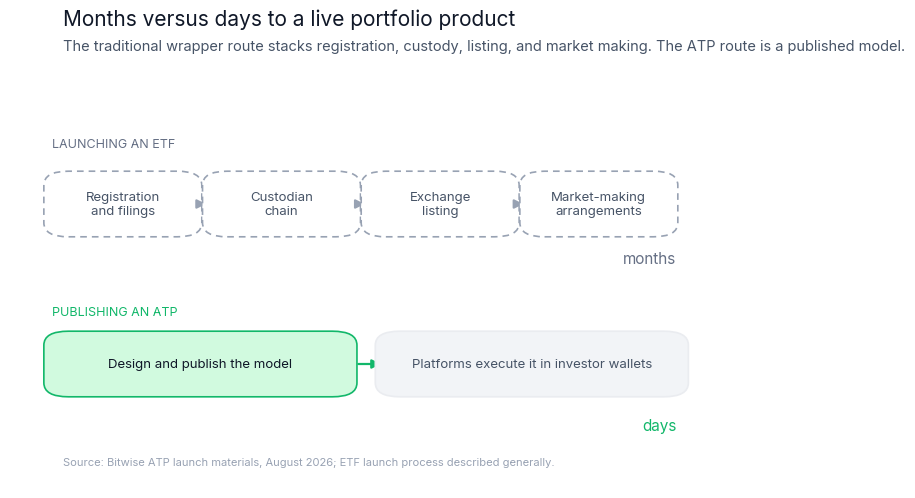
The traditional route from idea to investable product runs through a wrapper. An ETF requires registration, a custodian chain, an exchange listing, and market-making arrangements, months of work before the first investor can buy a share. A fund requires pooling investor money, with the administration and custody obligations that pooling creates. The published path inverts the sequence. The manager designs a rules-based model and publishes it: constituents, weights, and the methodology for periodic reconstitution. Implementing platforms execute that model in each investor's wallet. "ATPs create an infinite canvas for portfolio innovation," said Matt Hougan, Bitwise's chief investment officer, at the August 2026 launch. "If someone wants exposure to a fast-emerging theme, instead of waiting months for an ETF to build and launch, they can access it now."
What the manager never touches
The separation of roles is the structure's core property, and Bitwise's published disclosures define it precisely for its own models. The manager custodies, holds, and controls no assets; holds no private key, session key, or signing authority; and initiates, authorizes, and executes no transaction in any investor's wallet. There is no pool to administer because there is no pool. Implementation and rebalancing are performed entirely by the platform through investor-authorized credentials. Publishing a model creates no advisory, fiduciary, or contractual relationship with the investors who follow it: the methodology is published on identical terms to all eligible users. The manager's product is the methodology itself.
What a model can hold, and who it reaches
Anything tokenizable can enter a model: tokenized stocks, crypto assets, tokenized gold, and vault positions, combined in one allocation and held across chains. A theme too new, too narrow, or too cross-asset for an exchange listing can exist as a published model as fast as its constituents can be tokenized. Distribution is global by construction: ATPs are available to eligible non-US persons under Regulation S, and any app can implement a published strategy. Glider's strategy provider program documents the lifecycle, from creating a strategy through the B2B API to making it available to distributors, each with its own public strategy page. The licensing precedent is non-exclusive: Bitwise's arrangement with Glider explicitly allows additional implementing platforms, so a published model is not locked to one storefront.
The economics
The live precedent is a methodology access fee: Bitwise's ATPs charge 0.15% for access to the published model, exclusive of trading fees and of the fees charged by the implementing platform. The structure matters as much as the number. The fee attaches to the methodology rather than to pooled assets, which means the manager's revenue no longer requires the manager to hold anyone's money.
Frequently asked questions
Do we custody investor assets when we publish a model?
No. The manager designs and publishes the methodology and never holds, controls, or executes against any investor's assets. Implementing platforms execute the model in each investor's own wallet through credentials the investor authorizes. There is no pool, so there is nothing to custody, administer, or unwind.
Who executes the trades?
The implementing platform. Glider's infrastructure rebalances each enrolled wallet to the published weights through limited-authority session credentials, covers gas and DEX aggregator fees, and leaves every position in the investor's own account. The manager publishes reconstitutions; the platform implements them.
Can a published model be distributed beyond Glider?
Yes. The licensing precedent is non-exclusive: Bitwise's arrangement with Glider explicitly allows additional implementing platforms. A published strategy can be made available to any distributor through the B2B API, and each carries its own public strategy page.
What eligibility rules apply?
ATPs are available only to eligible non-US persons under Regulation S, and tokenized US stocks inside them carry the same restriction. The methodology is published on identical terms to all eligible users, and publishing a model creates no advisory or fiduciary relationship with the investors who follow it.
How does a manager earn from a published model?
Through a methodology access fee. The live precedent is Bitwise's ATPs at 0.15%, charged for access to the published model and separate from trading and platform fees. The fee attaches to the intellectual property, the methodology, rather than to assets under custody.
The bottom line
The wrapper used to be the price of admission: to sell a portfolio, a manager first had to become a fund. Direct-to-Wallet Strategies ended that arrangement. Publish the methodology, and platforms deliver it into every enrolled wallet, to eligible investors anywhere, with the assets never touched by anyone along the way. The model is the product now.
Read the strategy provider guide or talk to the Glider team about publishing a model.
ATP structure, roles, and eligibility verified against Bitwise's published ATP materials, the Glider Developer Portal, and the Glider launch post as of August 2026. ATPs are available only to eligible non-US persons and involve risk of loss, including total loss. Nothing in this article is investment advice.