Why Institutional Capital Can Deploy Onchain Without Giving Up Custody
The separately managed account has been how serious capital holds a managed portfolio for forty years. Automated Token Portfolios carry the same structure onto onchain rails: the assets never move, and the model comes to them.
Why would an institution deploy meaningful capital into onchain portfolios? Not for a theme, and not for yield. The reason is structural: Automated Token Portfolios let capital hold a professionally managed portfolio without the assets ever leaving the institution's own wallet. No pool, no commingling, no custody transfer. Structural facts verified against Bitwise's published materials in August 2026.
The question is structural, not directional
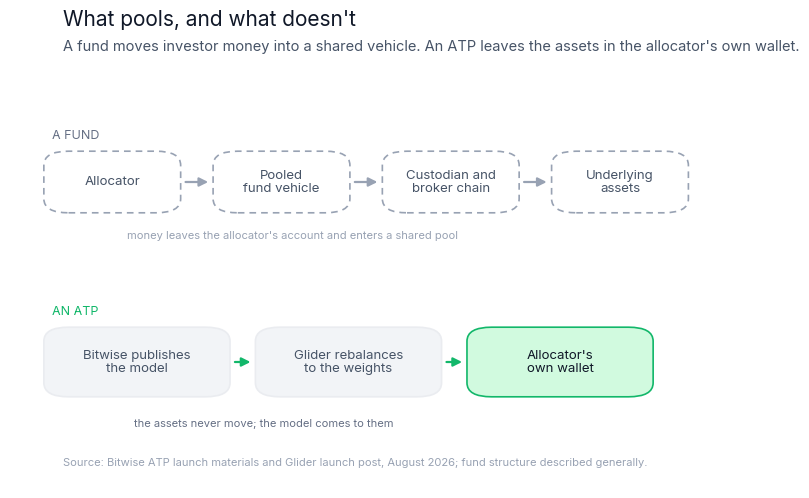
At institutional size, the first question about any allocation is never the strategy. It is the structure: who holds the assets, who can move them, and what happens when something in the chain fails. A fund answers all three by pooling. Capital moves into a shared vehicle, a custodian chain holds it, and the allocator carries a claim on the pool rather than the assets themselves. Most of what an allocation committee prices as counterparty risk lives inside that arrangement. Onchain portfolios inherited that skepticism, and for pooled structures like vaults, it was earned.
The answer: the model comes to the assets
An Automated Token Portfolio (ATP) reverses the flow. Bitwise Investment Manager designs and publishes a rules-based model portfolio: the constituents, the weights, and the methodology behind periodic reconstitution. Coinbase issues the holdings as tokenized US stocks, which Coinbase represents are backed one-for-one by real shares, under an ADGM structure supervised by the FSRA. Glider implements the model in the allocator's own wallet, rebalancing to the published weights through limited-authority session credentials the allocator authorizes and can revoke at any time. ATPs are the first Direct-to-Wallet Strategies: institutionally managed portfolios whose assets live in each investor's own wallet, the category Glider's infrastructure was built to power.
The custody line is the one that matters. Neither Bitwise nor Glider takes custody of anything, at any point. Bitwise's published disclosures state that it holds no private key, session key, or signing authority, and initiates, authorizes, and executes no transaction. The assets sit in the allocator's wallet, observable onchain in real time, and no pool exists that could fail as a pool. The first ATP is the Bitwise Mag7X: eight of the world's largest companies at equal weight, with Robotics and AI Leaders models announced to follow.
What this changes at scale
The operational differences compound with capital. There are no share classes, no transfer agent, and no fund administrator between the allocator and the assets. Settlement is continuous rather than batched through market hours. Each position remains individually operable: a single holding can be sold without touching the rest of the portfolio, or posted as collateral in onchain lending markets at the allocator's own initiative. Entry and exit do not pass through a subscription and redemption process, because there is no fund to subscribe to. And alignment to the published model is maintained automatically, on a daily basis, inside the wallet.
The full risk picture, because size requires it
An institutional evaluation deserves the complete list, and Bitwise publishes one. An ATP is not a fund and not a deposit. It is not insured, carries no SIPC or equivalent protection, and involves risk of total loss. It operates through smart contracts, which may contain undiscovered vulnerabilities despite auditing, and onchain transactions are generally irreversible. The ADGM issuance structure became operational in August 2026 and has not been tested through a market stress event. Bitwise's registration with the SEC relates to its separately conducted advisory business, which includes ETFs and separately managed accounts, and does not extend regulatory protection to ATP users. Selecting a model creates no advisory, fiduciary, or contractual relationship with Bitwise. A structure that hid any of this would not deserve institutional capital. This one publishes it.
Who stands behind the models
The models are designed by the firm that helped bring crypto into regulated wrappers. Bitwise reports $9 billion in client assets as of July 1, 2026, eight years of operation, and more than 70 investment products across its traditional business. "For over a century, getting a professional model meant handing your assets to a fund," said Matt Hougan, Bitwise's chief investment officer, at launch. "ATPs mean you can keep the assets in your own wallet, and the model comes to you." Glider's co-founder and CEO Brian Huang frames the access side: "Finally, we have global access to the same institutional managers we respect in traditional finance, but now in digital assets." ATPs are available to eligible non-US persons under Regulation S, through Glider today and through additional platforms over time under a non-exclusive arrangement.
Frequently asked questions
Is an ATP a fund or a separately managed account?
Neither, legally. An ATP is a published, rules-based model portfolio designed by Bitwise and implemented by Glider in the investor's own wallet. Structurally it behaves like a separately managed account: direct ownership, no pooling, no custody transfer, individually operable positions. What it adds is onchain settlement and continuous, automated alignment to the published model.
Who holds the assets?
The allocator does. Assets remain in the allocator's own wallet throughout. Bitwise holds no keys or signing authority and executes no transactions. Glider operates only through limited-authority session credentials that the allocator authorizes and can revoke at any time, which stops all future rebalancing.
What are the fees?
Two, stated plainly. Bitwise charges a 0.15% methodology access fee, exclusive of trading and platform fees. Glider charges 0.30% of automated trading volume and covers all gas and DEX aggregator fees, so rebalancing arrives without per-transaction network costs. There is no expense ratio on the balance because there is no fund.
Who is eligible?
ATPs are available only to eligible non-US persons under Regulation S, in eligible jurisdictions outside the United States. The tokenized US stocks inside the portfolios carry the same restriction. Access runs through Glider today, with additional platforms expected under the non-exclusive arrangement.
Does selecting a model create an advisory relationship with Bitwise?
No. Each ATP is a general, rules-based methodology published on identical terms to all eligible users. Bitwise does not know who selects a model, makes no suitability determination, and provides no personalized advice. The contractual and service relationship is with Glider as the implementing platform.
What happens if a service provider stops operating?
The assets never leave the allocator's wallet, so there is no pool to unwind and no custodian chain to petition. Session credentials can be revoked at any time, ending automated rebalancing, and the holdings remain the allocator's property, individually sellable or transferable.
Is an ATP a fund or a separately managed account?
Neither, legally. An ATP is a published, rules-based model portfolio designed by Bitwise and implemented by Glider in the investor's own wallet. Structurally it behaves like a separately managed account: direct ownership, no pooling, no custody transfer, individually operable positions. What it adds is onchain settlement and continuous, automated alignment to the published model.
Who holds the assets?
The allocator does. Assets remain in the allocator's own wallet throughout. Bitwise holds no keys or signing authority and executes no transactions. Glider operates only through limited-authority session credentials that the allocator authorizes and can revoke at any time, which stops all future rebalancing.
What are the fees?
Two, stated plainly. Bitwise charges a 0.15% methodology access fee, exclusive of trading and platform fees. Glider charges 0.30% of automated trading volume and covers all gas and DEX aggregator fees, so rebalancing arrives without per-transaction network costs. There is no expense ratio on the balance because there is no fund.
Who is eligible?
ATPs are available only to eligible non-US persons under Regulation S, in eligible jurisdictions outside the United States. The tokenized US stocks inside the portfolios carry the same restriction. Access runs through Glider today, with additional platforms expected under the non-exclusive arrangement.
Does selecting a model create an advisory relationship with Bitwise?
No. Each ATP is a general, rules-based methodology published on identical terms to all eligible users. Bitwise does not know who selects a model, makes no suitability determination, and provides no personalized advice. The contractual and service relationship is with Glider as the implementing platform.
What happens if a service provider stops operating?
The assets never leave the allocator's wallet, so there is no pool to unwind and no custodian chain to petition. Session credentials can be revoked at any time, ending automated rebalancing, and the holdings remain the allocator's property, individually sellable or transferable.
The bottom line
The reason to deploy capital here is not a narrative about crypto. It is that the structural properties institutions have always insisted on, direct ownership, no commingling, a named manager, full transparency, now exist on onchain rails, with a published institutional methodology behind them. The assets never move. The model comes to them.
Talk to the Glider team about institutional access to ATPs.
ATP structure, roles, fees, and eligibility verified against Bitwise's published ATP materials and the Glider launch post as of August 2026. ATPs are available only to eligible non-US persons and involve risk of loss, including total loss. Nothing in this article is investment advice.