Direct-to-Wallet Strategies: The New Primitive for Wealth Management
A Direct-to-Wallet Strategy is an institutionally managed portfolio whose assets never leave the investor's own wallet. Not a new distribution channel for asset management; a new architecture for it.
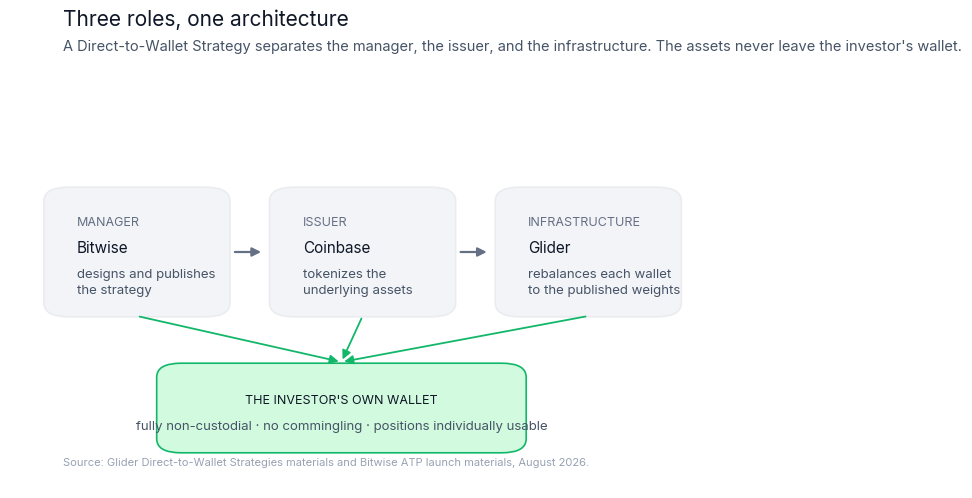
A Direct-to-Wallet Strategy is an institutionally managed portfolio whose assets never leave the investor's own wallet. A manager designs and publishes the strategy, an issuer tokenizes the underlying assets, and Glider's portfolio infrastructure rebalances each wallet to the manager's published weights. The first Direct-to-Wallet Strategies are Bitwise's Automated Token Portfolios.
What is a Direct-to-Wallet Strategy?
A Direct-to-Wallet Strategy is a new asset-management primitive: a professionally managed strategy that remains fully non-custodial. The closest traditional analogue is the separately managed account, where a client owns the underlying securities directly and a manager trades the account to a mandate without ever taking custody. A Direct-to-Wallet Strategy carries that structure onto onchain rails. The manager, such as Bitwise, designs and publishes the strategy. The issuer, such as Coinbase, tokenizes the underlying assets. Glider's infrastructure keeps every enrolled wallet aligned with the manager's published weights, through credentials the investor authorizes and can revoke at any time. There is no pool, no commingling, and no point at which the investor's assets sit in someone else's account.
Why self-custody and professional management were mutually exclusive
Asset management has always forced a trade. Self-custody meant self-management: hold assets in a personal account or wallet, and every allocation decision is the holder's own. Professional management meant the opposite: hand the assets to a fund or an adviser, and the holdings become a claim on someone else's pool. The investor could have ownership or management, never both at once. Direct-to-Wallet Strategies remove that trade. For the first time, investors anywhere in the eligible world can custody their own assets while electing to have some of their holdings professionally managed.
What the wallet unlocks
Because the assets live in the investor's own wallet rather than inside a fund, every position stays individually usable. Holdings can serve as margin collateral, can be lent or staked where the underlying asset supports it, and can be sold one at a time, at the investor's own initiative. A fund share can do none of these things, because a fund share is a claim on a pool rather than the assets themselves. The strategy adds no third-party contract holding the funds; the assets sit in the wallet, and no pool exists to drain.
Not a channel, an architecture
It would be easy to read Direct-to-Wallet Strategies as a new way to distribute the same old products. That misses what changed. The roles are separated by construction: any qualified manager can publish a strategy, any issuer can tokenize assets, and any app can distribute the result, with execution handled by shared infrastructure. The strategy is a published methodology rather than a pooled vehicle, which means a new theme can reach investors as fast as its constituents can be tokenized, and a manager's product is the methodology itself. This is not a new distribution channel for asset management. It is a new architecture for it.
The first Direct-to-Wallet Strategies
The category launched in August 2026 with Bitwise's Automated Token Portfolios. Bitwise and Glider are day-one partners for Coinbase Equities, and the first strategy is the Bitwise Mag7X: eight of the world's largest companies at equal weight, held as Coinbase-issued tokenized US stocks, rebalanced automatically in each investor's wallet by Glider. Robotics and AI Leaders models have been announced to follow, and the partner roadmap extends to further institutional managers and asset issuers. ATPs are available to eligible non-US persons under Regulation S.
Glider's role is the infrastructure layer the category runs on: smart accounts, enrollment, rebalancing, gas and chain abstraction, and the B2B API through which any app can offer these strategies to its own users.
Frequently asked questions
What is a Direct-to-Wallet Strategy?
An institutionally managed investment strategy whose assets remain fully non-custodial, living in each investor's own wallet. A manager designs and publishes the strategy, an issuer tokenizes the assets, and Glider's infrastructure rebalances each wallet to the published weights. The first examples are Bitwise's Automated Token Portfolios, launched August 2026.
How is a Direct-to-Wallet Strategy different from a fund?
A fund pools investor money into a shared vehicle and issues claims on the pool. A Direct-to-Wallet Strategy never pools: the investor holds the underlying assets directly, the manager never takes custody, and positions remain individually usable as collateral or for partial sales. There is no share class, no transfer agent, and no redemption queue.
Who can offer Direct-to-Wallet Strategies?
Any app whose users are eligible can distribute them through Glider's B2B API, from wallets and exchanges to consumer fintechs with no onchain surface. The arrangement behind the first strategies is non-exclusive, and additional implementing platforms may be added over time.
Are Direct-to-Wallet Strategies available in the United States?
No. The first Direct-to-Wallet Strategies, Bitwise's ATPs, are available only to eligible non-US persons under Regulation S, and the tokenized US stocks inside them carry the same restriction.
What are the risks?
Digital assets and tokenized securities involve high risk, including total loss. The strategies operate onchain, where transactions are generally irreversible and smart contracts can contain undiscovered vulnerabilities despite auditing. The strategies are not deposits, are not insured, and no party guarantees any result. Investors should read Bitwise's published disclosures in full.
What is a Direct-to-Wallet Strategy?
An institutionally managed investment strategy whose assets remain fully non-custodial, living in each investor's own wallet. A manager designs and publishes the strategy, an issuer tokenizes the assets, and Glider's infrastructure rebalances each wallet to the published weights. The first examples are Bitwise's Automated Token Portfolios, launched August 2026.
How is a Direct-to-Wallet Strategy different from a fund?
A fund pools investor money into a shared vehicle and issues claims on the pool. A Direct-to-Wallet Strategy never pools: the investor holds the underlying assets directly, the manager never takes custody, and positions remain individually usable as collateral or for partial sales. There is no share class, no transfer agent, and no redemption queue.
Who can offer Direct-to-Wallet Strategies?
Any app whose users are eligible can distribute them through Glider's B2B API, from wallets and exchanges to consumer fintechs with no onchain surface. The arrangement behind the first strategies is non-exclusive, and additional implementing platforms may be added over time.
Are Direct-to-Wallet Strategies available in the United States?
No. The first Direct-to-Wallet Strategies, Bitwise's ATPs, are available only to eligible non-US persons under Regulation S, and the tokenized US stocks inside them carry the same restriction.
What are the risks?
Digital assets and tokenized securities involve high risk, including total loss. The strategies operate onchain, where transactions are generally irreversible and smart contracts can contain undiscovered vulnerabilities despite auditing. The strategies are not deposits, are not insured, and no party guarantees any result. Investors should read Bitwise's published disclosures in full.
The bottom line
For a century, professional management required handing assets to someone else. Direct-to-Wallet Strategies end that requirement: the manager publishes, the issuer tokenizes, the infrastructure executes, and the investor's assets never move. The first strategies are live, and the architecture is open to the managers, issuers, and apps that come next.
See the first Direct-to-Wallet Strategies on Glider, available to eligible non-US investors.
Category structure, roles, and eligibility verified against Bitwise's published ATP materials, the Glider Developer Portal, and the Glider launch post as of August 2026. Available only to eligible non-US persons. Digital assets involve risk of loss, including total loss. Nothing in this article is investment advice.