Glider vs Risevest: Fees, Portfolios, and Custody Compared (Nigeria)
Risevest manages dollar portfolios for a 0.5–1% annual fee under an SEC Nigeria license. Glider builds automated onchain portfolios with no annual balance fee and assets in your own wallet. Fees, custody, and regulation compared.
Risevest and Glider are the closest model match in Nigerian retail investing: both manage the portfolio so the user does not have to. The difference is in what the portfolio can hold, who controls the schedule, and where the assets sit. Risevest runs managed dollar portfolios of US stocks, fixed income, and real estate under an SEC Nigeria fund manager license. Glider runs automated onchain portfolios of crypto, tokenized stocks, and gold, rebalancing on a cadence the user chooses, with assets kept in the user's own wallet. Every figure below was verified in August 2026.
Glider vs Risevest at a glance
| Glider | Risevest | |
|---|---|---|
| Model | Automated onchain portfolios, non-custodial | Managed dollar portfolios, custodial |
| Assets | Crypto, tokenized US stocks, tokenized gold | US stocks, fixed income, real estate |
| Who manages | The portfolio's rules, executed automatically | Risevest's investment team |
| Rebalancing | Automatic, on a cadence the user chooses | At the manager's discretion |
| Management fee | None | 0.5% of assets per year above $1,000; 1% below $1,000 |
| Trading fee | 0.30% of automated volume; 0.50% of manual volume; gas and DEX aggregator fees covered | None stated; card deposit fees of 1.4% to 3.9% + ₦100 apply depending on card type |
| Minimum | None | $10 |
| Custody | Assets stay in the user's own wallet | Assets held within Risevest's structure; US stocks carry SIPC protection through US partners |
| Regulation | Onchain infrastructure; not a licensed fund manager | SEC Nigeria Fund and Portfolio Manager license since February 2026 |
Who should choose Glider, and who should choose Risevest?
| If the priority is... | The better fit is |
|---|---|
| A licensed Nigerian fund manager with a human investment team | Risevest |
| Real estate and fixed income alongside stocks | Risevest |
| SIPC protection on US stock holdings | Risevest |
| Crypto, stocks, and gold in one automated allocation | Glider |
| Choosing how often the portfolio rebalances | Glider |
| Assets held in a personal wallet, not by a platform | Glider |
| No annual percentage fee on the balance | Glider |
What is Risevest?
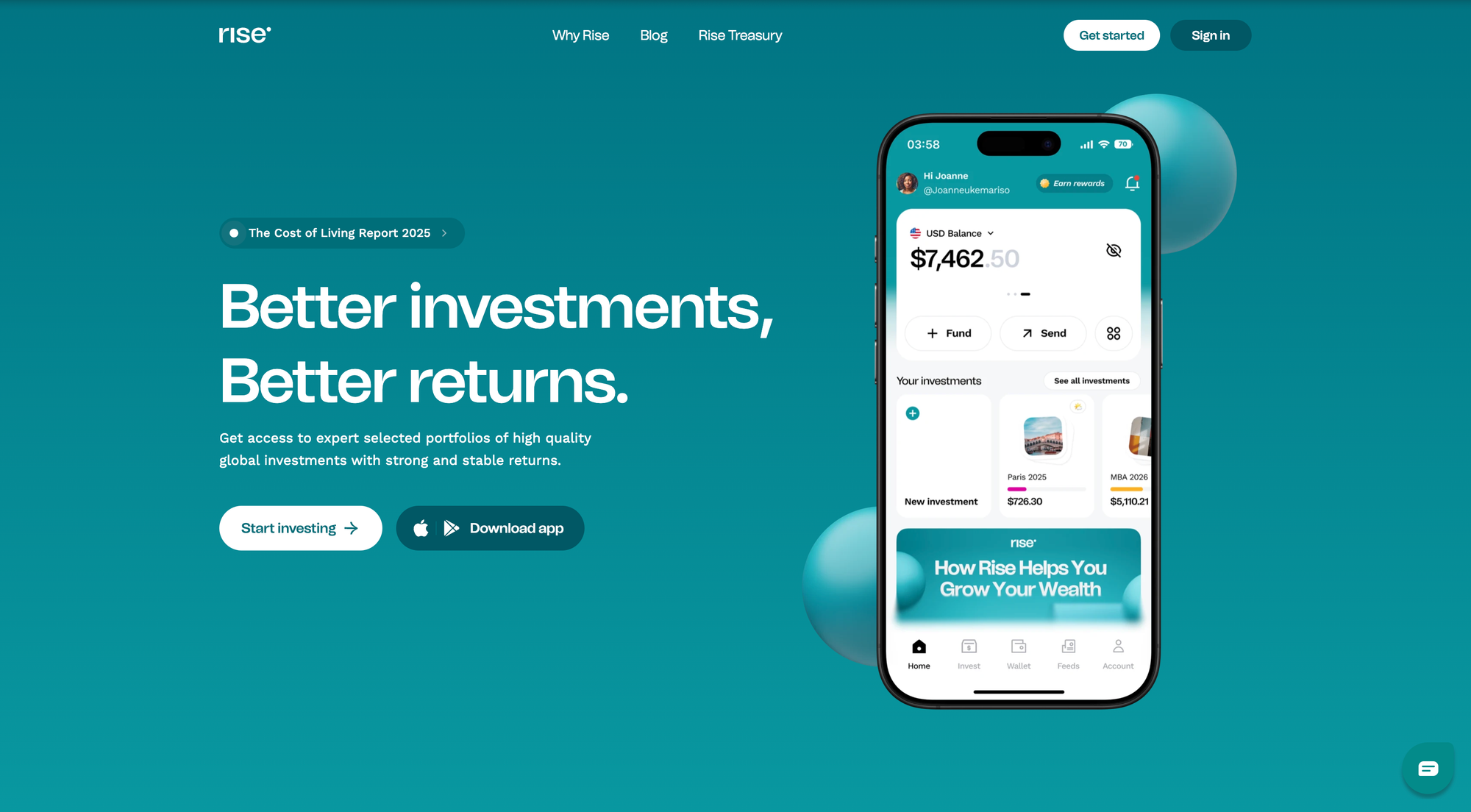
Risevest, founded in Lagos in 2019, is a managed investing app: the user deposits naira or dollars, picks a plan, and Risevest's team manages the money across three portfolio types: US stocks, dollar fixed income, and real estate. The company holds a Fund and Portfolio Manager license from the Securities and Exchange Commission Nigeria, issued in February 2026 through its subsidiary RV Fund Management Limited. US stock holdings carry SIPC protection against broker failure through Risevest's US partners, and the company acquired the SEC-licensed trading platform Chaka in 2023.
Risevest charges an annual management fee of 0.5% of assets for balances of $1,000 and above, and 1% for smaller balances. Funding by card carries a deposit fee: 1.4% to 1.5% plus ₦100 on naira cards, capped at ₦2,000, and 2.9% to 3.9% plus ₦100 on dollar cards, per Risevest's published guide. Withdrawals to a bank account carry a ₦35 transfer fee and take about one business day.
What is Glider?
Glider builds automated portfolios onchain. A user picks a portfolio that can hold crypto assets, tokenized US stocks, and tokenized gold in a single allocation, and Glider executes it and keeps it balanced on a cadence the user chooses. The assets stay in the user's own wallet: Glider is non-custodial, so there is no platform balance exposed to platform failure. Portfolios can also be copied from other users and adjusted.
Glider charges 0.30% of automated trading volume and 0.50% of manual trading volume, and covers gas and DEX aggregator fees. There is no annual management fee, no deposit fee, and no minimum. Glider is backed by a16z CSX, Coinbase Ventures, Uniswap Ventures, and Ondo. The service is available globally except in sanctioned countries, including Cuba, Iran, North Korea, Russia, and Syria. Tokenized stocks on Glider are available to non-US persons only.
How do the fees compare?
Risevest prices the management: a percentage of the balance, every year. Glider prices the activity: a percentage of what trades, when it trades. Both models are honest, and they suit different behavior.
| Fee component | Glider | Risevest |
|---|---|---|
| Annual management fee | None | 0.5% of assets ($1,000+); 1% below $1,000 |
| Trading fee | 0.30% of automated volume; 0.50% of manual volume | None stated |
| Deposit fee | None charged by Glider | 1.4% to 3.9% + ₦100 on card deposits, by card type |
| Withdrawal fee | None charged by Glider | ₦35 bank transfer fee |
| Network and routing fees | Covered by Glider | Not applicable |
A worked example with real numbers
Consider $1,000 invested for twelve months. On Risevest, the annual management fee at the 0.5% tier comes to $5.00, before any card deposit fee. Funding that $1,000 by naira card adds roughly $10 at the 1.5% rate, capped in naira terms. On Glider, the initial allocation costs $3.00 at the 0.30% rate. If the portfolio rebalances quarterly and each rebalance trades 25% of the balance, that is four trades of $250 at $0.75 each, adding $3.00 for the year. The Glider total is $6.00 under those assumptions, with no fee for funding or leaving.
Below $1,000 the comparison tilts further: Risevest's fee doubles to 1% on smaller balances, while Glider's rate does not change with balance size. Above $1,000, Risevest's 0.5% is competitive with anything in Nigerian retail investing, and the honest summary is that the two fee models cost roughly the same at that balance under moderate trading. The difference is what the fee buys: a human team's discretion, or a rules-based portfolio the user controls.
What is inside the portfolios?
Risevest portfolios hold US stocks, dollar fixed income, and real estate, selected and managed by its investment team. The mix is conventional in the good sense: familiar asset classes, managed by people whose full-time job is the portfolio. There is no crypto.
Glider portfolios hold the assets themselves onchain: crypto assets such as bitcoin and ether, tokenized US stocks for non-US persons, and tokenized gold, combined in whatever weights the portfolio specifies. No managed platform in Nigeria offers crypto and gold inside the same automated allocation as stocks. The trade-off is that onchain assets carry risks a stock portfolio does not, covered in Glider's guide to tokenized stocks.
Who controls the portfolio?
On Risevest, the manager does. The team decides what the portfolios hold, when to change the mix, and when to trade. For an investor who wants to delegate judgment entirely, that is the product.
On Glider, the rules do. The user picks the allocation and the rebalancing cadence, and the platform executes exactly that, nothing more. An investor who wants to know precisely what the portfolio will do next month prefers this model. The mechanics are covered in Glider's explainer on portfolio rebalancing. Nigerians weighing the self-directed route instead can read the guide to investment platforms available in Nigeria.
Where Risevest is genuinely better
Regulation and protection structure. An SEC Nigeria Fund and Portfolio Manager license, SIPC protection on US stocks through its partners, and years of operating history give Risevest a conventional safety architecture that Glider, as non-custodial onchain infrastructure, does not replicate.
Asset classes Glider does not have. Dollar fixed income and real estate are core Risevest offerings. Glider does not offer either. An investor who wants rent-backed or bond-backed dollar returns belongs on Risevest.
Where Glider is genuinely better
Custody. Assets on Glider never leave the user's wallet. There is no manager to trust with withdrawals, because the assets were never handed over.
Asset breadth. Crypto, tokenized stocks, and tokenized gold in one self-balancing portfolio is a combination Risevest does not offer.
Cost structure for small and active balances. No 1% tier for small balances, no deposit fee, no withdrawal fee, and no annual percentage of assets parked on the platform.
User-controlled cadence. The rebalancing schedule belongs to the user, not to a manager's calendar.
How should an investor decide?
Three questions settle it. First, delegation versus control: an investor who wants a licensed human team making every call chooses Risevest; an investor who wants rules they set themselves chooses Glider. Second, asset mix: fixed income and real estate point to Risevest; crypto and gold point to Glider. Third, custody: conventional insured custody points to Risevest; assets in a personal wallet point to Glider. The two platforms overlap so little in what they hold that running both is a coherent strategy: Risevest for the conventional dollar core, Glider for the onchain allocation.
Frequently asked questions
Is Risevest licensed in Nigeria?
Yes. Risevest holds a Fund and Portfolio Manager license from the Securities and Exchange Commission Nigeria, issued in February 2026 through its subsidiary RV Fund Management Limited. Glider is not a licensed fund manager; it is non-custodial onchain infrastructure, and user assets stay in the user's own wallet rather than with a regulated custodian.
Is Glider cheaper than Risevest?
At balances above $1,000 with moderate activity, the two cost roughly the same: Risevest charges 0.5% of assets per year, while a $1,000 Glider portfolio with quarterly rebalancing costs about $6.00 per year in trading fees under stated assumptions. Below $1,000, Risevest's fee rises to 1% and its card deposit fees apply, while Glider's 0.30% trading rate stays flat with no deposit or withdrawal fee.
Does Risevest offer crypto?
No. Risevest portfolios hold US stocks, dollar fixed income, and real estate. Glider is the option for investors who want crypto assets, tokenized stocks and ETFs, and tokenized gold inside an automated portfolio. Tokenized stocks on Glider are available to non-US persons only.
Who holds the money on each platform?
On Risevest, funds sit within the platform's managed structure, with US stock holdings carrying SIPC protection through US partners. On Glider, assets remain in the user's own onchain wallet at all times. Glider is non-custodial, so there is no platform balance to withdraw from or wait on.
Can a beginner start with $20 on either platform?
Yes. Risevest's minimum is $10 and Glider has no minimum. At that size, Risevest's 1% management tier for sub-$1,000 balances costs about $0.20 per year, and a Glider allocation costs $0.06 to enter. The meaningful difference at small balances is the model: managed by a team on Risevest, automated by rules on Glider.
Does Glider offer real estate or fixed income like Risevest?
No. Glider portfolios hold crypto assets, tokenized US stocks, and tokenized gold. Investors who specifically want dollar real estate or fixed income exposure should look at Risevest, which manages both as core offerings.
Can an investor use both platforms?
Yes, and the combination is coherent because the two barely overlap in holdings. A common split is Risevest for conventional managed dollar assets such as fixed income and real estate, and Glider for an automated onchain allocation across crypto, tokenized stocks, and gold.
The bottom line
Risevest is the strongest conventional answer in Nigeria to the question of who should manage a beginner's dollar portfolio: licensed, human-run, and reasonably priced at scale. Glider is the answer to a different question: how a portfolio can manage itself, hold assets a fund manager does not touch, and never take custody of anyone's money. The choice is less about which platform is better and more about which job needs doing.
See how Glider works and start a portfolio with no minimum.
Fees, licenses, and features verified against Risevest's website and published guides, and Glider's published terms, as of August 2026. Fee schedules change; check both platforms before deciding. Nothing in this article is investment advice.